
The rebrand has a budget, and somebody has shared a brand audit template: forty checks, a score out of 100, a column for notes. It looks thorough. It will tell you the logo appears in three versions and the tone shifts from page to page. It won't tell you why demo requests fell after the last launch, and that's the question the rebrand was supposed to answer.
This guide covers how to do a brand audit that finds the answer, and why the useful part of the work can't be written down before it starts. It's what 30-plus websites have taught me, first from the design side and now from the strategy side.
Key takeaways
- A brand audit explains why the brand stopped working. The symptoms are where it starts, never where it ends.
- Look into three mirrors. What you say, what buyers hear and what the business is now. The findings are the gaps between them.
- The checks get chosen as the evidence comes in. A fixed checklist finds the symptoms and stops there.
- Tools answer questions; they don't choose them. Search Console, GA4, Clarity, Semrush, the Wayback Machine and AI assistants each answer one.
- Every fix in the redesign traces back to a cause. A change with no finding behind it is somebody's taste.
A brand audit explains why the brand stalled
A brand audit compares what a company says about itself with what its buyers hear and with what the business has become, then explains the gaps. For a B2B company the main evidence is the website, because it's the one place where the claims, the proof and the structure sit in public, and where you can watch how visitors move through them.
You don't need an audit to notice that something is off. The Growth Gap shows up in four places, from the CEO's dinner pitch to the pricing conversation. The audit answers the next question: which gap is costing you, and what caused it. Run one before a rebrand or a redesign gets briefed, after a funding round or an acquisition, after a launch that changed who buys, and whenever sales stops sending prospects to the website.
The test before you brief anyone is one sentence that says why the current brand stopped working. If that sentence names a symptom, such as "the site looks dated" or "leads are down", you don't have a diagnosis yet.
A brand audit checklist stops at the symptoms
Picture two vehicles at the same garage with the same complaint: both pull to one side. One is a Ram 1500 pickup, built on a high-strength steel frame. The other is a Tesla Model Y, which Tesla started building with a single-piece rear underbody casting. The mechanic's first check looks the same on both: suspension and alignment. The causes don't. Say the truck's frame is bent and the electric car's rear casting is cracked. Same symptom, same first check, two different repairs.
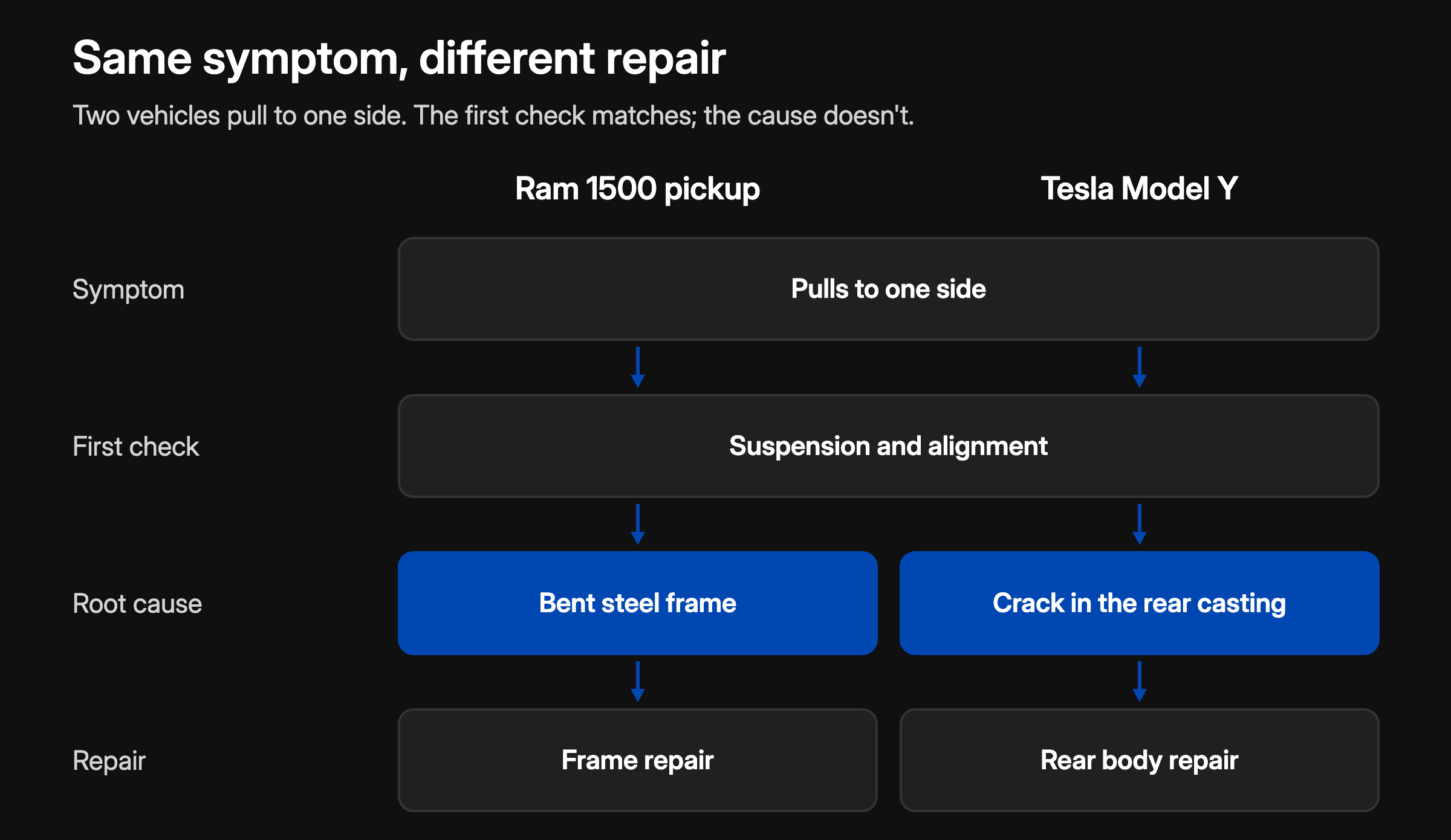
A template brand audit is a mechanic with one inspection sheet for every vehicle. It runs the same list on every company: logo usage, color consistency, typography, tone of voice, social profiles, and a score at the end. That's the mark of a cheap agency or an inexperienced freelancer. The better ones built their template from their own projects, so it at least catches real problems and gives the redesign something to fix. It still can't do what a diagnosis needs: pick the next check based on what the last one found.
Some checks do belong in every audit, the way tire pressure gets checked on every car. Brand colors are one: WCAG 2.2, the W3C accessibility standard, asks for a contrast ratio of at least 4.5:1 between text and its background at Level AA, 3:1 for large text (18 point, or 14 point bold), and logos are exempt. A color pair that fails it fails on every page that uses it for text. Run those checks, because they're cheap and real. They're also the first hour of the work, and a brand audit checklist that ends there has measured the tires.
Before you hire anyone for an audit, ask to see two audits they've run for different companies. Matching section headings are fine, because the steps repeat. If the checks and the findings could be swapped between the two, you're buying the template.
Three Mirrors show where the brand breaks
I sort the evidence into three mirrors, because a brand problem is a gap between reflections that should match.
- What you say. The homepage and every page title, the sales deck, the LinkedIn page, the boilerplate in the press kit, job posts, onboarding emails, the visual identity. Old versions count too: how the story read two years ago shows where it drifted.
- What buyers hear. Sales call recordings and win/loss notes, reviews, support tickets, the searches that bring people to the site, what visitors do once they arrive, what AI assistants say when someone asks about you, and how the competitors sound next to you.
- What the business is now. The strategy, the roadmap, pricing, the customers who bring the revenue, and the segments the company has decided to stop chasing.
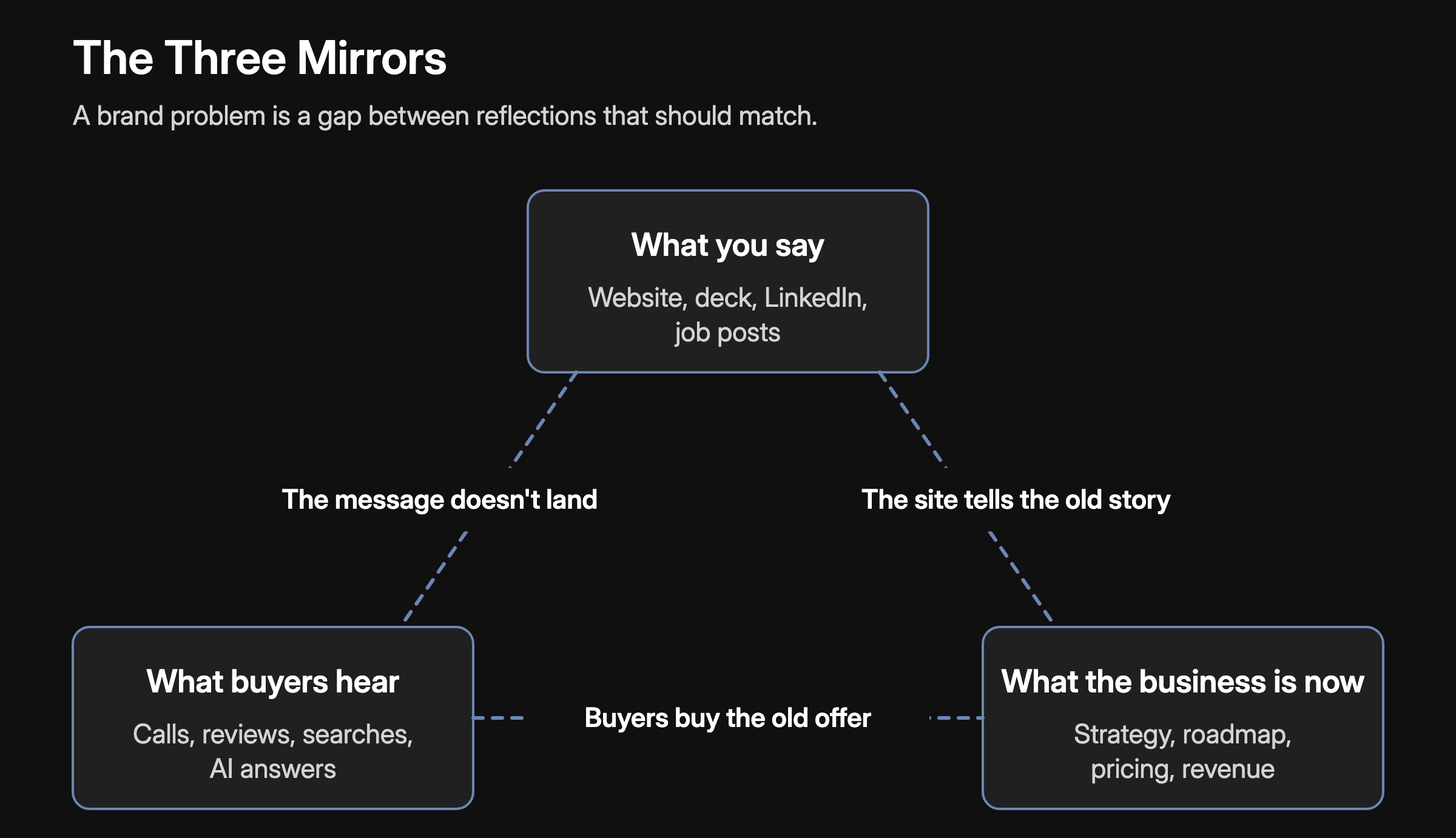
When what you say and what buyers hear drift apart, the message doesn't land: the homepage leads with the platform while the reviews praise the support team. When what you say lags what the business is, the site tells the old story. And when buyers still hear the old offer after the business has moved on, the market keeps buying the product you're retiring.
Collect all three mirrors before you form an opinion. A finding seen in one mirror is a hunch. When a second mirror shows the same gap, it's something you can act on.
The checks get invented as the diagnosis runs
Here's how to conduct a brand audit when the checks can't be written down in advance. The order of the work stays the same: collect the three mirrors, name the symptoms, write down what could cause each one, then design the check that tells those causes apart. The checks themselves change with every company, because they come from the hypotheses, and the hypotheses come from the evidence.
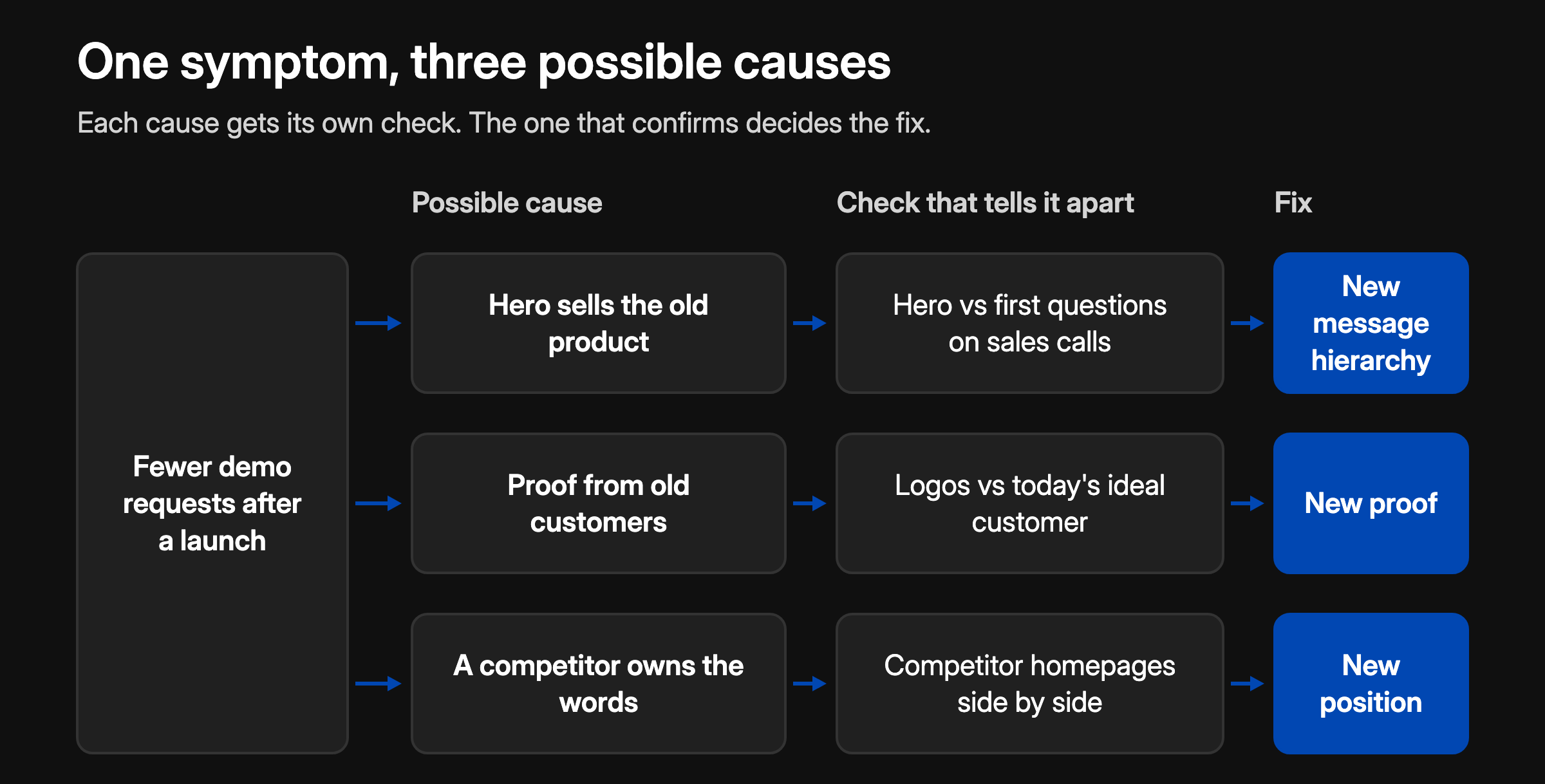
Take one symptom: demo requests fell after a product launch. The cause could be a hero that still sells last year's product, proof from customers the company no longer targets, or a competitor that now owns the category's vocabulary. Each cause gets its own check. Compare the hero with the first question prospects ask on recent sales calls. Line up the logos and case studies against today's ideal customer. Put the closest competitors' homepages side by side and mark who claims what first.
At Sedric, a compliance platform I worked with, the trust decisions came from one question: what does the buyer have to believe before acting? The case answers it in one line: "In compliance fintech, trust decides the deal." Turn that question into checks and you ask where a buyer finds proof, and whether they can learn the price without booking a call. At Sedric, before the rebuild, the only way to learn what it cost was to request a demo.
Write each hypothesis next to the check that would disprove it, and run the cheapest check first.
Two live pages, each with three possible causes
Here's what a brand audit example looks like at the moment the evidence comes in: two live B2B pages, captured on 22 October 2026 with the names hidden. Each shows a symptom within seconds. Neither shows its cause.

The first page tells two stories. The hero headline sells infrastructure for AI-powered enterprise operations, with two-way sync as the first of four things the subhead lists. The footer of the same page describes only a tool that syncs data between CRMs, ERPs and databases, and the browser tab calls the company a real-time, two-way data sync platform. Nothing here is wrong on its own; the question is which story is current.
If the business has moved to the platform, the footer and the page title are the old story, and the fix is finishing the move. If sync still brings the revenue and the searches, the hero has run ahead of the business, and the fix is leading with what buyers buy today. If two teams own two halves of the page, the fix is one owner for the message. The checks are revenue by product, the Search Console queries that bring qualified visits, and who last edited each block.

The second page is the one that explains why buyers should choose the company. Its three reasons carry generic headings, "Smart compliance", "Unmatched fraud prevention" and "Scalable growth", with the same placeholder sentence under each, while the rest of the page is written.
If sales and leadership name different top reasons when asked, the reasons were never agreed, and that's positioning work. If the reasons already sit in the sales deck, the page shipped before its copy did, and that's an ownership fix. If nobody can show evidence for "unmatched", the claims are ahead of the proof, and the fix is proof or a smaller claim.
For any symptom you find, write down at least two causes before you write a fix.
Each tool answers one question you asked
Tools come after the questions. None of the services below tells you which question matters.
| The question | The service | What it shows |
|---|---|---|
| How does the company describe itself, page by page? | A site crawler, such as Screaming Frog | Every page title and H1 in one sheet |
| How did the story drift? | The Wayback Machine | Past versions of a page, and a Changes view that compares two of them |
| Do people search for you by name? | Search Console, branded queries filter | Branded and non-branded searches, split |
| Which searches bring in strangers? | Search Console, Performance report | Every query that brings traffic; the Non-branded view shows the strangers |
| Where do visits start? | GA4, Landing page report | The first page of each visit, and how many land on each page |
| Where do visitors hesitate? | Microsoft Clarity | Session recordings and heatmaps, free |
| Who competes with you for the same searches? | Semrush, Organic Rankings Competitors | Domains that rank for the same keywords |
| Is interest in the category growing? | Google Trends | Search interest over time, compared across terms |
| What do buyers say when you're not in the room? | Call recordings, win/loss notes, review sites such as G2 | Their words, their objections, what they praise |
| What do AI assistants tell buyers about you? | ChatGPT, Copilot, Gemini, Perplexity | The description they give, and the pages they link to |
Read three of these with their caveats. Google says its branded filter is AI-assisted and that some queries may occasionally be misidentified, and it only appears for top-level properties with enough queries and impressions. Trends numbers are relative, scaled on a range of 0 to 100 by a topic's share of all searches, and terms with low search volume show as 0, so a narrow B2B category name may not register at all. Clarity only sees visits after its code goes on the site, so install it on the first day of the audit.
AI reads faster than you and guesses more
AI earns its place in a brand audit in three jobs.
- Reading volume. Paste in two hundred review excerpts or a quarter of call notes and ask for the objections, grouped, with one quote for each. You read the groups instead of the pile.
- Comparing competitors. Give it the homepage copy of five competitors and ask what each claims first and who it's for. The overlap is the category's noise. What nobody claims is where an open position might be.
- Hearing what the assistants say. Ask ChatGPT, Claude, Gemini and Perplexity what your company does and who it's for, then ask Google's AI Mode the same question. Google says AI Overviews and AI Mode may use a "query fan-out" technique, issuing multiple related searches across subtopics and data sources, so an answer can draw on pages you forgot you published. Note which pages each answer links to.
Then check everything it hands back. OpenAI defines a hallucination as an instance where a model confidently generates an answer that isn't true, and a model asked to review your own homepage can lean toward praise: OpenAI rolled back a GPT-4o update in April 2025 because it was "overly flattering or agreeable".
A pattern AI found counts only when you can open the review, the call or the page it came from. Strip names and deal values before you paste anything in. What marketing leaders get wrong about AI covers why the thinking has to come before the tool.
Every redesign fix traces back to a cause
The output of a brand audit is a short list of causes, each with the decision it forces. Some causes call for a rebrand and others for much less: the 20% Test sorts a refresh from a rebrand with five yes-or-no questions.
At Sedric, the answers on proof and price became a Customers page built as a full trust center, with case studies feeding the same argument, and a published Pricing page, as part of a rebuild organized around what Sedric sells. In GA4, the quarter after the rebuild against the quarter before (May to July 2026 against January to March), engagement time per user rose from 23 to 30 seconds and key events from 793 to 845, from fewer users (12,244 against 16,561).
At Fiscallion, a fractional CFO firm, the map of how comparable firms build their sites led to a two-sentence read of the category: "Every firm in this category sounds confident. Very few are easy to follow." The fix was a site that answers a buyer's questions in the order they ask them.
Both fixes answer a question the buyer was already asking, and the questions differed: a compliance buyer needed proof before a call, and a founder weighing a fractional CFO needed a firm that was easy to follow. Only each company's evidence could say which question mattered.
In my Website Strategy engagement, this diagnosis is the first of three documents, aimed at the website: what the site is actually doing today, its one job, and the open position in the category. The service page puts it in one line: "Not a generic audit of what is wrong." For every change in your redesign brief, write down the finding it answers, then let the website content strategy turn the findings into page-level verdicts.
Final thoughts
A brand audit is worth what it changes. If the report could have been written for your closest competitor with the logo swapped, it's a template with your name on it. This method is built for B2B companies whose website carries the story. Consumer brands with heavy media spend need brand-tracking research on top, and that's a research firm's job.
If you're about to brief a rebrand or a redesign, start with the diagnosis. It's the first part of the work I do as a B2B website strategy consultant.
Frequently asked questions
What is a brand audit?
A brand audit is a diagnosis of why a brand works, or why it stopped working. It compares what the company says, what buyers hear and what the business has become, and names the causes of the gaps. For a B2B company, the website is the main evidence.
How long does a brand audit take?
It depends on how much evidence already exists. In my Website Strategy engagement, the diagnosis is the first of three documents inside a fixed three-week scope, because it runs on evidence the company already has: how people behave on the site and in search, existing customer research, and what sales hears in calls. If the existing evidence has a material gap, I say so before the work starts.
Who should run a brand audit?
Someone outside the team that built the current brand, with access to the people who own the decisions. Insiders know the history, which makes it hard to see the gaps everyone has learned to walk around. Marketing owns the result, and leadership has to accept the diagnosis before anything gets briefed.
Is there a brand audit template I can use?
For the universal checks, yes: a standard list of logo use, colors, contrast and consistency does that job. For the diagnosis, no. The checks that find causes depend on your symptoms and your evidence, so a template either skips them or runs checks that don't apply to you.
What are the steps involved in conducting a brand audit?
Collect the three mirrors, list the symptoms, write the possible causes of each, run the checks that separate them, name the causes, and turn each one into a decision for the brief. The steps stay the same on every project. The checks inside them don't.
What's the difference between a brand audit and a marketing audit?
A marketing audit looks at channels, spend and performance: what each campaign costs and returns. A brand audit looks at what the company stands for and how that comes across before any channel carries it. A marketing audit can show that a channel underperforms; a brand audit shows whether the message it carries is the problem.