
A positioning statement is an internal sentence or two that says who your product is for, what it is, the benefit you lead with and why a buyer should pick it over the alternative. Geoffrey Moore's Crossing the Chasm gives the template this article uses: for (target customer) who (need), (product) is a (category) that (key benefit). Unlike (the alternative), it (the difference).
Filling in the template is the quick part. Agreeing on it takes longer, and a team that skips the agreement ends up having the same argument over homepage drafts, one revision round at a time. Getting a leadership team to that agreement before a rebrand is part of my website strategy consulting.
Key takeaways
- It's a decision, written down. The statement names the buyer, the category, the one benefit and the alternative you beat. The tagline and the homepage copy are written from it.
- Write the alternative first. In B2B the alternative can be a spreadsheet, an in-house build or the vendor the buyer already pays, and your difference only means something against it.
- Homepages print the category and skip the unlike. In the heroes of eight B2B homepages I read on 13 November 2026, seven named a category and only one said both what it beats and how.
- Use the Homepage Test. The statement is done when someone outside the meeting can write the homepage hero from it without a single question.
A positioning statement records a decision
In Positioning: The Battle for Your Mind, Al Ries and Jack Trout describe positioning as "what you do to the mind of the prospect," rather than anything you do to the product. A positioning statement writes down the place you want to hold in that mind, in a sentence or two, for the people who'll build everything else from it: marketing, sales, product and the team that designs the website. Buyers never read it. They read what it produces.
So what is a positioning statement, next to the other sentences a company keeps? It's the only one of them that decides something. A value proposition says what one buyer gets from one offer, so a single position can carry several value propositions, one per buyer or offer.
| Sentence | Who reads it | What it does | Where it lives |
|---|---|---|---|
| Positioning statement | Marketing, sales and the team that builds the site | Decides the buyer, the category, the benefit and the alternative | The strategy doc and every brief |
| Tagline | Buyers | Makes the decision memorable in a few words | The logo lockup, ads |
| Mission | Employees, investors | Says why the company exists | The about page, the board deck |
| Value proposition | Buyers | Says what a buyer gets from a specific offer | The hero, product pages, sales decks |
Here's a quick test for whatever your team calls its positioning statement today. If it could run as an ad, it's a tagline. If nobody on the leadership team would argue with it, it hasn't decided anything yet. A finished statement rules some buyers out and names the alternative it beats, and at least one person in the room will have wanted a different version.
Six elements, and the last two matter most
The elements of a positioning statement are the six slots in Moore's template: the target customer, their need, the category, the key benefit, the alternative and the difference. Moore offers the template as the way to pass his "elevator test," and later editions reword the slots, writing the need as the customer's dissatisfaction with the current market alternative. In B2B, each slot asks for something more specific than the consumer version does:
- Target customer. A company type and a role, plus the moment that sends them looking. "VPs of Marketing at software companies that just raised a Series B" is a target. "B2B companies" isn't.
- Need. The problem in the buyer's own words, ideally the trigger that started the search.
- Category. The shelf the buyer already shops. If nobody would type your category into a search box, the homepage will spend its first screen explaining it.
- Key benefit. One result. A list of benefits is a feature list.
- Alternative. What the buyer would do if you didn't exist: a spreadsheet, an in-house build, nothing at all, or the vendor they already pay.
- Difference. What you do that the alternative can't, worded so a competitor couldn't paste the sentence into its own deck.
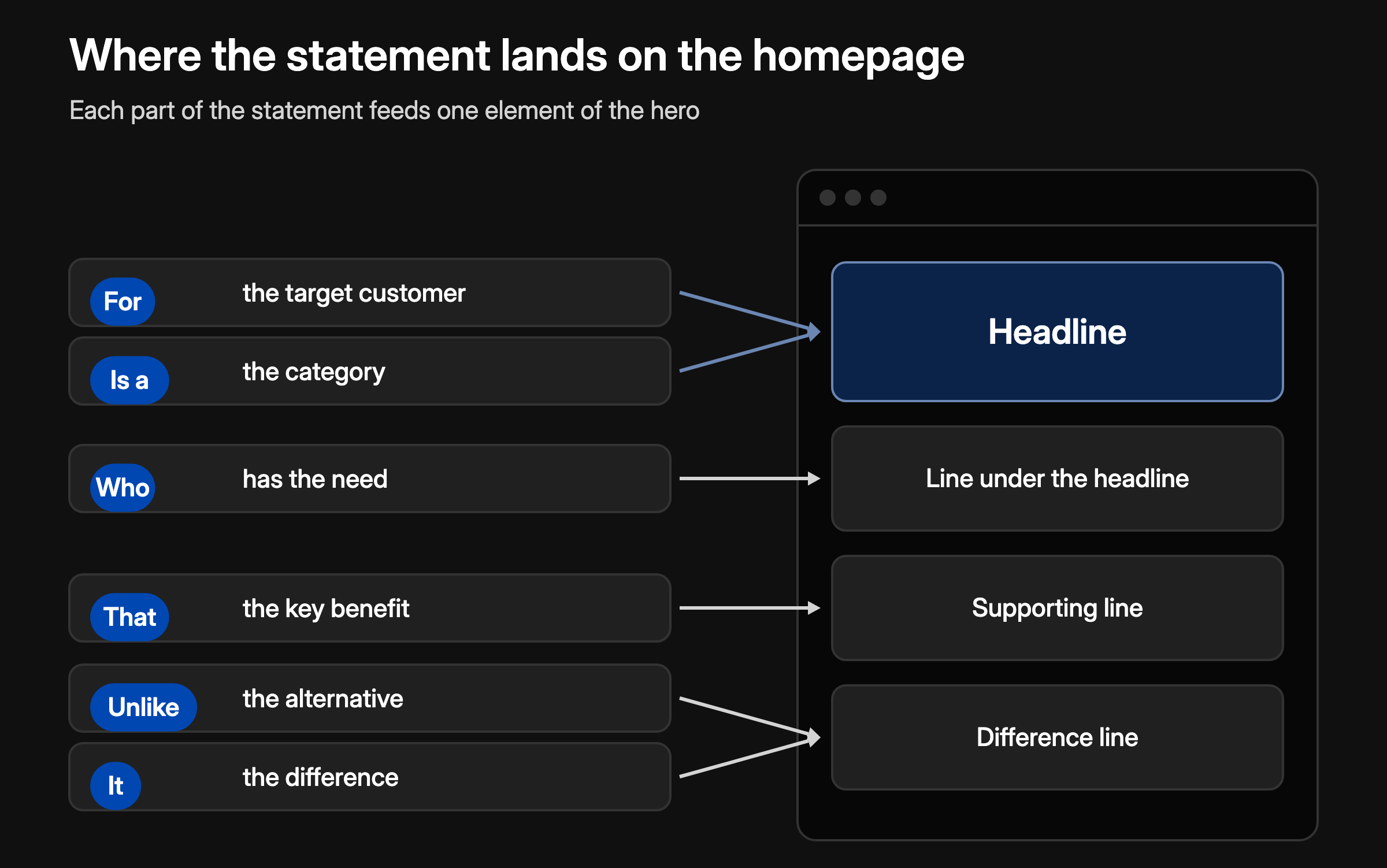
The last two carry the weight because they're the only part that makes you name what you're better than. Everything else can be true of three companies at once. Check each slot with one question: could a competitor paste this exact phrase into its own statement? Any slot where the answer is yes isn't finished.
Eight B2B homepages, read back into statements
On 13 November 2026 I read the homepages of fifteen well-known B2B software companies and took the hero of eight of them: the headline and the line under it. For each, I wrote the statement those two lines imply. These are my reconstructions from the page, not statements the companies have published, and any hero can change next week.
| Homepage | The hero, word for word | The statement it implies (my reading) | Left to the rest of the site |
|---|---|---|---|
| Stripe | "Financial infrastructure to grow your revenue." ... "from your first transaction to your billionth." | For businesses of any size, Stripe is financial infrastructure that grows revenue from the first transaction to the billionth. | The buyer by name, the alternative |
| Linear | "The product development system for teams and agents" "Purpose-built for planning and building products." | For product teams and their AI agents, Linear is a product development system, purpose-built for planning and building products. | The benefit as a result; the alternative, implied by "purpose-built" |
| Intercom | "A complete system for AI and human customer service" "Intercom is the only helpdesk with a natively integrated AI Agent ..." | For customer service teams, Intercom is a helpdesk where every conversation improves the next one. Unlike other helpdesks, its AI agent is built in. | The buyer by company type |
| Supabase | "Build in a weekend" "Scale to millions" "Start your project with a Postgres database." | For developers starting a project, Supabase is a Postgres development platform you can build on in a weekend and scale to millions. | The buyer by name, the alternative |
| Mercury | "Radically different banking" "Apply online in 10 minutes to experience banking unlike anything that's come before." | For startups, small businesses and scaling companies, Mercury is business banking you can apply for online in 10 minutes, unlike anything that's come before. | What exactly is different; the buyer, named in the page title rather than the hero |
| Gong | "Revenue AI Built To" with six rotating endings, from "Close deals faster" to "Predict churn" | For revenue teams, Gong is Revenue AI that captures every interaction and automates what happens next. | Which of the six outcomes leads |
| PostHog | "Your product's context layer" "PostHog ingests and stores your analytics, errors, replays, and business data ..." | For product teams and their agents, PostHog is a context layer that keeps analytics, errors, replays and business data in one place to query. | A category word buyers already use |
| Attio | "Welcome to agentic revenue." "Attio is the platform that builds pipeline, advances deals, and grows accounts around the clock." | For revenue teams, Attio is a CRM (its page title says so) that builds pipeline, advances deals and grows accounts around the clock. | The alternative |
Read as positioning statement examples, the eight agree on what to print. Seven name a category in the hero itself, though PostHog's "context layer" is a new one; Attio's headline names an idea, "agentic revenue," and its page title supplies "CRM." None names the buyer by role or company type. Six imply one through what the product does, such as customer service, revenue or building an app, and Gong prints it in the line above its headline: "#1 AI OS for Revenue Teams."
Only Intercom says both what it beats and how: "the only helpdesk with a natively integrated AI Agent." Mercury names what it beats, banking "unlike anything that's come before," and leaves the difference to the rest of the page.
The fifteen heroes share one more habit. Seven of the fifteen headlines contain "AI," "agents" or "agentic," and ten do once you count the line underneath. A word that sits in seven headlines can't be anyone's difference. That's the lesson for B2B positioning I take from these fifteen: the unlike has to come from something only you can say, and the homepage is where its absence shows.
Run the same exercise on your own homepage and three competitors'. Write the statement each hero implies, then cover the logos. If you can't tell which statement is yours, a buyer comparing the four tabs can't either.
Write the statement in five steps, alternative first
I write the slots in a different order from the one they're read in. The alternative comes first, because everything else depends on it: a difference only means something against a specific alternative, and the benefit follows from the difference. Here are the steps, with a worked example for a hypothetical company that sells demand-forecasting software to regional food distributors.
- Name the alternative. What the buyer does today, or would do without you. If there are several, pick the one they'd actually fall back on. Example: a purchasing manager's spreadsheet and the reorder points in the distributor's ERP, the system that runs its orders and stock.
- Find the difference only you can claim against it. Example: the software forecasts each product for each customer, every day, from orders, promotions and weather, which a spreadsheet can't do at that scale.
- Turn the difference into one benefit. The result the buyer would repeat to their boss. Example: ordering the right amount of every fresh line, so less stock expires before it sells.
- Name who feels that benefit most, and when. Example: purchasing directors at regional food distributors whose write-offs grew after they added fresh lines.
- Pick the category the buyer already shops. Example: "demand-forecasting software," not "AI supply-chain intelligence platform."
Assembled in Moore's order, the example reads:
For purchasing directors at regional food distributors whose write-offs grew after they added fresh lines, the product is demand-forecasting software that tells them how much of each fresh line to order. Unlike spreadsheets and ERP reorder points, it forecasts each product for each customer, every day, from orders, promotions and weather.
Every part of that statement can be argued with, and that's the point: a draft nobody disagrees with hasn't decided anything. It's also why "positioning agreed in one sentence" opens my B2B rebrand checklist. Skip it, and the positioning still gets decided, by whoever gives the last round of feedback on the homepage.
The Homepage Test tells you it's finished
The Homepage Test is the one I use: a statement is finished when someone who wasn't in the meeting can write the homepage hero from it (the headline, the line under it, a supporting line and a line that states the difference) without asking a question. Each question they come back with points to an empty slot: "Who is this for?" is the target, "What do we call it?" is the category, and "Why us and not them?" is the unlike.
Here's the test run backwards on my own homepage, live on 13 November 2026: each line of the hero, and the part of the statement it carries.
| Hero line | Part of the statement | The line on the homepage |
|---|---|---|
| Headline | For (Marketing VPs at B2B companies) and the category (website strategy) | "Website strategy for Marketing VPs leading a B2B rebrand" |
| Line under it | Who: their company has outgrown its brand, and the rebrand is theirs to lead | "Your company has outgrown its brand, and the rebrand sits with you." |
| Supporting line | That: settles what the company stands for and what the website has to prove, before design | "I settle what it stands for and what the website has to prove before anything gets designed." |
| Difference line | Unlike starting with the build, the direction comes first | "The direction comes first; the build follows it." |
The alternative is the one part the hero implies instead of naming: it says what comes first and lets the reader supply the opposite. The same test turns the food distribution statement into a hero. Here is that hypothetical company's hero before the statement existed, and after:
| Hero line | Before the statement | After the statement |
|---|---|---|
| Headline | AI-powered supply chain intelligence | Demand forecasting for regional food distributors |
| Line under it | Make smarter decisions with real-time insights across your operations. | You added fresh lines, and the write-offs grew with them. |
| Supporting line | One platform for planning, purchasing and inventory. | Know how much of each fresh line to order, every day. |
| Difference line | Trusted by leading brands | Unlike a reorder spreadsheet, it forecasts each product for each customer from orders, promotions and weather. |
Run the test before the website brief goes out. Hand the statement to a writer or a designer outside the project, ask for the hero, and count the questions. Zero questions means the statement is ready. One or two mean a slot needs another pass, and three or more mean the meeting isn't over.
Positioning vs messaging, in that order
Positioning vs messaging comes down to a choice and its wording. Positioning chooses the buyer, the alternative and the difference. Messaging turns that choice into words for each audience: the pillars, the proof and the order they come in.
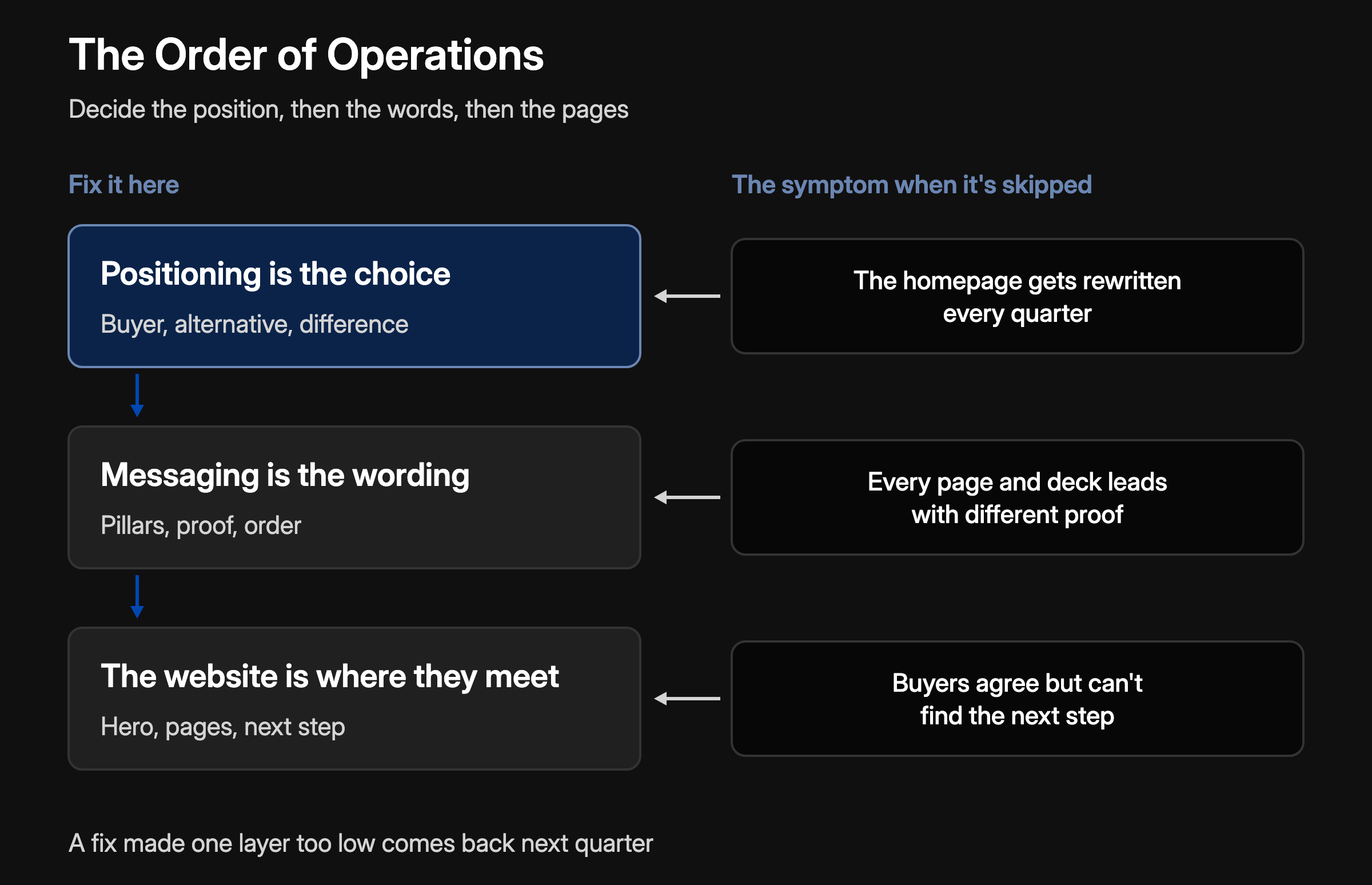
The website is where the two meet in public, or visibly don't. I call this the Order of Operations, and it only runs one way.
When the order runs backwards, the symptom shows up on the website, whichever layer caused it. A homepage rewritten every quarter, or sales and the site describing different companies (the pattern behind when growth creates confusion), means the choice was never made. Pages and decks that agree on the claim but each lead with different proof mean the wording was never agreed. Buyers who agree with the message but can't find the next step have a website problem, which is the part website strategy settles.
Before you brief a copywriter, find the layer the problem lives in. A copy fix on a positioning problem comes back next quarter, with a new headline and the same argument.
Four mistakes that break a B2B positioning statement
- Writing it for everyone. A statement with no company type and no role gives the homepage nothing to say to anyone in particular. Name the company type, the role and the moment, and accept that some visitors will see it isn't for them.
- Using a category only you use. A new category name asks the buyer to translate it. If you coin one, keep the familiar word close by, the way Attio's page title reads "The CRM for agentic revenue."
- Passing a feature off as the benefit. "AI-powered" and "real-time" describe the product. The benefit is what changes for the buyer, so ask "so what?" until the answer is a result instead of a capability.
- Claiming a difference any competitor could claim. The two heroes below come from two interactive-demo tools, with names and logos hidden. Both headlines promise demos for the whole customer journey. Each lists its features, AI demo agents in one and sandbox environments in the other, but neither says who it's for or what it does better than the alternative. Swap the logos and both still read true.
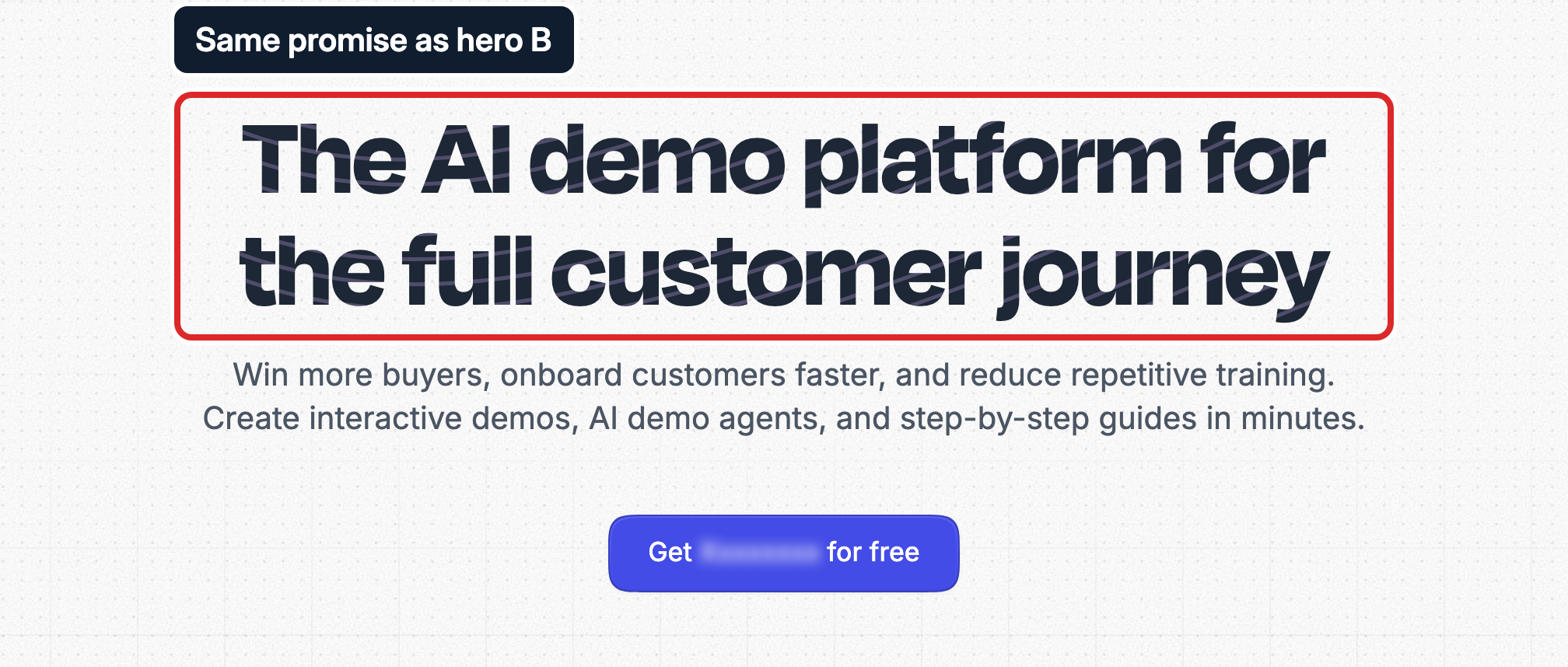
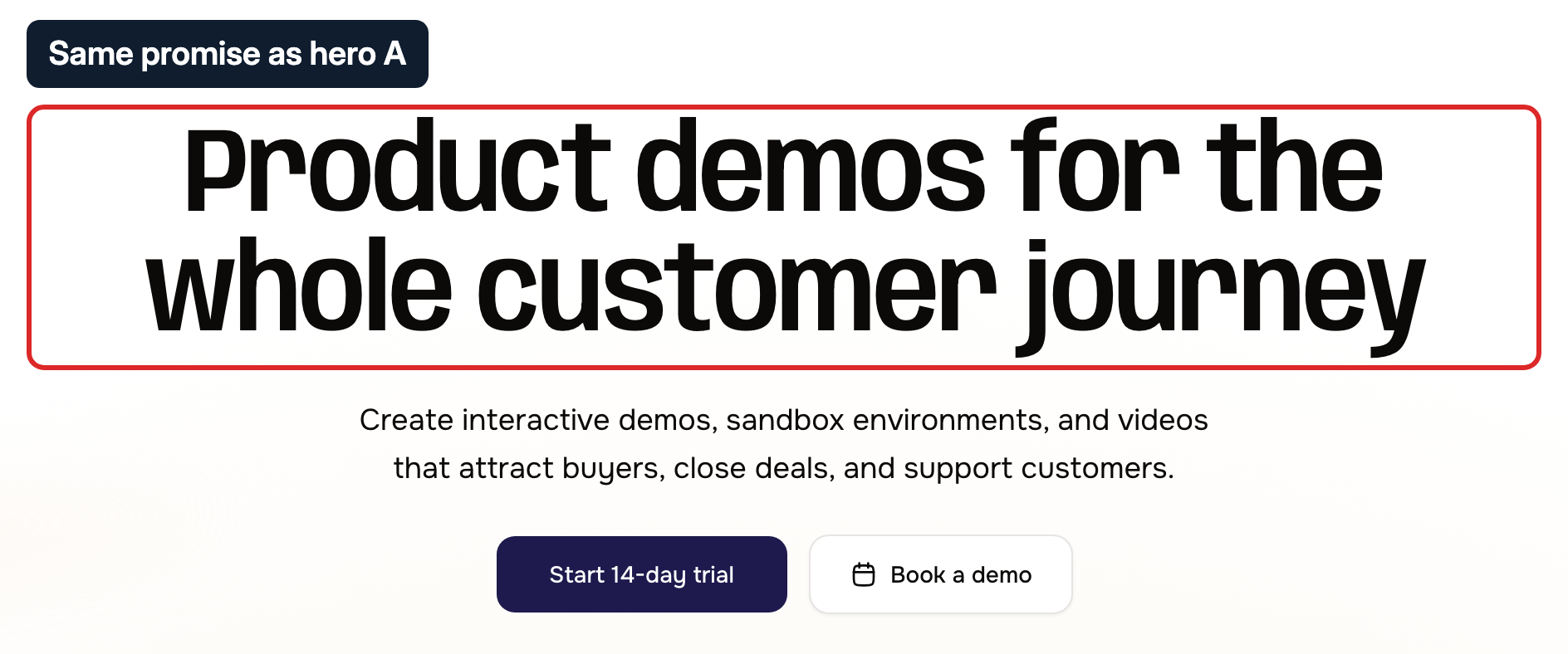
The fix for the last one starts at step one: name the alternative both companies share, and write the one thing only you can say against it.
Final thoughts
This article stops at the statement. The message built on it (the pillars, the proof and what you choose not to lead with) is separate work, and so is testing the statement against what buyers say on sales calls, which no template can do for you. A positioning statement is short because the decision behind it is hard. If you want that decision closed before the homepage brief goes out, that's the work I do as a B2B website strategy consultant, and the B2B website strategy guide shows what gets built on it.
Frequently asked questions
How do you write a brand positioning statement?
Start with the alternative the buyer would choose instead of you, then the one difference you have against it, the benefit that difference produces, the buyer who feels it most and the category they already shop. Assemble it in Moore's order: for, who, is a, that, unlike. A brand positioning statement uses the same template as a product's; it just covers everything the company sells.
How is a positioning statement different from a tagline?
The statement is internal and decides who you're for and why you win. The tagline is public and makes that decision memorable in a few words. A tagline can change with a campaign; the statement changes only when the business does.
Who should write the positioning statement?
The head of marketing drafts it, because they'll live with the homepage it produces. The CEO and the head of sales sign it, because a statement sales won't repeat on a call is decoration. When the leadership team disagrees about the buyer, an outside facilitator helps: someone with no stake in which version wins.
When should you update a positioning statement?
When the business changes: a new buyer, a new category, a new main competitor or a price the old promise no longer fits. A new campaign or a homepage redesign isn't a reason. If the statement changes every quarter, it was never agreed.
Is a positioning statement the same as a value proposition?
No. A value proposition says what a buyer gets from a specific offer, and a company can have several. The positioning statement sits above them: one statement per company or product, and every value proposition has to agree with it.