

You sent the website redesign RFP to three agencies, and the quotes came back looking like three different websites. The agencies didn't do anything wrong. The RFP left the decisions open, and each of them filled the gaps with its own guess.
A website redesign RFP gets comparable quotes when the four decisions behind the site are closed and written into it word for word, and when it tells agencies how their proposals will be scored. Closing those decisions before anyone quotes is what my website strategy consulting is for.
Key takeaways
- An RFP with open decisions buys guesses. Every agency fills the gaps differently, so the quotes describe different projects and can't be compared.
- Decide first, then pick the document. With the decisions closed and no team chosen, write an RFP. With a team chosen, a brief is enough.
- Describe results, not pages. The US federal buying rules tell buyers to describe work "in terms of the required results" wherever practicable, and a website RFP works the same way.
- Tell bidders how you'll score them. Put the evaluation factors and their weights in the RFP, and ask for past work and an approach instead of free design concepts.
An RFP with open decisions buys guesses
A potential client asks, "How much will the website cost?" and the obvious answer seems to be a number. But here's the problem: at that point, nobody really knows what the project is yet. An RFP asks the same question in writing, to several agencies at once.
You might know you need a new website and might even have a list of pages. But do you know:
- What the positioning should be?
- What the site needs to communicate?
- Which pages actually matter?
- What the customer needs to understand before they take action?
Usually, not yet… so any quote at that stage is partly a guess.
Before I moved to strategy, I quoted website builds myself, and the guess cuts both ways. If I quote too low, the project eventually forces compromises. Pages get added, the structure changes, and messaging needs to be rewritten. Suddenly, the original scope doesn't match the actual work. On the other hand, if I quote too high, I might lose a good project simply because I priced something that hadn't been properly defined. The outcome? Neither is particularly useful.
Send that guess to three agencies and you get three guesses, each one priced for a different project. Part of the spread between the quotes is what the RFP left open, and that part can only be fixed before the document goes out.
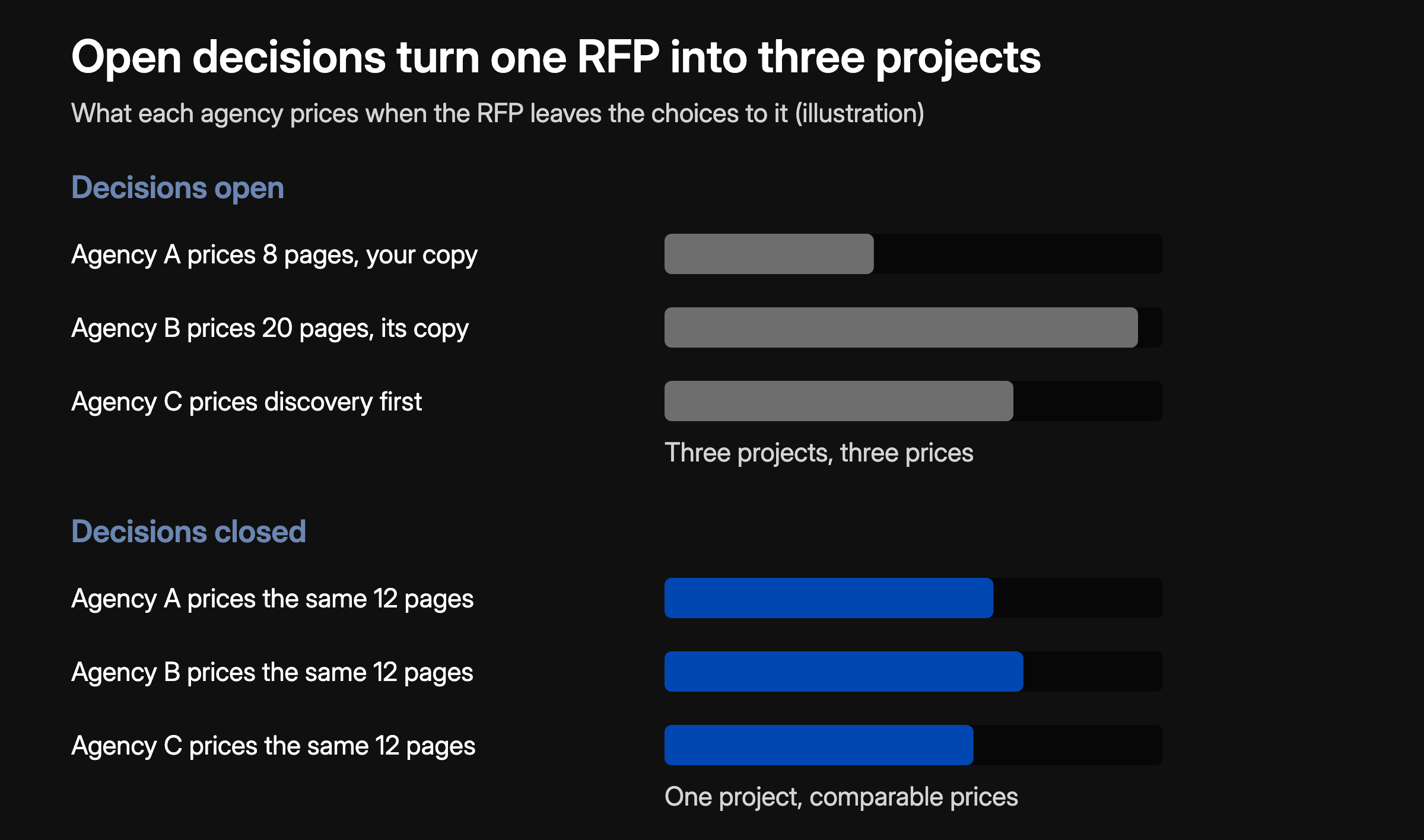
A quick count tells you how exposed an RFP for website redesign is. Mark every place where an agency would have to choose for you: the buyer the site writes for first, the pages it keeps, the message on the homepage, what's out of scope. Each mark is a line that three agencies will price three ways.
Choose between an RFP and a brief last
In a website project, an RFP is a competitive document. The US Federal Acquisition Regulation, which governs federal buying, says requests for proposals are used in negotiated acquisitions "to communicate Government requirements to prospective contractors and to solicit proposals" (FAR 15.203(a)). Put your company in place of the government and the job is the same: one written requirement that several teams answer and you compare.
The FAR itself is being rewritten under the Revolutionary FAR Overhaul. Proposed rules published in June and September 2026 renumber the sections quoted in this guide and reword some of them, so every quote here is from the text in force on 2 November 2026.
A website brief has a different job. It goes to one team that's already chosen, in-house or hired, and tells it what to build. A website design brief is the same document stopping at design. Neither asks anyone to compete, so neither needs a response format or scoring factors.
An RFQ is narrower still: it asks for a price on something already specified, while a proposal describes how a team would do the work and what it would cost. A redesign fits an RFQ only when the build is fully specified, which it can't be before the decisions are made.
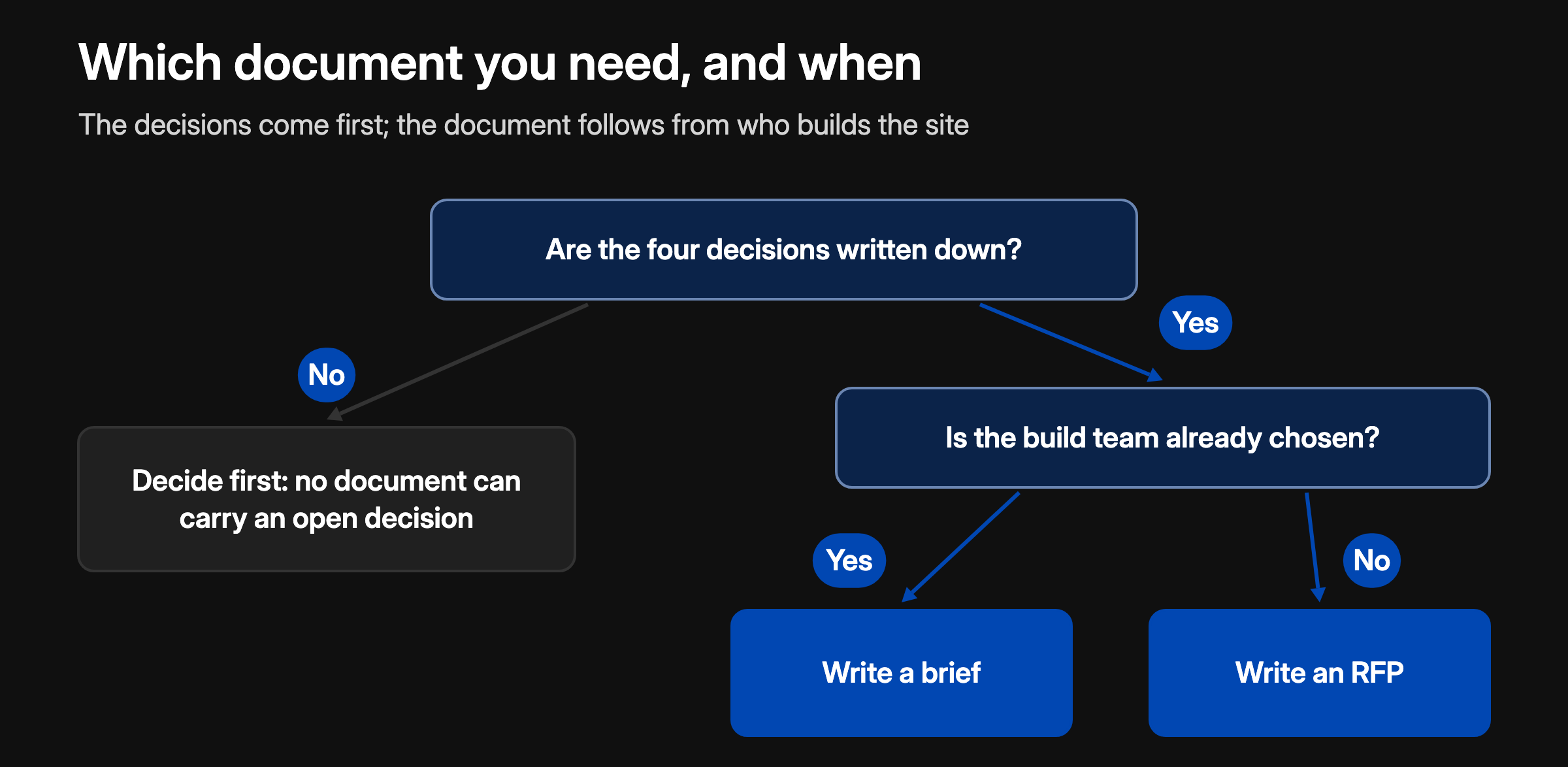
So the order is decisions first, then the document. If the decisions aren't written down, neither document can carry them, and the next step is making them. If they are written and no team is chosen, write the RFP. If the team is chosen, write the brief.
Skip the RFP when the comparison would cost more than it can save: a small update to a site that works, or a team you've already worked with and trust. A clear brief to that team does more than a formal competition nobody else can win.
Close the four decisions before you write
The decisions an RFP can't make for you are the four in what website strategy is: what the site is for, who it must persuade, what it must say and what gets built. They have to be closed before anyone writes an estimate. That doesn't mean a giant discovery process, nor months of workshops and decks, but just enough strategic work to understand what we're actually building.
At Fiscallion, a fractional CFO firm, the project opened with the positioning questions: "Who is the ideal client. Why do customers pick you over the next firm. What are the main services, what should pricing say, what should a visitor do next." The case page records what happened next: "Every answer went into writing while the project was still documents. By the time anyone opened Figma, the arguments were over."
Write each answer as one sentence a stranger could act on. "We write the homepage for operations directors at mid-size manufacturers" is a decision. "We want to appeal to a broad range of stakeholders" is not, and an agency will price it as a guess.
Closers settle what collectors only gather
Four questions belong at the start of any website project, and they're the ones I ask before anything else:
- "What changed and what does the business need now?"
- "Who are we speaking to?"
- "What needs to be different?"
- "What does success actually look like?"
Asked in a workshop, though, each of them can end in a pile of opinions. Collectors gather opinions: "What do you think of our homepage?" Closers force a choice: they put options on the table and ask the person with the authority to pick one, by a date. An RFP needs closers, because an agency can't quote an opinion.
| The collector version | The closer version |
|---|---|
| What should the new site do? | Which one action should a first-time visitor take: book a call, start a trial or read pricing? |
| Who visits our site? | Which buyer does the homepage speak to first, and who comes second? |
| What do people think of our messaging? | Which of these three positioning lines do we commit to? |
| Which pages do we need? | Which current pages do we keep, rebuild, merge or retire, and why? |
| What features would be nice? | Which features ship at launch, and what's explicitly out of scope? |
| What metrics should we track? | Which number do we report six months after launch, and what is it today? |
| Any thoughts on design? | Which two sites in our category must we not look like, and why? |
| Who needs to sign off? | Who has the final say on copy, on design and on budget, by name? |
Each closer ends as a sentence in the RFP. If a question still has two live answers, the document isn't ready to send.
Every closer also needs one person who can answer it. If the honest answer to "who decides the homepage message?" is a committee, the RFP inherits the committee's open questions, and so does every quote. Name the owner of each decision before the RFP goes out, the way I describe in how to avoid design by committee.
A website redesign RFP needs eight sections
The federal rules offer a sound skeleton. When the government states its objectives and lets the bidders propose the work, its statement of objectives must cover, at a minimum, the purpose, the scope, the period and place of performance, the background, the "performance objectives, i.e., required results" and any operating constraints (FAR 37.602(c)). An RFP must also state the terms that will apply, what goes into a proposal and which factors will be used to evaluate it, "and their relative importance" (FAR 15.203(a)).
Adapted to a website design RFP, that gives eight sections:
- Background. Who you are, what changed and why the site has to change now.
- Purpose. The site's one job and the number that proves it.
- Audience. The buyer the site writes for first, and who comes second.
- Message. The positioning line and the proof points, written out word for word.
- Scope. Every page with its job, the pages being retired, who writes the copy, integrations, the content migration with its redirect map (the part website redesign SEO covers) and what's explicitly excluded.
- Constraints. Platform, deadline, budget range, who approves what, anything legal has already fixed, and the contract terms you'll require: who owns the design files and code, how payment is staged and what support follows launch.
- Proposal format. Approach, the team by name, relevant past work, timeline and a price broken down by phase.
- Scoring. The factors you'll judge on and their weights.
The same section tells the government, "to the maximum extent practicable", to write the work up this way:
"Describe the work in terms of the required results rather than either 'how' the work is to be accomplished or the number of hours to be provided" (FAR 37.602(b)(1))
In a website RFP, a page list is the "how", and the purpose and its number are the result, which is why the purpose section comes before the scope.
Here's a website RFP example for the four sections that carry the decisions, written for a hypothetical logistics software company replacing a twelve-page site:
- Purpose. The site's job is to turn operations directors at mid-size manufacturers into booked demos. We'll judge it by demo requests from target accounts, compared with the last two quarters.
- Audience. The homepage speaks to the operations director first. The CFO comes second and gets the business case on the pricing page.
- Message. The positioning line, word for word: "Every shipment's status in one view, without calling the carrier." Three proof points sit under it, each with its source named.
- Scope. Twelve pages today: keep four, rebuild five, merge two into one, retire one with a redirect. Add an integrations page, whose job is to show which ERP and carrier systems connect before a demo, and a pricing page, whose job is to give the CFO the business case. Every other page gets its one-line job in a table under this section. Our team writes the copy from the message above. Out of scope: the customer portal and the help center.
The constraints follow the same pattern: the site stays on Webflow, launches before the end of the second quarter, carries a stated budget range and the contract terms, and the product team checks every claim about integrations.
An agency can price that without a discovery workshop. No website RFP template does the same for you: a template gives you the headings, and every heading still needs a decision under it. In an RFP for website development alone, with the design already done, the scope section carries the most weight: pages and templates, integrations, migration, and what the team hands back at launch.
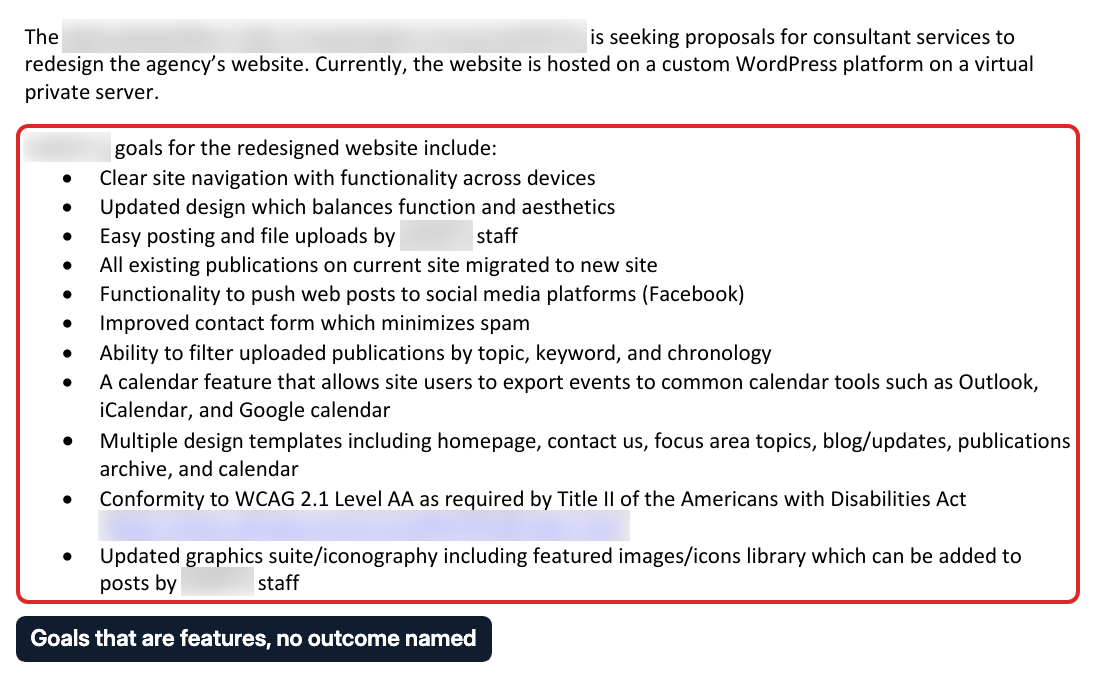
The goals section below, from a public website redesign RFP, shows the pattern to avoid: eleven goals, each one a feature or a quality of the site, and none of them naming an audience or a result.
The Build-Ready Test says when to send it
Before the RFP goes out, run five checks. If any of them fails, the document isn't ready:
- Every page has a stated job. "About us" is a page name. "Convince a CFO that we've done this at their size" is a job.
- The message is written, not described. The positioning line is in the document word for word, not "messaging to be developed".
- Priorities are ranked, not listed. When two goals conflict, the RFP says which one wins.
- Exclusions are explicit. What's out of scope is named, so nobody prices it and nobody assumes it.
- No decision inside it is still open. Nothing reads "to be confirmed" or "to be discussed in discovery".
It's the same principle I've seen across rebrands and larger website initiatives: when direction isn't defined early, execution eventually becomes a negotiation. Everyone starts interpreting the brief differently. As a consequence, more feedback and revisions follow. Small decisions become big ones because nobody knows who owns the direction.
A document that passes gives every agency the same project to price, and the winner starts from decisions instead of a workshop. There is less room for the project to slowly become something completely different from what everyone agreed to at the beginning.
Score responses against the RFP you wrote
The federal rules make the RFP say how proposals will be judged. Its evaluation factors must "support meaningful comparison and discrimination between and among competing proposals" (FAR 15.304(b)(2)), and the RFP must state them with their relative importance, though not the rating method (FAR 15.304(d)). Go one step further and publish the weights, so every agency knows what you'll reward.
Here's the rubric I'd start from, then adjust to the project. The heaviest line rewards understanding: a proposal that copies your RFP back scores low on it, and one that names a risk in your plan and how the team would handle it scores high.
| Factor | Weight | What earns the points |
|---|---|---|
| Understanding of the decisions | 30% | The proposal restates your purpose and audience correctly and challenges one assumption with evidence |
| Approach | 25% | How they'd get from your RFP to a launched site, phase by phase |
| Relevant work | 20% | Past sites for buyers like yours, and what changed after launch |
| Price and its breakdown | 15% | Price by phase, with what's included and what isn't |
| Team | 10% | Who actually does the work, by name and role |
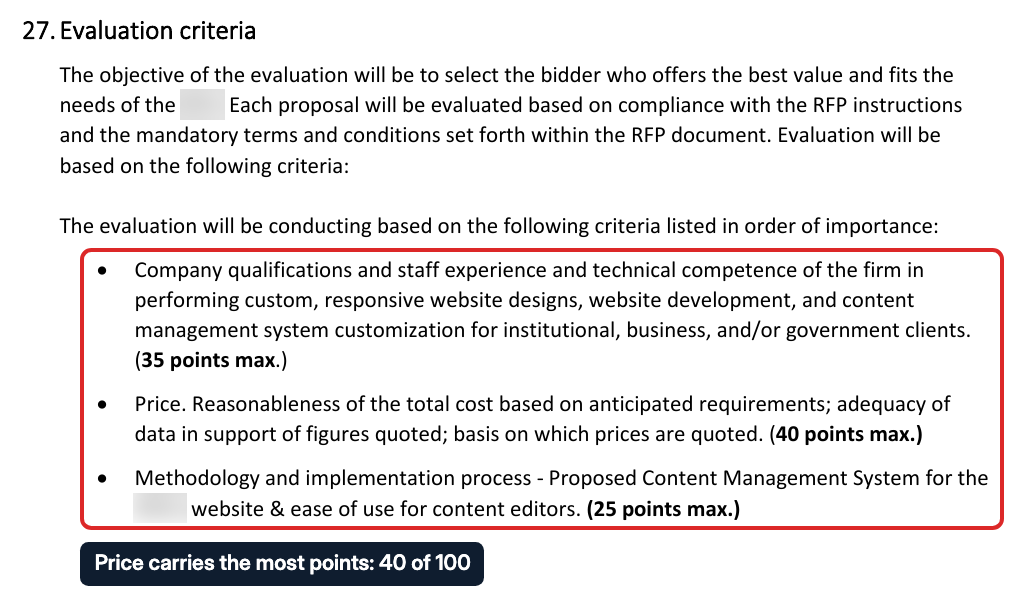
Compare that with the evaluation section below, from another public RFP. Price carries the largest single weight, 40 of 100 points, ahead of 35 for qualifications and 25 for method. On an RFP that leaves the decisions open, a scale like that puts the most points on the one line that can't be compared: the price of different projects.
Don't ask for free design concepts. A concept drawn from the document alone, before a single working session with your team, shows taste rather than fit.
AIGA, the US professional association for design, publishes a sample letter for designers to send to buyers whose RFP asks for spec work. It says AIGA "strongly discourages the practice of requesting that design work be produced and submitted on a speculative basis", and suggests asking instead for "examples of their work from previous assignments as well as a statement of how they would approach your project" (AIGA's sample letter).
If the quotes are still far apart against the same RFP, the spread itself is information: one agency may be planning to redo discovery your RFP already contains, a point I cover in choosing a rebranding agency.
Read where the difference sits before you compare the totals. If one agency prices copywriting and another assumes you'll supply the copy, the RFP left that line open. Put it back to every bidder as a written question, and ask for revised prices against the same answer.
Run the RFP process in five steps
The process around the document decides whether the answers are worth reading:
- Decide. Close the four decisions and write them into the RFP.
- Ask the market first, if you need to. When you don't know what a redesign of your size involves, send a short request for information. The federal rules use RFIs when a buyer "does not presently intend to award a contract, but wants to obtain price, delivery, other market information, or capabilities for planning purposes" (FAR 15.201(e)).
- Send to a short list. Three to five agencies that work with buyers like yours. More responses add reading time without improving the choice.
- Answer questions for everyone. Set a deadline for questions, answer them in writing and send every answer to every bidder, without naming who asked or repeating anything that gives away a bidder's approach. The federal rule in force today works the same way: information one bidder gets that it needs to prepare a proposal "must be made available to the public as soon as practicable", to avoid "an unfair competitive advantage", unless sharing it would reveal that bidder's "confidential business strategy" (FAR 15.201(f)).
- Score, then meet. Score the proposals against the published factors, meet the top two, and decide against the same RFP you sent.
Final thoughts
This guide stops at private buying: a public body's RFP follows its own procurement law, and its legal team sets the format. What no guide can settle is the content of your decisions. Those come from your buyers, your sales calls and your own numbers.
The timing is the point: strategy doesn't delay the website. Instead, it actually makes the website possible to build with confidence. If you want those decisions closed before the RFP goes out, that's the work I do as a B2B website strategy consultant, and the redesign itself follows the B2B website redesign process.
Frequently asked questions
What should be included in a website RFP?
Background, the site's purpose and the number that proves it, the priority audience, the message written out, the scope with its exclusions, the constraints (platform, deadline, budget range, approvals, contract terms), the proposal format and the scoring factors with their weights. The test is whether every agency that reads it would price the same project.
Do you need an RFP for a website redesign?
Only when you're comparing several teams. If you've already chosen who builds the site, in-house or hired, a brief does the job. And if the decisions behind the site aren't made yet, neither document helps: make them first, then write whichever one fits.
What's the difference between an RFP and a brief?
An RFP asks several teams to compete on how they'd do the work and what it would cost, so it includes a response format and scoring factors. A brief goes to one team that's already chosen and tells it what to build. The decisions inside both are the same.
How long should a website RFP be?
As long as the decisions, and no longer. If a section describes your company's process instead of a decision, cut it. If a decision takes a full page to explain, it probably isn't closed yet.
Should the RFP include a budget?
Yes, as a range. Without one, every agency guesses what you can afford and scopes the project to its guess, so the quotes stop being comparable. A range lets each of them show what fits inside it and what doesn't.