

What marketing leaders get wrong about AI starts before anyone opens a chat window.
Over the last year, I've noticed that many marketing leaders are disappointed with AI. They tried the tools, generated content, asked for campaign ideas, and even used AI to write website copy.
However, the results felt generic, underwhelming, and sometimes completely wrong. The conclusion was usually the same: "AI isn't that good." But in most cases, they don't realize that the issue isn't AI. In fact, the problem showed up long before the first prompt was written.
The truth is, AI tends to amplify whatever already exists. So, if the strategic direction is clear, AI can accelerate work. But what if it's unclear? Then it generates confusion. That's why some teams see enormous value from AI while others only get polished noise.
The same rule holds one level down, for the person at the keyboard. AI in B2B marketing scales the expertise of whoever uses it: someone who knows the buyer and knows how the tools behave gets more good work out of a week, and someone who knows the tools but not the buyer gets more confident mistakes.
The surveys show a gap between using AI and getting results. In McKinsey's 2026 State of AI survey of 1,719 respondents, nearly nine in ten report regular use of AI, but 37% attribute any EBIT impact to it, even though revenue gains are "most often attributed to the use of AI in marketing and sales". Gartner's 2026 CMO spend survey of 401 marketing leaders, mostly at companies with over $1 billion in revenue, found them putting an average of 15.3% of their marketing budgets into AI, while only 30% report mature readiness to scale it.
The mistakes cluster in five places: the prompt, the session, the check, the content plan and the search strategy.
Key takeaways
- AI scales what you know; it doesn't replace it. Expertise plus skill with the tools multiplies good work. With the tools but without the expertise, it multiplies convincing errors.
- The model can't see your decisions. Your buyer, positioning and proof stay invisible to it unless someone writes them into the window.
- Long sessions drift, and fluent isn't checked. Restart a drifting thread instead of arguing with it, and give every number and quote a source someone opened.
- AI search quotes passages. A page that answers one question completely gives an assistant something to lift; one page per question was the decision behind Fiscallion's 105 AI citations.
AI amplifies whatever you bring to it
Many have the misconception that AI can compensate for unclear thinking… but so far, it can't. I've seen a lot of companies ask AI to improve messaging before they've agreed on positioning. Others try to generate website copy before defining who they're speaking to. Some even expect AI to solve engagement problems that actually stem from a confused market position.
Surprisingly, the output often sounds convincing, and that's part of the problem. Although the result reads well to move forward, it's not good enough to move in the right direction yet. Why? Because the outcome there is more content, ideas, and execution… not clarity.
Since nowadays AI can very quickly produce positioning statements, homepages, campaign concepts, or even a content strategy, things may get tricky fast. That speed creates the impression that progress is happening. It's not always so.
I've seen projects where teams generated dozens of directions before agreeing on a single strategic objective. They moved faster than ever, but nobody was sure where they were going:
- At first, it felt productive
- Then, the revisions started
- Later, the debates began
- Eventually, somebody asked a question that should have been answered weeks earlier
Therefore, the problem wasn't the quality of the execution itself, but that it got ahead of alignment… again. It's the loop I describe in execution without direction, with AI making each lap faster.
Put the people using AI on two axes, and the pattern sharpens. One axis is how well you know your field: the buyer, the market, what's true about your product. The other is how well you work with the tools: what they can see, where they drift, how they fail.
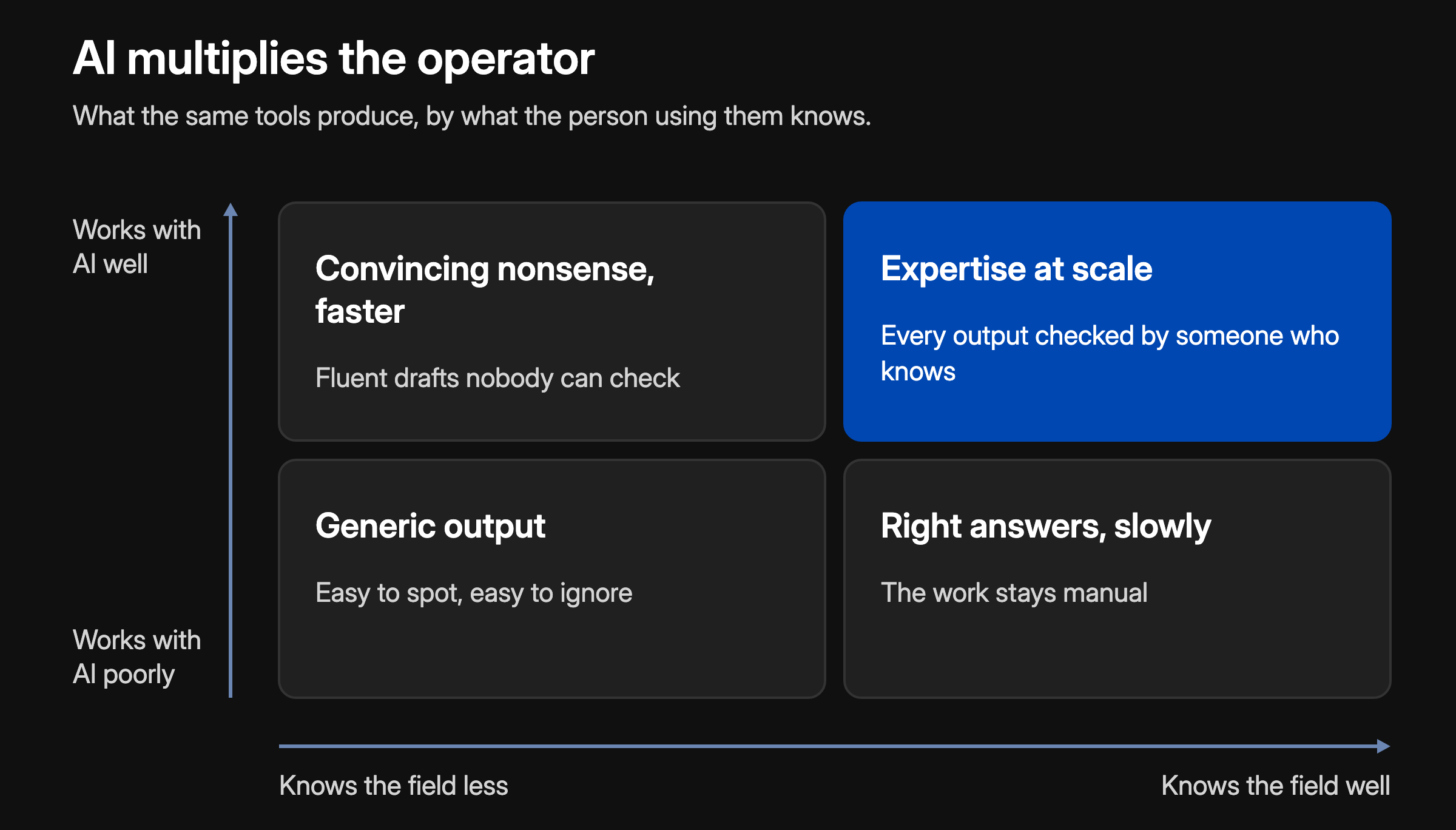
Only one corner produces better work than before: high on both axes. The dangerous one sits next to it: fluent drafts from someone who works the tools well but can't tell a true claim from a plausible one.
McKinsey's high performers, 6% of its respondents, redesign workflows around AI rather than insert it into existing ones, and redesigning a workflow takes someone who knows the work. Before you judge any output, ask who on the team could have caught its mistakes. If the answer is nobody, no AI marketing strategy will fix it: the gap is expertise.
Shallow prompts expect the model to read minds
A prompt like "write our homepage headline" assumes the model knows the product, the buyer, the positioning and the decisions behind them. It can't see any of those decisions. It works from the words in the window, so it fills each gap with a likely answer for the category, which is how competitors end up with interchangeable headlines.
When the audience is undefined, positioning is unclear, and leadership hasn't aligned on direction, the vague prompts inherit those problems. Then AI does exactly what it's designed to do, i.e. generating an answer based on wrong inputs.
The labs say so themselves. Anthropic tells users to treat the model as "a brilliant but new employee who lacks context on your norms and workflows", with a golden rule: if a colleague with minimal context on the task would be confused by your prompt, "Claude will be too." Its engineering team lists prompts that "falsely assume shared context" as a failure mode. OpenAI's guide asks you to "give the model any additional information it might need to generate a response".
Marketing leaders often judge AI by the quality of the output, but a better question is whether the brief itself was strong enough to produce a useful result in the first place. That's actually where AI creates real value.
The fix is a context document, written once and loaded at the start of every thread. Here's the difference for one task at an invented company:
| What the model needs | A shallow prompt gives it | A context document gives it |
|---|---|---|
| The buyer | "B2B companies" | Heads of finance at Series B SaaS companies with 50 to 200 people, still closing the books in spreadsheets |
| The positioning | Nothing | One sentence leadership has agreed on |
| The proof | Nothing | Three numbers, each with its source |
| The language | Nothing | The words you use, and the ones you never use |
| The decisions | Nothing | What the page must lead with, and what it must not claim |
| The task | "Write our homepage headline" | Five headline options for the hero, each under ten words, each naming the buyer and one outcome |
That's also why good AI prompts for marketing can stay short: the prompt says what to do, and the context says everything the model can't know.
Long threads drift without warning
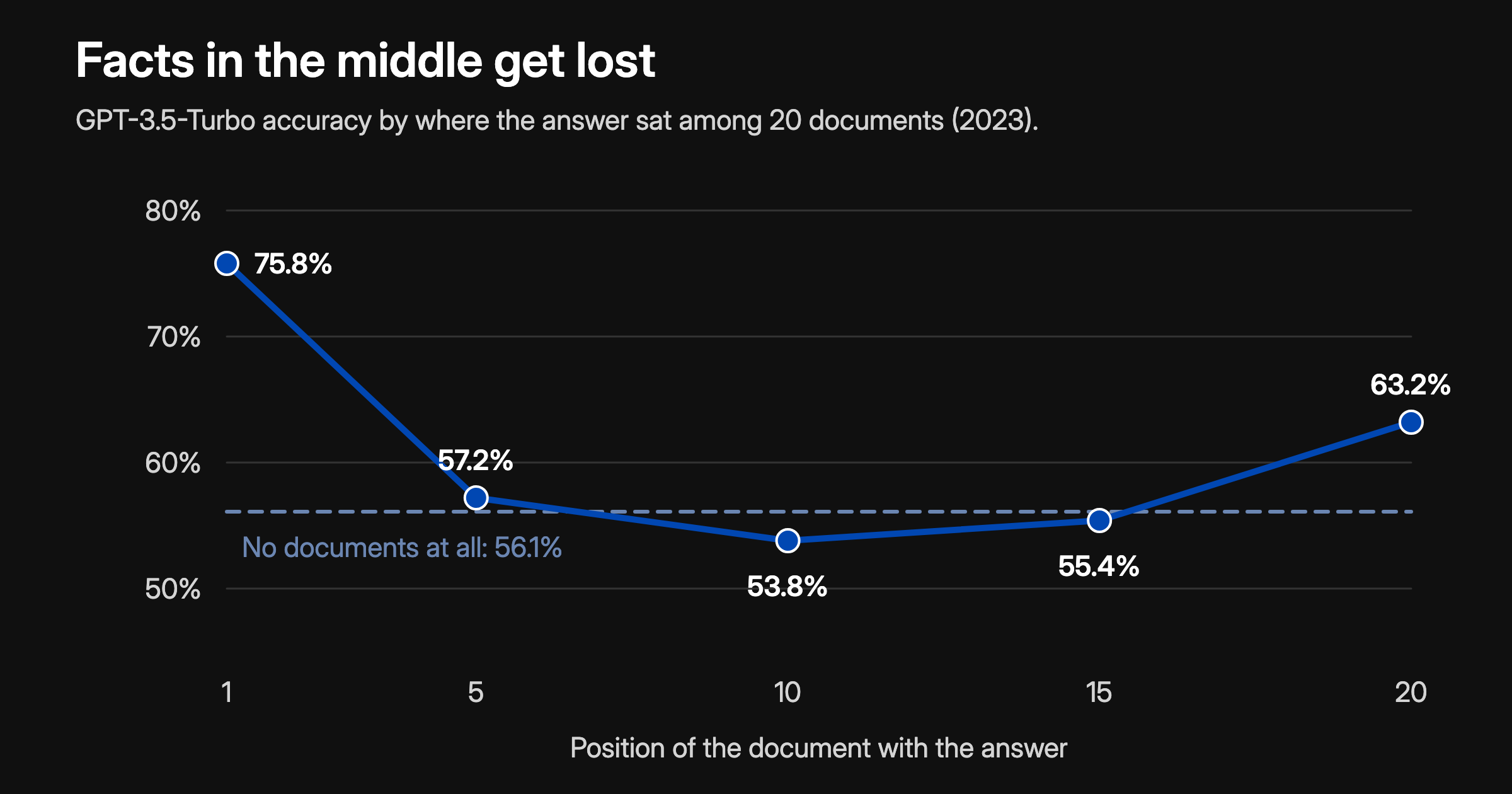
Some failures do come from the tools, and knowing them is part of the expertise. Even a good context gets diluted in a long thread. Lost in the Middle, a peer-reviewed study, found performance "often highest when relevant information occurs at the beginning or end" of a long input, and worse in the middle.
With the answer in the middle of twenty documents, GPT-3.5-Turbo scored 53.8%, below the 56.1% it scored with no documents at all. Those were 2023 models, but Anthropic's engineers write that context rot, the declining ability to "accurately recall information from that context" as the window fills, "emerges across all models".
Conversations add a second problem. In a 2025 preprint, researchers from Microsoft and Salesforce gave 15 models the same tasks either as one complete instruction or in pieces over several turns, and found "an average drop of 39%" in the multi-turn version. The models "often make assumptions in early turns and prematurely attempt to generate final solutions", and once off track, "they get lost and do not recover".
The drop appears "even in two-turn conversations", and the researchers call it likely one reason for low uptake of AI systems, "particularly with novice users who are less skilled at providing complete, detailed instructions from the onset of conversation".
Their advice is the rule I'd give any team: when a thread goes wrong, consolidate what you've said into one instruction and start a new conversation. Three habits keep you out of trouble:
- Give each thread one job.
- When a decision changes, write the new version into the context document instead of mentioning it in passing.
- When a thread contradicts what you agreed earlier, don't argue with it; restart with the context document and a summary of the decisions so far.
Fluent output isn't checked output
OpenAI defines a hallucination as the moment "a model confidently generates an answer that isn't true", and its researchers argue it persists because "standard training and evaluation procedures reward guessing over acknowledging uncertainty."
A second flaw makes it worse for marketers. In 2023, Anthropic researchers found five AI assistants giving "feedback that is more positive when the user states they like or wrote" the text in question, and OpenAI rolled back a GPT-4o update in April 2025 because it was "overly flattering or agreeable". Ask a model to review the homepage you wrote and you're asking a reader inclined to agree with you.
The AI hallucination examples on public record aren't chatbots telling jokes:
- Lawyers in a New York federal case submitted fake quotes and citations created by the artificial intelligence tool ChatGPT. The court found "nothing inherently improper about using a reliable artificial intelligence tool for assistance", put the duty to check accuracy on the attorneys, and, finding bad faith in the false and misleading statements that followed, imposed a $5,000 penalty.
- The Chicago Sun-Times printed a syndicated summer reading list in May 2025 that recommended books that do not exist. It had been "created through the use of an AI tool" and inserted "without review from our editorial team".
One more case matters, though its record never says the chatbot used AI: the company answered for what went out under its name. Air Canada's website chatbot told a customer that bereavement fares could be claimed retroactively. The airline gave the tribunal no information about the nature of its chatbot, and the tribunal held it responsible for all the information on its website, "whether the information comes from a static page or a chatbot". It ordered the airline to pay C$812.02 in damages, interest and fees.
Even AI companies regularly remind their users to verify important information. The reason? Unfortunately, AI doesn't understand your business:
- It doesn't sit in leadership meetings
- It doesn't know which assumptions are accurate or which stakeholder concerns matter
- It has no idea in which direction your company is trying to go next
- Although it can process information, it can't own the consequences of a decision
Google tells publishers the same thing: generative models "don't retrieve facts, but predict a likely sequence of words", so "it is critical to manually factcheck and review all AI-generated content". The bluffing has tells you can learn to spot:
- A precise number with no source. Ask where it comes from; if the answer is a source you can't open, the number goes.
- A study, quote or customer story you can't find. Search for it before it reaches a draft.
- An answer that agrees with whatever you suggested. Ask the same question the other way around and compare.
- A confident claim about your own product that nobody gave the model.
So marketing leaders still need to evaluate what AI produces before taking action… because judgment matters in the end. The rule I'd set for any team: nothing reaches the website until someone has checked it against a source they opened.
Context engineering is the skill teams skip
Anthropic defines context engineering as "the set of strategies for curating and maintaining the optimal set of tokens" a model works with, and warns that context "must be treated as a finite resource with diminishing marginal returns".
Gartner found the gap at the top of marketing: 65% of the 402 marketing leaders it surveyed from August to October 2025 expect AI to disrupt their role, but only 32% say significant changes are needed to the CMO profile and skill set. Its analyst's prescription reads like a job description: "build fluency in model limitations, and institutionalize output validation."
For a marketing team, it comes down to six habits:
- Map the problem before you prompt. A one-page mind map of the decision: the buyer, their problem, the claims you can make, the proof behind each, the objections.
- Write the context document from that map, with the four decisions your site rests on. Keep it under a page and store it in your tool's project instructions, so every thread starts with it.
- Split the job. Research, options, critique, draft and check are separate steps, each with its own thread.
- Show, don't describe. A few short examples of the tone you want teach more than a paragraph of adjectives; Anthropic's guide calls examples "one of the most reliable ways to steer Claude's output format, tone, and structure".
- Ask for assumptions. End the prompt with "list what you assumed and what you couldn't know", then fix the context instead of the output.
- Keep the decision human. The model drafts and critiques; someone who knows the market chooses.
Before pasting positioning, customer or pricing data into a tool, check that your account keeps it out of model training.
When used correctly, it can accelerate research, explore possibilities, test ideas under pressure, and identify patterns. AI can also help teams move through execution much faster once direction is already clear and agreed upon.
And as a result, AI is not replacing, but actually supporting the strategic clarity all along! The strongest teams I've seen don't use AI to make decisions for them. Instead, they use it to evaluate what they've already framed properly. So, the thinking comes first, and the tool second.
The content cannon fills the site with sameness
A quick way to waste AI is to point it at a keyword list and publish what comes back. Generic copy existed long before AI; what changed is its cost. Here's the register to watch for, from a live B2B software blog (nothing on the page says how it was written):

Two paragraphs, 161 words, and not one product, customer or number a reader could check.
Google doesn't judge any text by how it was made: "Appropriate use of AI or automation is not against our guidelines." Its spam policy targets volume without value, and the first example it gives of scaled content abuse is using generative AI tools or other similar tools to generate many pages without adding value for users. Readers notice. In a Gartner survey of 307 U.S. consumers in March 2026, 49% agreed that GenAI has made the quality of available content worse.
Inside companies, researchers at BetterUp Labs and Stanford have a name for the AI-made version, workslop: AI-generated work that "masquerades as good work, but lacks the substance to meaningfully advance a given task". Of 1,150 full-time U.S. employees in their online survey, 40% reported receiving some in the last month, and they estimated an average of one hour and 56 minutes dealing with each instance.
An AI content strategy that starts from a keyword list makes that register cheap to publish at scale. One that starts from the questions buyers ask, answered by someone who knows, produces pages worth reading and citing. A website content strategy is where those questions get mapped to pages. The rule: no page goes live without one question it answers better than anything else on the web, and one named expert who checked it.
AI search lifts answers, so pages need positions
The last mistake is treating AI search as keyword SEO with a new name. Google's AI features can answer one question by "issuing multiple related searches across subtopics and data sources", and Google says "users are asking longer and more specific questions". My own Search Console shows questions arriving as whole sentences, such as "our website no longer reflects who we are. which web development company should we hire for rebranding?"
Google is clear that the fundamentals carry over: "The best practices for SEO remain relevant for AI features in Google Search", "There are no additional requirements to appear in AI Overviews or AI Mode", and "You don't need to create new machine readable files, AI text files, or markup to appear in these features." It doesn't name llms.txt, but an AI text file is what it says you can skip for its own AI features; the page doesn't cover other assistants.
Google's first tip for AI search: "Focus on making unique, non-commodity content that visitors from Search and your own readers will find helpful and satisfying." Generative engine optimization and AI search optimization are useful names for what does change: the unit. The assistant can lift a passage from your page into its answer, whether or not the reader opens the page.
That turns every page into a candidate quote, and quotes get chosen for what they say. I call my filter the Citability Test. Before a page goes live, it has to pass four checks:
| Check | Passes | Fails |
|---|---|---|
| It states a position | "Close the decisions before design starts" | "Strategy matters in every rebrand" |
| It answers one question completely | One page per question, with the answer in the first lines | A page that touches five questions and settles none |
| It attributes its numbers | Every figure links to where it comes from | "Studies show 70% of buyers…" |
| It matches how buyers phrase the problem | The buyer's own words in the headings | Internal jargon and category labels |
Fiscallion is my receipt. Its blog was built on one decision: one page per question Fiscallion's buyers ask, from what NRR is to what deferred revenue does to a SaaS balance sheet. When someone asks an AI assistant what NRR means or how burn rate works, Fiscallion is now part of the answer: 105 citations across AI engines, all on non-branded questions. Claude and ChatGPT show up in its referral report, at 1.3% of sessions so far. Small, and real.
For a rebrand, this means message clarity now pays twice. A positioning that names its buyer and its outcome reads better to the people on the site and gives the assistants they ask something worth quoting; a vague one gives neither much to work with. That's the argument the Growth Gap makes for a company that has outgrown its story, with a second audience added. Run the four checks on your ten most important pages before you commission any new ones.
Final thoughts
Most marketing leaders are asking whether AI is good enough. I think that the better question is whether the strategy for feeding the tool is clear enough. When positioning is vague, audiences are unclear, and leadership hasn't aligned on direction, AI simply reflects the confusion that's already there. But when the foundation is clear, AI becomes something much more valuable: not a replacement for strategic thinking, but an amplifier of it.
That's the case for AI in a marketing team: it scales the person who knows the field and knows the tools, including when the model is bluffing and when it has lost the thread. It doesn't replace that person.
No source here settles how today's models compare with those tested in 2023 and early 2025, or how much the four checks move citations beyond one site. If your positioning and site decisions aren't closed yet, that's the work I do as a B2B website strategy consultant, before any tool or agency writes a word.
Frequently asked questions
How should marketing leaders use AI?
As a multiplier of expertise the team already has. Write the context once, give each thread one job, check every number and quote against a source, and keep the decisions with the people who know the market. Use it to scale research, options, drafts and critique.
Why does AI produce generic marketing copy?
Because the prompt leaves out what makes your company specific. The model can't see your decisions unless they're in the window, so it fills the gaps with a likely answer for your category. A context document with the buyer, the positioning, the proof and the decisions already made is what moves the output away from average.
Why does ChatGPT lose context in long conversations?
Two effects show up in the research. In 2023 tests, models used information at the start and end of a long input better than what sat in the middle, and Anthropic says the decline in recall as the context fills shows up across all models. In conversations, models "often make assumptions in early turns" and don't recover from a wrong turn; one 2025 preprint measured an average drop of 39% when the same tasks arrived over several turns. Consolidate what you've said into one instruction and start a new thread.
What is generative engine optimization for B2B?
It's making your pages easy for AI assistants to quote when buyers ask them questions. Google says its AI features need nothing beyond normal indexing, so once crawlers can reach the page, the work is the content itself: pages that state a position, answer one question completely, attribute their numbers and use the buyer's own words, the four checks of the Citability Test.
Can AI replace a marketing strategist?
No. It can draft, summarize and critique, but it doesn't sit in leadership meetings, doesn't know which assumptions are accurate, and can't own the consequences of a decision. It makes a strategist faster; it can't be one.