

You're about to rebuild the company site, and the build team's first request is a sitemap and a moodboard. Both are fair asks. Both assume someone has already decided who the site has to convince, and what each of those people needs to find when nobody from your side is in the room.
That decision is the B2B website strategy, and closing it before anyone designs a page is what my website strategy consulting is for. This guide builds it in order: the buying group, the stages, the words, the research path, the measure, and the handoff to whoever builds the site.
Key takeaways
- The site argues for you between conversations. In Gartner's 2025 survey, 67% of B2B buyers preferred a rep-free experience, and 69% still wanted a sales rep to validate AI-generated insights.
- The Room Map puts the whole buying group on one page. Each role gets the sentence it must be able to repeat, the proof behind it, the page that carries it and the next step it's ready for.
- Each stage of buying needs its own ask. For many purchases, up to 95% of business buyers aren't in the market at any one time, so a site whose only ask is a sales call has nothing for a buyer who is a year away.
- Decide before design. The build team owns the layout and the code; the strategy hands it the decisions, written so a team you've never met could execute them.
B2B website strategy works when you're not there
In a Gartner survey of 632 B2B buyers in 2024, 61% preferred "an overall rep-free buying experience", and most preferred "to carry out independent research through digital channels" (Gartner, June 2025). In the August to September 2025 survey, 67% said they prefer a rep-free experience (Gartner, May 2026).
Gartner keeps the seller in the picture. In the same survey, 69% of buyers preferred to validate AI-generated insights with a sales rep, and reps "remain the most important information source when buyers are researching a business problem or need, identifying a preferred supplier and securing internal support, and finalizing the purchase" (Gartner, May 2026). The site carries the reading between those conversations, and it's the page your champion forwards when they argue for you in a room you're never invited to.

So a B2B website strategy is the set of decisions that lets a site argue for you when nobody from your side is there. The four decisions underneath it are the ones in what website strategy is: what the site is for, who it must persuade, what it must say, what gets built. This guide covers what B2B adds to them: a group of readers with different stakes, arriving at different stages.
A quick test before you go further. Pick the person most likely to champion you inside a client. If they had to forward one page to their CFO with a single sentence, which page would it be, and could they write the sentence from what's on that page?
The Room Map covers the whole buying group
The B2B buying group, also called the B2B buying committee, is everyone whose yes the purchase needs. Gartner's 2026 advice to sales enablement leaders is to help buying groups reach "value clarity, a clear understanding of how a solution improves outcomes in the buyer's specific role and business context" (Gartner, March 2026). A website can help with that only after someone has written down which roles those are.
The Room Map is that page. One row per role, four columns:
- Who reads. The role, by job title or function, never a persona's first name.
- What they must be able to say. The one sentence this person repeats about you in the meeting you're not in.
- The proof. What makes that sentence safe to say out loud: a customer story, a document, a number with its source.
- The page and the next step. Where the site gives the proof, and the step this reader is ready to take.
Here's a filled map for a hypothetical company that sells accounts-payable software to mid-size firms.
| Who reads | What they must be able to say | The proof | The page and the next step |
|---|---|---|---|
| CFO, signs the budget | "It shortens month-end close without new hires." | A customer story with close time before and after, from a company our size | Case study page; read the full story |
| AP manager, the champion | "It handles our approval chains and exceptions." | A walkthrough of approvals on real invoice types | Product page; watch the walkthrough |
| IT and security lead | "It passes our security review." | Security documentation, access controls, single sign-on | Security page; request the security pack |
| Procurement | "The pricing model is predictable and the contract is standard." | The pricing approach, contract terms, implementation timeline | Pricing page; ask for a quote |
Two rules keep the map honest. Every row ends at a page that exists, or at a page the brief commits to building. And every page on the sitemap serves at least one row: a page that serves nobody gets the verdict merge or retire.
A map with one row is a persona document. A map with nine is a sign the company hasn't decided who it sells to.
Fill the map from evidence you already have. Take the last five deals you won and list everyone who had to approve them, including the person who joined in the final week. Then take the deals you lost and note the role that stalled each one. Your sales team knows both lists, and the first calls tell you what each role asked before it said yes.
Most of your market isn't buying now
John Dawes of the Ehrenberg-Bass Institute put it in one sentence: "up to 95% of business clients are not in the market for many goods and services at any one time" (Dawes, 2021). Corporations change providers such as their bank or law firm around once every five years, so "only 20% of business buyers are 'in the market' over the course of an entire year; something like 5% in a quarter". He calls the 95% a heuristic, "not meant to be a precise rule".
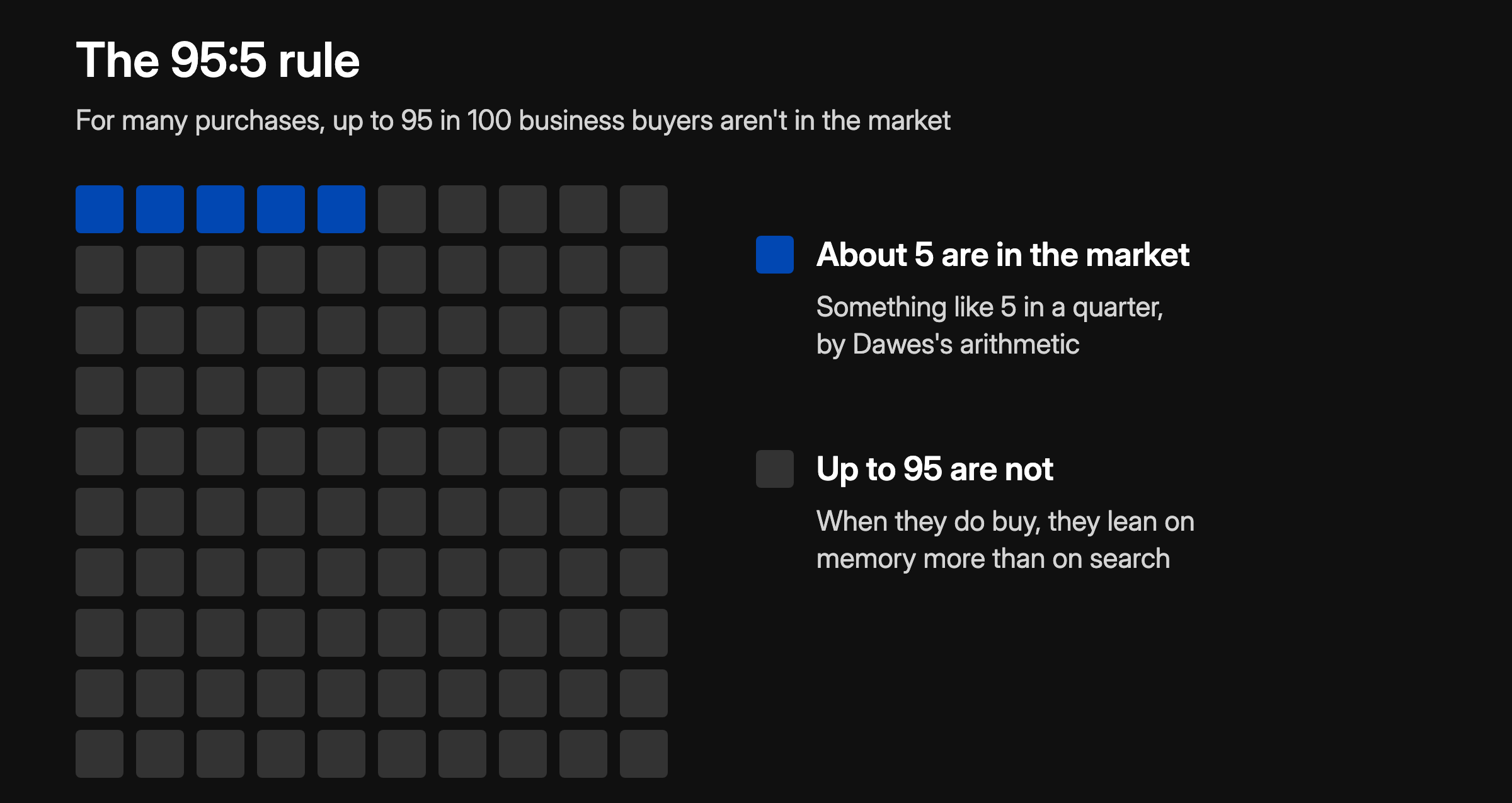
Dawes draws the lesson for advertising: it "mainly works by building and refreshing memory links to the brand", which activate when a buyer comes into the market. A website gets one part of that job. A reader who arrives from a search about a problem may be a year away from a budget, and if the page's only offer is a sales call, there's nothing to take away and nothing that brings them back.
The LinkedIn B2B Institute's advice, written for advertising, is to link the brand to buying situations, "also known as category entry points", well before buyers enter the market (B2B Institute). On a site, the pages that can tie your name to those situations are the problem pages and guides.
At Sedric, a compliance platform I worked with, the rebuild added a compliance playbook as a lead magnet, "for the buyers who are studying the problem months before they are ready to talk to anyone" (the Sedric case). The case page sums up what changed: "Interest that used to leave quietly now leaves an address."
Check your ten most-visited entry pages. For each one, write down what a reader who isn't buying this year can take away (a guide, a checklist, a template, a newsletter) and how they'd find you again when the problem comes back. A page with no answer to either only works for a buyer who is ready now.
Every buying stage needs its own next step
A first screen with one ask treats every reader as someone ready to talk. Gartner's 2024 survey points the other way: buyers "favor online self-service tools over sellers when searching for general information and learning new things", and turn to a seller for tasks like "determining whether a product or service fits their company's needs" (Gartner, June 2025).
So the ask is a decision, made before anyone designs a button. Each stage of buying needs a step the reader is ready for.
| Stage | What the reader needs | A next step that fits |
|---|---|---|
| Not in the market yet | A reason to remember you for the problem | A guide or template worth saving, a newsletter |
| Researching | How you solve it, and for whom | A walkthrough, a customer story for their role |
| Building the internal case | Proof they can forward | Case studies with sourced numbers, the pricing approach, the security page |
| Ready to talk | To know what the meeting is | A call named for what happens in it, on a page that sets expectations |
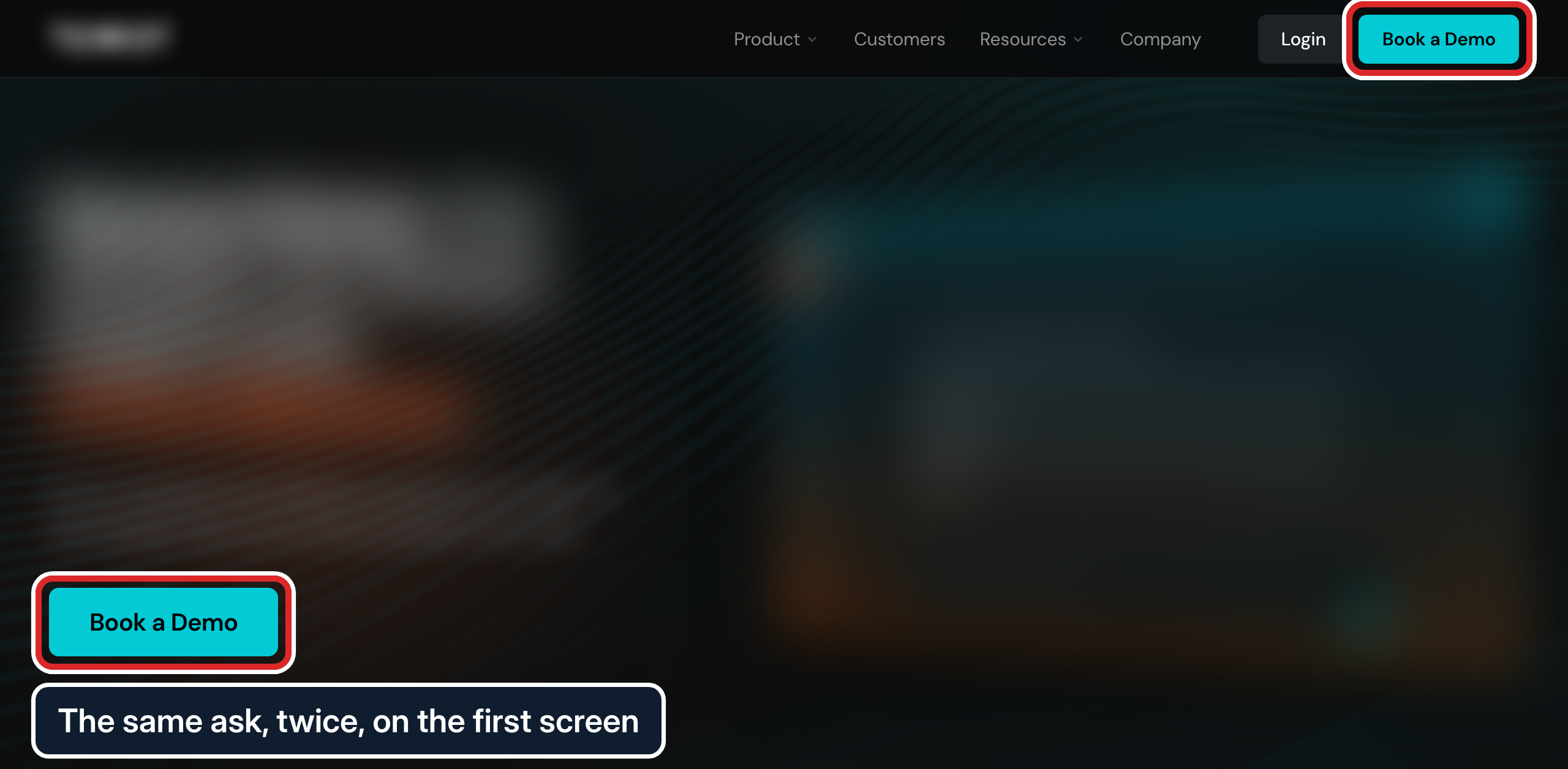
Then read each ask out loud, with the page behind it. A good one says what happens next: who the reader will talk to, for how long, and what they'll leave with. "Book a demo" on its own says none of that.
The first screen below makes the same ask twice, "Book a Demo" in the header and again in the hero, and none of its buttons speaks to a reader who is still researching.
The curse of knowledge writes your homepage
In a 1989 paper, three economists reported experiments in which traders who knew a company's actual earnings had to bet on what less-informed forecasters had predicted. They called what they found the curse of knowledge: "better-informed agents are unable to ignore private information even when it is in their interest to do so" (Camerer, Loewenstein and Weber, p. 1232). Their first example is the one that matters here: "sellers are better informed about the true value of their products than buyers" (p. 1233).
A homepage is written by the people who know the product best, and they can't read it the way a stranger does. So the hero fills with words from the inside: the category the company named itself, internal product names, the problem as the roadmap describes it. The second of the two B2B website examples in this guide shows it: a headline built from category terms, with no buyer and no outcome in it.

The outsider test takes ten minutes. Show the first screen, without scrolling, to someone who has never worked in your category, then ask three questions: what does this company do, who is it for, and what changes for them. Write down their exact words. If the answers miss, the hero was written from the inside, and the fix starts with what buyers hear, the second of the three mirrors in a brand audit.
Map the research path before the pages
In Gartner's 2025 survey, buyers used an average of seven information sources during a recent purchase, and 45% used GenAI, "primarily to gather information on vendors and products" (Gartner, May 2026). Google says AI Overviews and AI Mode "may use a 'query fan-out' technique", running related searches across subtopics and sources to build one answer (Google Search Central). The pieces of one question can land on different pages.
The research path is the set of pages that answer those pieces, in the order a buying group asks them. Draw it from the rows of the Room Map before anyone draws a sitemap:
- The problem. In the words a buyer uses before they know your category exists.
- The approach. How you solve it, who it's for, and who it isn't for.
- Proof for each role. One page per row of the Room Map, or a section that a link can point to.
- The questions that stall deals. Security, the pricing approach, implementation, switching.
- The meeting. A page that says what happens in the first call and who is on it.
For the accounts-payable company from the Room Map, the path might run from a guide on why month-end close slips, to the approval walkthrough for the AP manager, the customer story for the CFO, the security page for IT and the pricing approach for procurement. It ends at a call named for what happens in it: a review of the buyer's own approval flow with a product specialist.
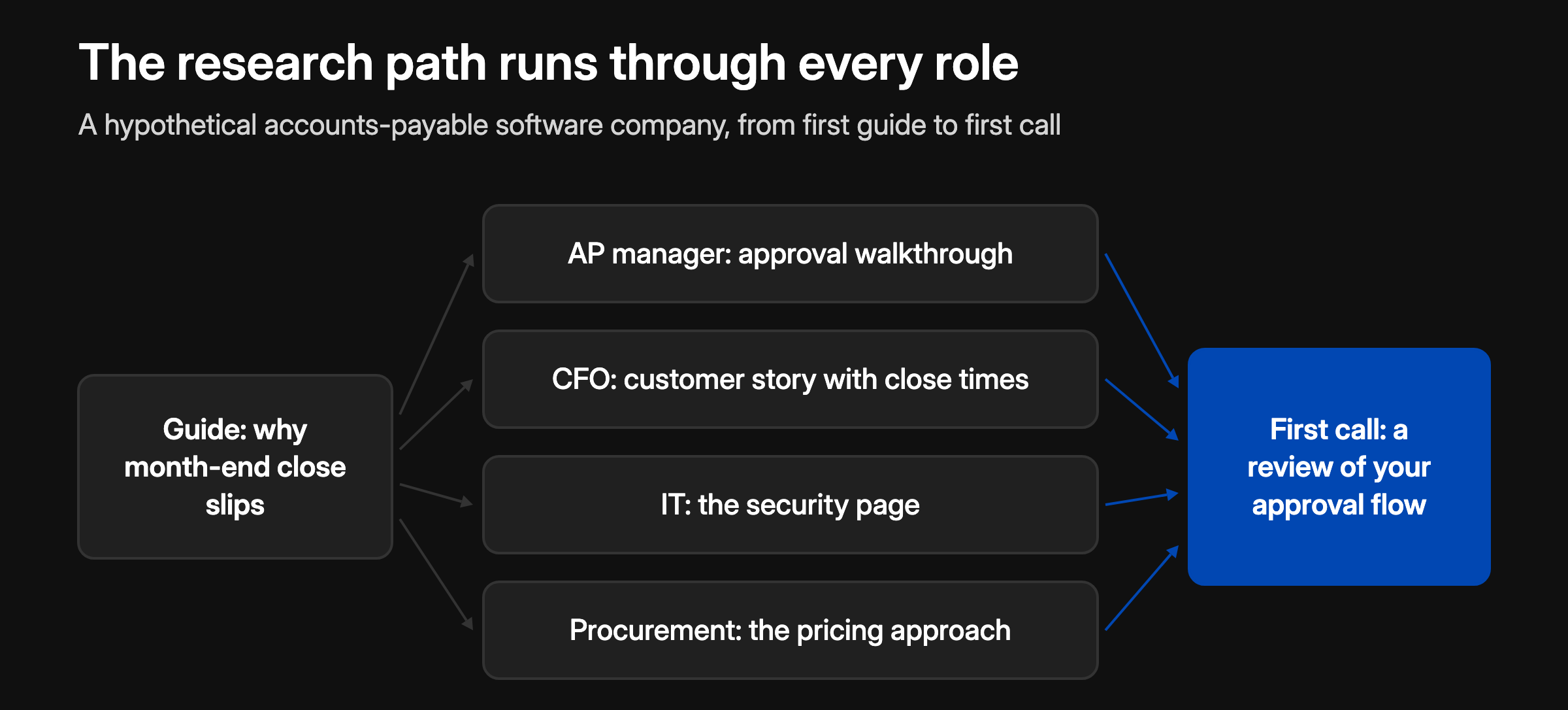
The path also has to say what your sales team says. In the 2024 survey, 69% of B2B buyers reported inconsistencies between the website and the information sellers gave them (Gartner, June 2025). So the message gets written once, for marketing, sales and whoever builds the site, and page by page it becomes the B2B website content strategy.
Measure the site by the meetings it starts
A B2B site that does its job produces first meetings, so the first meeting is the number to set up before launch. In Google Analytics 4, a booked call becomes a key event: you "create or identify an event that measures the important user interaction and then mark the event as a key event" (Google Analytics Help). If bookings happen inside an embedded calendar, make sure the booking itself fires the event, not the visit to the page.
The full set is four signals, each tied back to the map:
- One key event. A booked first meeting, counted when the booking is confirmed.
- Proof read before booking. Which case studies, security and pricing pages appear in the sessions that end in a booking.
- Returns to entry pages. Whether the guides written for buyers who aren't ready yet bring readers back.
- Questions from first calls. What buyers asked in the meeting that the site should have answered.
Review them once a month with someone from sales in the room. The questions from first calls are cheap research: each one is a missing piece of the path.
Decide before design, then hand over the build
Whoever builds the site will make a long list of small decisions about layout, copy and components, and B2B website design best practices belong to that team. What the build team can't decide for you is what the site is for and who it must persuade. In the B2B website redesign process, those decisions have to be closed and written down before the first wireframe, or the design ends up making them by default.
| Phase | Who owns it | What it produces |
|---|---|---|
| Strategy, before design | Leadership, with a strategist | The Room Map, the message, a sitemap with a verdict for every page, the brief |
| Design and build | Onward, the B2B website design agency I co-founded, or your in-house team | The site |
| Launch and learning | Marketing, with the build team | Redirects, the key event, the monthly review |
In my engagement, the strategy ends in three documents: the Diagnosis, the Direction and the Build-Ready Brief, the last one including "a handoff a team you have never met could execute" (the engagement). The Direction carries a Message Guide that "is not tied to a page design. Marketing, Sales and whoever builds the site all work from the same one." Design and development sit outside the engagement.
If you'd rather the build team already knew the decisions, Onward can take the brief from there. If the rebuild changes URLs, the redirect map belongs in the brief too, as website redesign SEO explains.
Final thoughts
No survey can tell you who sits in your buying group or which questions stall your deals. Your sales calls and your own analytics can, and the strategy is only as good as that evidence.
The order matters more than any single page. A site built before the Room Map exists gets written for the person who briefed the build team, and the people who sign the contract may never see themselves on it. If you want an outside view on those decisions, that's the work I do as a B2B website strategy consultant: three weeks that end in a brief your build team can execute.
Frequently asked questions
What is a B2B website strategy?
It's the set of decisions a B2B site is built on, the same four as in what website strategy is: what the site is for, who it must persuade, what it must say to each of them and what gets built. The B2B part is the buying group: several people research separately, at different stages, and part of the deciding happens in rooms you're not in.
Which B2B website best practices matter most?
The ones that come from decisions, before design. Give each role in the buying group proof it can repeat, give each stage of buying a next step it's ready for, and keep the site saying what sales says. Speed and accessibility matter too, but they're build-side practices, and they work best once these decisions exist.
How is a B2B website different from B2C?
A B2B purchase is decided by a buying group, and each member reads the site for a different reason: the CFO for the business case, the user for the workflow, IT for security, procurement for the contract. So a B2B site needs proof for several roles at once, and a next step for readers who are months away from a budget.
Who builds the site after the strategy?
Onward, the agency I co-founded, or your in-house team. Either way, the build starts from closed decisions: the message written, every page given a job and a verdict. If the team has to rediscover the strategy in workshops, the brief wasn't finished.
How do you measure a B2B website?
Count the first meetings it starts, as a key event fired by the booking itself, then look at what people read before they booked. Traffic and time on page tell you something only as steps toward that meeting. Once a month, add the questions buyers asked in first calls: each one the site could have answered is a page to fix.