




Growth is strange. From the outside everything looks like it's working: revenue is up, the team is bigger, there's more activity and more visibility. Internally, something feels off. You go to the website, and it doesn't quite sound like you anymore. Sales is explaining things differently on every call. The brand you launched with feels like it belongs to a different company. Why? Because it actually does. That gap between the company you are and the company your brand describes has a shape, a set of predictable symptoms, and a fix that starts somewhere most teams don't look. This article walks through all three.
Key takeaways
- The gap is normal and it is structural. The business evolves; the brand, however, stays where it was. Nobody decided that, which is exactly why nobody owns fixing it.
- It announces itself in four places. The pitch, the sales deck, day-one hires, and pricing all start contradicting the website before anyone calls it a brand problem.
- Cosmetic fixes widen it. A redesign on top of outdated positioning gets you a better-looking version of something outdated. Diagnosis comes first.
How the gap opens while everything grows
Companies scale by adding: new products, new markets, new messaging, new priorities. Each decision makes sense in isolation, but over time they create noise, and teams try to manage that noise through execution. They update the website, refine messaging, adjust visuals. Those efforts only organize the noise. They don't remove it.
That's the mechanism. The business moves forward. The brand stays fragmented. A brand typically falls behind the business in three situations: the company has expanded beyond its original positioning, the target audience has shifted toward more complex or enterprise clients, or the value proposition has evolved but the narrative hasn't caught up. All three are versions of the same brand misalignment: the company changed faster than its story, and the site no longer reflects the business it describes.
Nobody notices at first, because nothing is broken. It's gradual, even fine at first. Then prospects start asking more questions than they should, conversion drifts down, and the friction becomes measurable long before anyone names its cause.
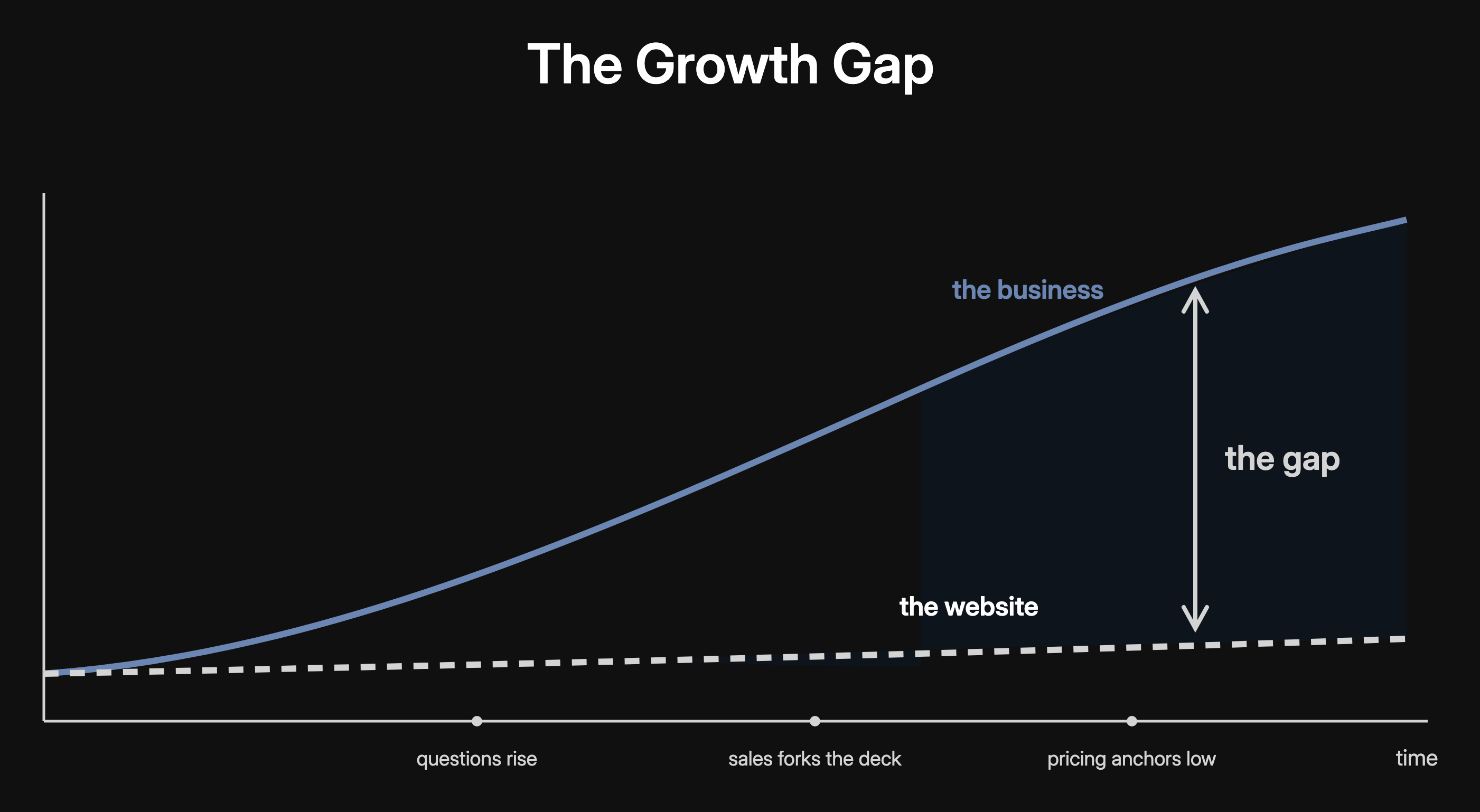
The Growth Gap and its four telltale signs
I call the distance between the company today and the company the website still describes the Growth Gap. You don't need an audit to see whether you have one. It shows up in four specific places, usually in this order.
The pitch no longer matches the homepage
Listen to how your CEO describes the company at a dinner, then read your own hero section. In a company with a closed gap, those two sound the same. In a company with an open one, the spoken version is two years ahead: new category, new ambition, new customer, while the homepage still sells the launch-era product. The spoken pitch always evolves first, because it gets tested against live humans every week.
Sales quietly rewrites the deck
When the official materials stop matching reality, salespeople don't file a complaint. They make their own slides. If every rep is explaining the company differently on every call, and the "real deck" lives in someone's personal folder, your positioning has already been forked. The market is now hearing whichever version each rep believes, and none of them match the website.
New hires meet a different company
Candidates read your site, accept the offer, and discover on day one that the actual strategy, product and customers are something else. That surprise is data. The employer story is usually the last one anyone updates, so by the time recruits feel the gap, buyers have been feeling it for months.
Pricing has outgrown the positioning
You raised prices because the product earned it, and win rates held. But the brand still signals the scrappy, affordable option, so every deal starts with the buyer's expectations anchored two tiers below your quote. When procurement asks why you cost three times what your website suggests, the gap has reached your revenue.

Why cosmetic fixes make the gap wider
The instinct is to fix what's visible, be it a new website, better design, or updated copy. It feels like progress for a while, then things drift again a few months later, because nothing underneath actually changed. Maturity is structural, not visual. If the positioning hasn't caught up, and leadership isn't aligned on what the company is now, no amount of design will fix it. You'll just end up with a better-looking version of something outdated.
There's a second version of the same mistake: adding instead of redesigning. Humin, a wellbeing organization I worked with, had outgrown a six-page site while expanding into services, tools and courses for four distinct audiences. The tempting move was to bolt new pages onto the old structure. That would have made the site harder to navigate, not easier, because the structure itself was built for a smaller company with one generic visitor. More material on an outdated frame amplifies the confusion it was meant to solve.
Both mistakes share a root: they treat the brand as the artifact. The artifact is downstream. What actually expired is a set of decisions.
Closing the gap starts with diagnosis
Building a brand that reflects where the company is now starts with diagnosis, not with visuals or copy. The way I approach it is simple, but uncomfortable. It's closer to a doctor's appointment than a creative workshop: "Where does it hurt?" "Where are things breaking?" "Where has growth outpaced the current structure?" The visible problems, like low conversion and inconsistent messaging, are usually symptoms. The real issue sits deeper, in brand misalignment: positioning that no longer fits, or teams operating on different assumptions.
Once that's clear, the question stops being what the brand should look like and becomes what the company needs to communicate now. From there, three decisions get made and written down:
- What the company stands for at this stage and what it doesn't. The second half is the hard one, and the one that makes the first half usable.
- Who it's for and who it's not for. Growth usually changed this answer while nobody was watching.
- What the next phase of growth actually requires from the brand. Not what would look current. What has to be true for the next two years of selling.
Most rebrands skip this layer because it slows things down at the beginning. It's also the only thing that prevents everything from slowing down later. I've watched the sequence work from zero: Fiscallion, a fractional CFO firm, came to me as a one-page site with a single ranking keyword. We settled positioning and structure before any design existed, and the rebuilt site went on to rank for 260 keywords and become a cited source in AI answers. The design didn't do that. The decisions did, and the design executed them. Settling those decisions is the work I do as a Website Strategy Consultant; the build then has something real to execute.
Refresh or rebrand, how to tell the difference
Not every gap needs a full rebrand. If the business model, audience and positioning still hold and only the expression looks dated, a refresh closes the distance at a fraction of the cost and risk. If the company has genuinely changed underneath, what it sells, who it serves, how it wins, then refreshing the surface just repaints the old story. The honest test and the cost math live in rebrand vs refresh; the short version is that true rebrands are the minority, and knowing which side you're on before briefing anyone is worth more than either project done blind.
Final thoughts
The strange comfort in all of this: an outgrown brand is a symptom of success. The company moved. Something had to fall behind, and the brand is simply the part that doesn't update itself. Treat the gap as evidence of progress and a queue of decisions, in that order, and it closes cleanly. Treat it as a design problem and you'll meet it again, better dressed, in eighteen months. Growth creates confusion on a schedule; the companies that handle it well are the ones that diagnose before they decorate, and when growth creates confusion covers what that sequence looks like across the whole company.