

A messaging framework is the short set of sentences a company repeats everywhere: one core message, three pillars that support it, the proof behind each pillar, and the true things you chose not to lead with. The version I write adds one line for every page of the website: which pillar that page carries.
Writing the document is the easy part. The hard part is the handoff, because the framework has to leave the workshop and come back unchanged from Sales, from the homepage and from whoever writes the next landing page. I judge a framework by that handoff, and writing one that survives it is part of my website strategy consulting.
Key takeaways
- Write it in sentences someone can say. One core message, three pillars with proof, the true things you chose not to lead with, and which pillar each page carries.
- Pillars come from sales calls. Each one settles a doubt or matches a reason buyers give in their own words. A pillar no buyer ever mentions describes your org chart.
- The hierarchy follows attention. In Nielsen Norman Group's 2018 desktop eyetracking study, people spent about 57% of their viewing time above the fold, so the core message leads and the pillars follow in the order buyers raise their doubts.
- It's finished when it travels. Marketing, Sales and the team that builds the site can each work from it without a meeting, and one owner keeps it current.
A messaging framework turns one choice into sentences
A positioning statement is the choice: who the company is for, what it is, and why a buyer should pick it over the alternative. The messaging framework is the set of sentences that carries that choice to every audience and every page. My B2B rebrand checklist sets the bar for those sentences: the core message "exists as full sentences a salesperson could say out loud."
A messaging strategy is the plan for where and when the framework gets used: which channels, which campaigns, in what sequence. In practice it decides that the sales deck opens on the core message, that each ad carries one pillar, and that the homepage follows the same order as the deck. The framework is what that plan deploys, so it comes first. A brand messaging framework is another name for the same document, stressing that it sits at company level: the one core message above every product, campaign and page.
A quick check for the framework you have today: read it aloud. If it takes more than a minute, or sounds like a list of qualities any competitor would claim, it's raw material for a framework. Cut it until a new sales hire could deliver it in their first week.
Frameworks fail at the handoff to Sales
A messaging workshop produces a deck. The deck produces agreement in the room, and then the company goes back to work: Sales keeps its own slides, the website keeps last year's copy, and the next landing page gets written from memory. Every page and deck still agrees on the claim, and each leads with different proof. If they describe different companies altogether, the cause sits a layer higher, in decisions nobody wrote down, the pattern I trace in when growth creates confusion: "Content describes one company, ads another, sales materials a third, and every team believes it's aligned because each version is reasonable on its own."
Four things kill a framework after the workshop:
- Adjectives instead of sentences. "Innovative, trusted, customer-centric" can't be said to a buyer, so nobody says it.
- Pillars that mirror the org chart. "Product, service, partners" describes departments. Buyers want answers to their doubts, and departments don't answer any.
- No page map. The framework never says which page carries which pillar, so each page writer picks a favorite.
- No owner. Nobody's job is to keep it current, so it describes the company as it was the week of the workshop.
Before you write a new framework, find the old one and ask Sales which sentence from it they used this week. If the answer is none, rewording it won't help. The next one has to be built for the handoff from the first draft.
The Message Guide has five parts
The deliverable I write is called a Message Guide: one core message, three pillars with proof, the true things you chose not to lead with, and which pillar each page carries. Split out, that's five parts, with the proof as its own part and the page map as the last one. When you compare messaging framework examples, look for the last two parts first. They're what make a guide usable outside the room.
Here's a guide for the hypothetical company from my positioning statement guide, which sells demand-forecasting software to regional food distributors:
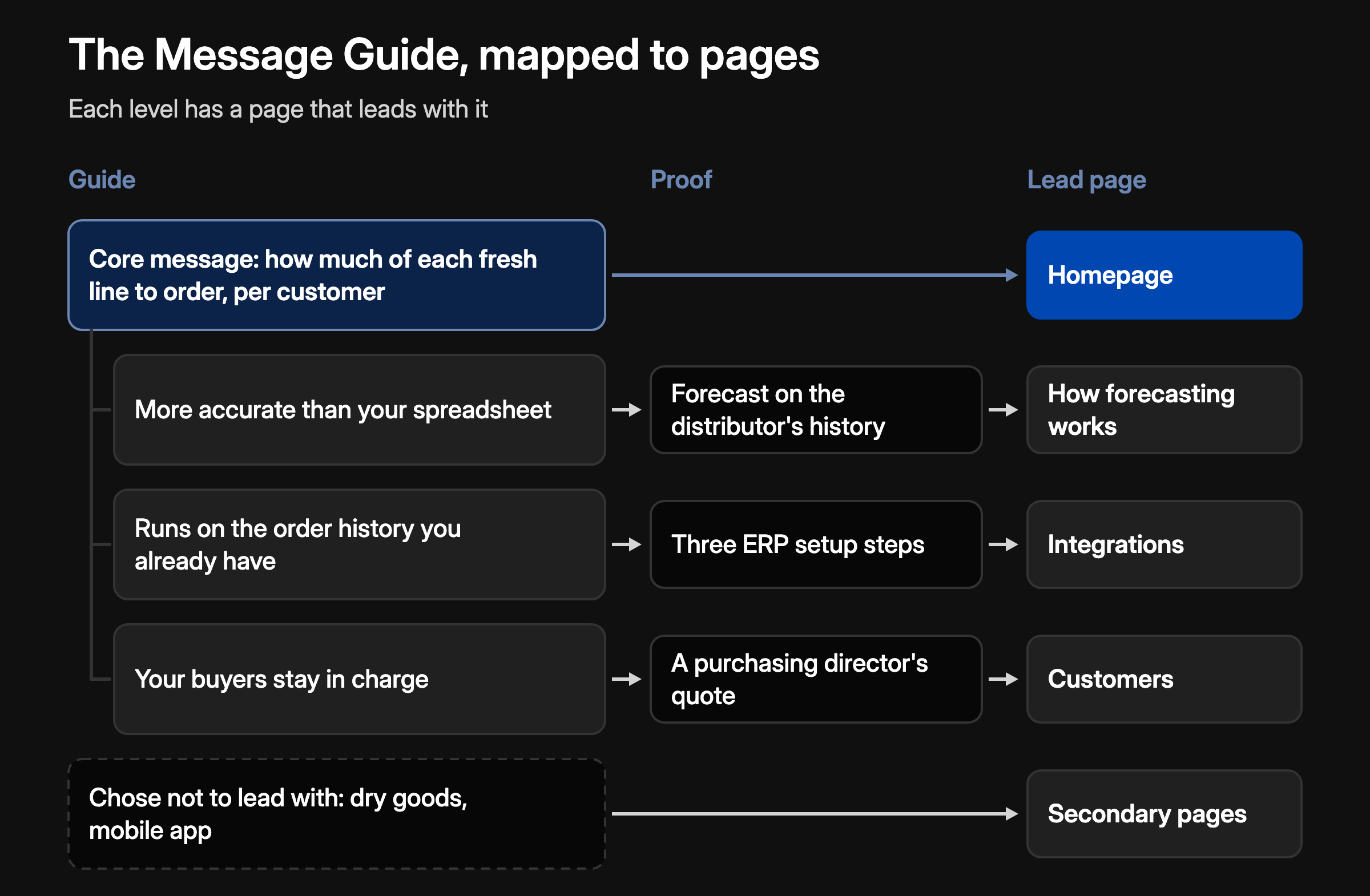
- Core message. One sentence that carries the positioning in words a buyer would use. Example: "Know how much of each fresh line to order for each customer, every day, so less of it expires before it sells."
- Three pillars. The three reasons a buyer should believe the core message. Each one matches a reason buyers give for moving forward or settles a doubt they raise. Example: "It's more accurate than your spreadsheet." "It runs on the order history you already have." "Your buyers stay in charge of every order."
- Proof for each pillar. The evidence that makes a pillar more than a claim, named by type so nobody invents it later. Example: a forecast run against the distributor's own order history, the three setup steps with the ERP, and a purchasing director describing how they override a suggestion.
- The true things you chose not to lead with. Example: it also cuts dry-goods stock, and it has a mobile app. Both are true, and neither leads, because the buyer's pain is fresh write-offs. Writing them down stops someone from rediscovering them next quarter and putting one in a headline.
- The page map. Which pillar each page carries, covered in the hierarchy section below.
Three rules keep the core message short. It's one sentence. It uses the buyer's words for the problem, the ones you hear on calls. And it carries the benefit and the difference from the positioning statement, so a reader who stops after it still knows why this company and not the alternative.
If a competitor could say your core message without lying, go back to the difference in your positioning statement.
A B2B messaging framework has one more job: the same core message has to reach several people in the buying company. The guide doesn't get a new message per role. It gets one translation per role, led by the pillar that answers that role's first doubt:
| Role | What they need to hear first | The pillar that leads |
|---|---|---|
| Purchasing director | Fewer write-offs on fresh lines | It's more accurate than your spreadsheet |
| CFO | Less cash sitting in stock that expires | It's more accurate than your spreadsheet |
| ERP owner | No new data entry and nothing to rebuild | It runs on the order history you already have |
| Buying team | They keep the final say on every order | Your buyers stay in charge of every order |
My B2B website strategy guide takes the same rows further, into the Room Map: the proof each role needs and the page that carries it. Test each part of the guide with two questions: could a salesperson say it, and could a designer place it on a page? A part that fails either one gets rewritten.
Build the guide in five steps
The order matters more than the format. Build it in this sequence, and end each step with something written down:
- Start from the positioning statement. If it isn't written, write it first. Every pillar has to serve the difference it names: prove it, or answer a doubt that stops a buyer from acting on it.
- Collect the buyers' words. Pull the reasons and doubts from your last twenty sales calls, won and lost. If calls aren't recorded, ask your three best reps to write down the last five objections they heard. Add the three versions of the company that exist today: the homepage hero, the first slide of the sales deck and your best-performing ad. The gaps between those three are the brief for the guide.
- Write the core message and say it out loud. Draft one sentence from the statement and the buyers' words, then say it to someone who doesn't work at the company. Rewrite it until they can repeat it back.
- Choose and order three pillars, then attach proof. Pick the three doubts and reasons that come up in the most calls and put them in the order buyers raise their doubts. Name the proof for each one. A pillar with no proof yet is a promise: mark it, and don't let it lead a page until the proof exists.
- Write the leftovers and the page map, then test. List the true things you chose not to lead with, assign every page a pillar or, for those leftovers, a page of its own, run the three tests further down and name the owner.
Aim for two pages. A rep preparing for a call and a designer starting a page both need to find their part in a minute.
Three messaging pillars, tested against sales calls
The number three has a precedent outside marketing. US risk communication uses the same structure and calls it a message map. The EPA's guidance for Superfund site teams describes a message map as "hierarchically organized answers to anticipated questions and concerns" and suggests they "identify three key messages to deliver to the target audience, keeping each key message to nine words or less" (EPA, Risk Communication). The tool offers its techniques as "suggestions rather than requirements," written for high-stress situations, and a buyer comparing vendors isn't in one.
The discipline still transfers: three short claims, each with its supporting facts underneath. A fourth pillar is a feature asking for promotion, so fold it into the proof of one of the three.
The messaging pillars also have to be true to the buyer, and the test is what buyers say. Take the call notes from step two and list every reason a buyer gave for moving forward and every doubt they raised, in their own words. Then put each pillar next to that list:
- A pillar that matches a reason buyers gave stays, reworded in the buyer's language if they put it better.
- A pillar that answers a doubt buyers raised stays, and the doubt becomes the question its section answers on the page.
- A pillar nobody mentions describes your org chart. Cut it or demote it to proof under another pillar.
When Sales and Marketing back different pillars, let the call notes decide and the owner sign off. In the food distribution example, "It's more accurate than your spreadsheet" survives if buyers on calls ask whether the forecast beats their own judgment. "AI-powered forecasting" fails, because no buyer says that sentence; they ask whether it's right. Order the three pillars the same way: the doubt buyers raise first becomes the first pillar on the homepage.
Messaging hierarchy decides what each page says first
A messaging hierarchy is the order the guide's parts appear in on a page, and the order matters because attention runs out. In Nielsen Norman Group's 2018 eyetracking study on desktop screens, people spent "about 57% of their page-viewing time above the fold," about 17% on the second screenful, and the remaining 26% further down (NN/g, Scrolling and Attention). NN/g notes that short pages may account for part of that, and that the spread depends on the design and on what the visitor came to do. Its conclusion, drawn from news, ecommerce, blog, FAQ and encyclopedia pages, is direct: "the closer a piece of information is to the top of the page, the higher the chance that it will be read."
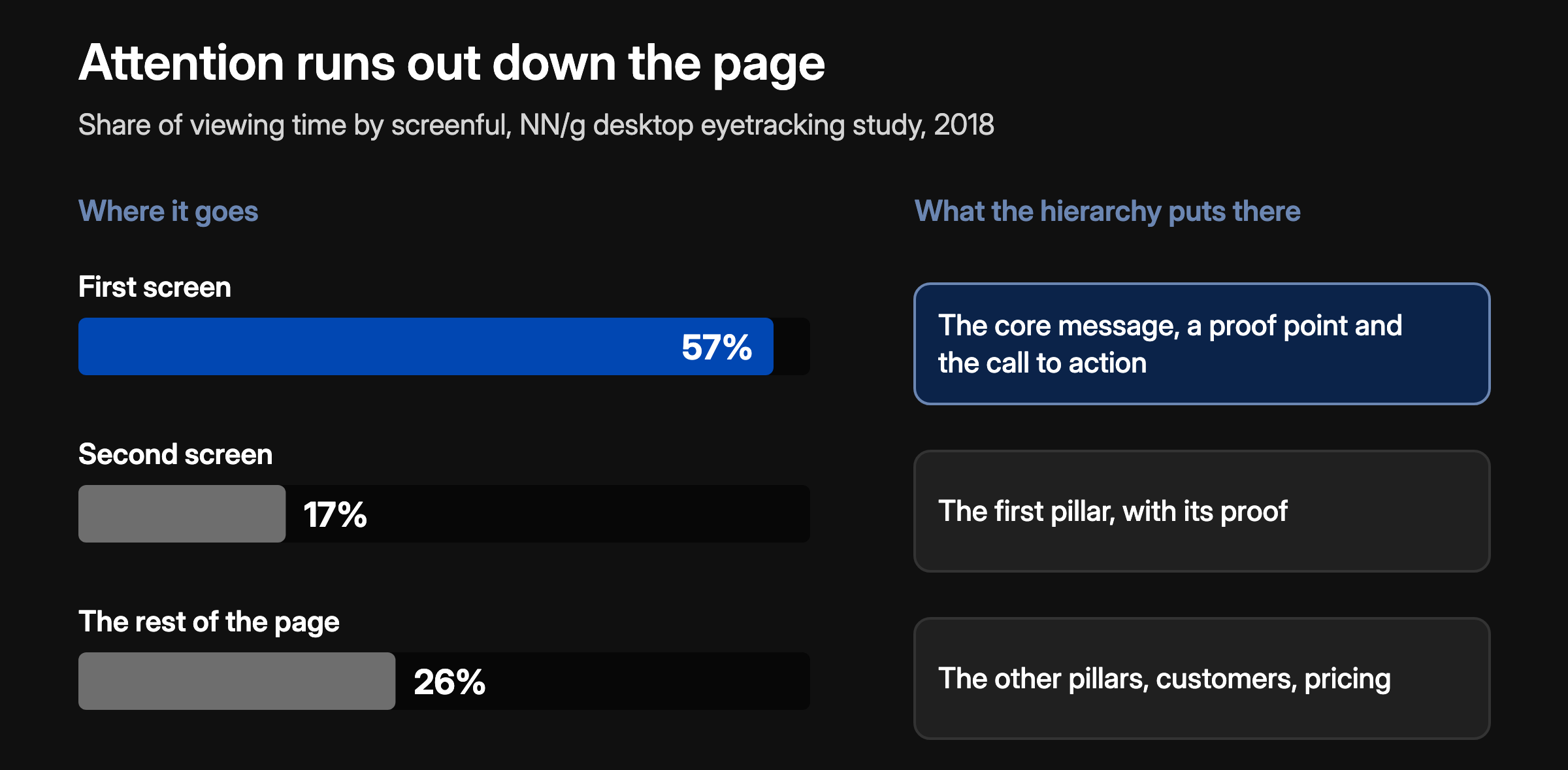
So the core message takes the first screen with one proof point and the main call to action, the pillars follow in the order buyers raise their doubts, and each pillar's proof sits right next to it.
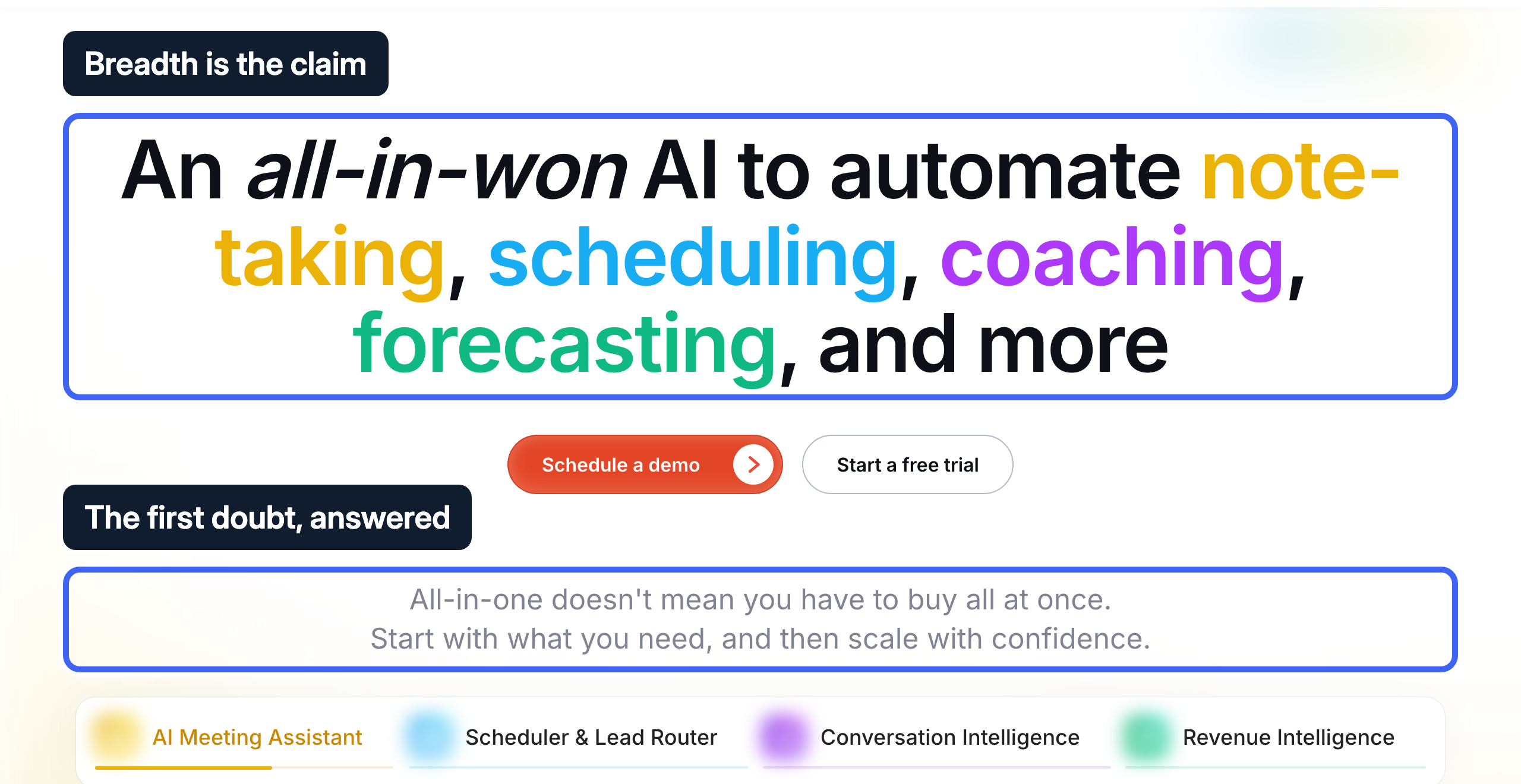
The live first screen below, names hidden, keeps that order with a broad claim. Its headline makes one claim, an all-in-one AI for "note-taking, scheduling, coaching, forecasting, and more," and the line under the buttons answers the doubt that claim raises: "All-in-one doesn't mean you have to buy all at once." When breadth is the position, that's a hierarchy. When the difference is one of those jobs, a headline like this gives it the same weight as the other three.
The rest of the site is the page map: each page leads with one pillar and carries it in depth. For the food distribution example:
| Page | Leads with | Carries |
|---|---|---|
| Homepage | The core message | All three pillars, in order: accuracy, effort, control |
| How forecasting works | It's more accurate than your spreadsheet | A forecast run against the distributor's own order history |
| Integrations | It runs on the order history you already have | The three setup steps with the ERP |
| Customers | Your buyers stay in charge of every order | Purchasing directors on how they override suggestions |
| Pricing | It runs on the order history you already have | The setup effort, next to the price |
| Dry goods, mobile app | A true thing you chose not to lead with | Its own page, never the homepage headline |
Read top-down, the example homepage runs in the guide's order:
- First screen: the hero from my positioning statement guide, which carries the core message, with one proof point under it (a line from the forecast run against a real distributor's order history) and the main call to action.
- Second screen: the first pillar, accuracy, with that forecast as its proof.
- Then the other two pillars: effort, with the three setup steps, and control, with a purchasing director's quote.
- Then customers, pricing and the call to action again.
- Lower down: links to the dry-goods module and the mobile app, never above the pillars.
Messaging architecture is the same hierarchy one level up, for a company with more than one product: a company core message, a core message per product that agrees with it, then each product's pillars. Two rules keep it together. No product page contradicts the company's core message, and an item from the "chose not to lead with" list leads only its own page, never the homepage or another product's headline.
Three tests before the guide goes live
My service page describes the Message Guide as "not tied to a page design": Marketing, Sales and the team that builds the site all work from the same one. That's the Portability Test, and it takes three checks before the website brief goes out:
- The five-second read. Write the first screen from the guide as plain text, the core message and the proof point under it, with no design. Show it to someone outside the company for five seconds, then hide it and ask what the company does, for whom, and why them. Run it with five people who match your buyer: if four of them name what you do and for whom, the first screen works. If they repeat an adjective, it's decoration. Run it again on the homepage draft before launch.
- The sales-rep test. Ask a rep to give the core message and the three pillars without slides, and record it. If what they say differs from the guide, either the guide is wrong or nobody taught it, and you can fix both this week.
- The build-team test. Hand the guide to whoever writes or designs the next page and ask which pillar the page carries and what proof goes next to it. If they answer from the guide alone, without a meeting, the guide works.
A guide that fails one of these costs a revision round. A site built on a guide that fails all three costs a redesign, because every page gets written around a different idea of the company.
One owner keeps the guide alive
The owner is the head of marketing, because they'll live with every page the guide governs, and the job is small and specific:
- Check it against sales calls every quarter. Keep a list of new doubts buyers raise and pillars nobody mentions, and use it the next time the business changes. The check runs on a calendar; the changes don't.
- Change it when the business changes. A new buyer, a new category or a new main competitor is a reason. A new campaign isn't.
- Make every new page declare its pillar. The page brief names it before a word gets written.
- Keep the "chose not to lead with" list current. When someone wants one of those items in the homepage headline, the list is the answer, and the owner decides whether it's time to change it.
Keep a change log at the bottom of the guide: the date, what changed and why. When the homepage and the sales deck disagree six months from now, the log shows which one moved first and whether anyone decided it.
Final thoughts
This article stops at the guide. The message is the third of the four decisions behind a website strategy, and the fourth, the structure, is where the page map ends up. Turning the guide into page copy is writing work, and deciding the navigation is information architecture; both go faster once the guide exists, because every page starts from a pillar. What no guide can do is choose the position it carries, and a framework written before that choice argues for a company nobody agreed on.
If you want the Message Guide written before your website brief goes out, that's part of the work I do as a B2B website strategy consultant, and the website content strategy guide shows how each page's brief builds on it.
Frequently asked questions
What are messaging pillars?
Messaging pillars are the three reasons a buyer should believe your core message, each one settling a doubt or matching a reason buyers give. Each pillar carries its own proof and leads at least one page of the site. Keep it to three, and fold a fourth into the proof of one of them. For a forecasting product they could be: it's more accurate than your spreadsheet, it runs on the order history you already have, and your buyers stay in charge of every order.
What should a brand messaging framework include?
Five parts: one core message, three pillars, proof for each pillar, the true things you chose not to lead with, and a map of which pillar each page of the site carries. Without the last two, it stays a slide that nobody outside Marketing opens.
What is a messaging hierarchy?
The order in which the messages appear: the core message first, then the pillars in the order buyers raise their doubts, then the proof and the details. On a single page it decides what goes on the first screen. Across the site it decides which page leads with which pillar. In the worked example above, the homepage runs accuracy, then effort, then control, because that's the order buyers raise them in.
How is a messaging framework different from a positioning statement?
The positioning statement is the choice: who you're for, what you are and why you beat the alternative. The messaging framework turns that choice into sentences for every audience and every page. Write the statement first, because the framework can only carry a position that has already been chosen.
Is there a messaging framework template?
The five parts above are the template. What no template can hold is the choices inside it: which three pillars, which proof, and which true things stay out of the headline. Start from your last twenty sales calls instead of a blank form, and the pillars will come with the buyers' own words attached.