
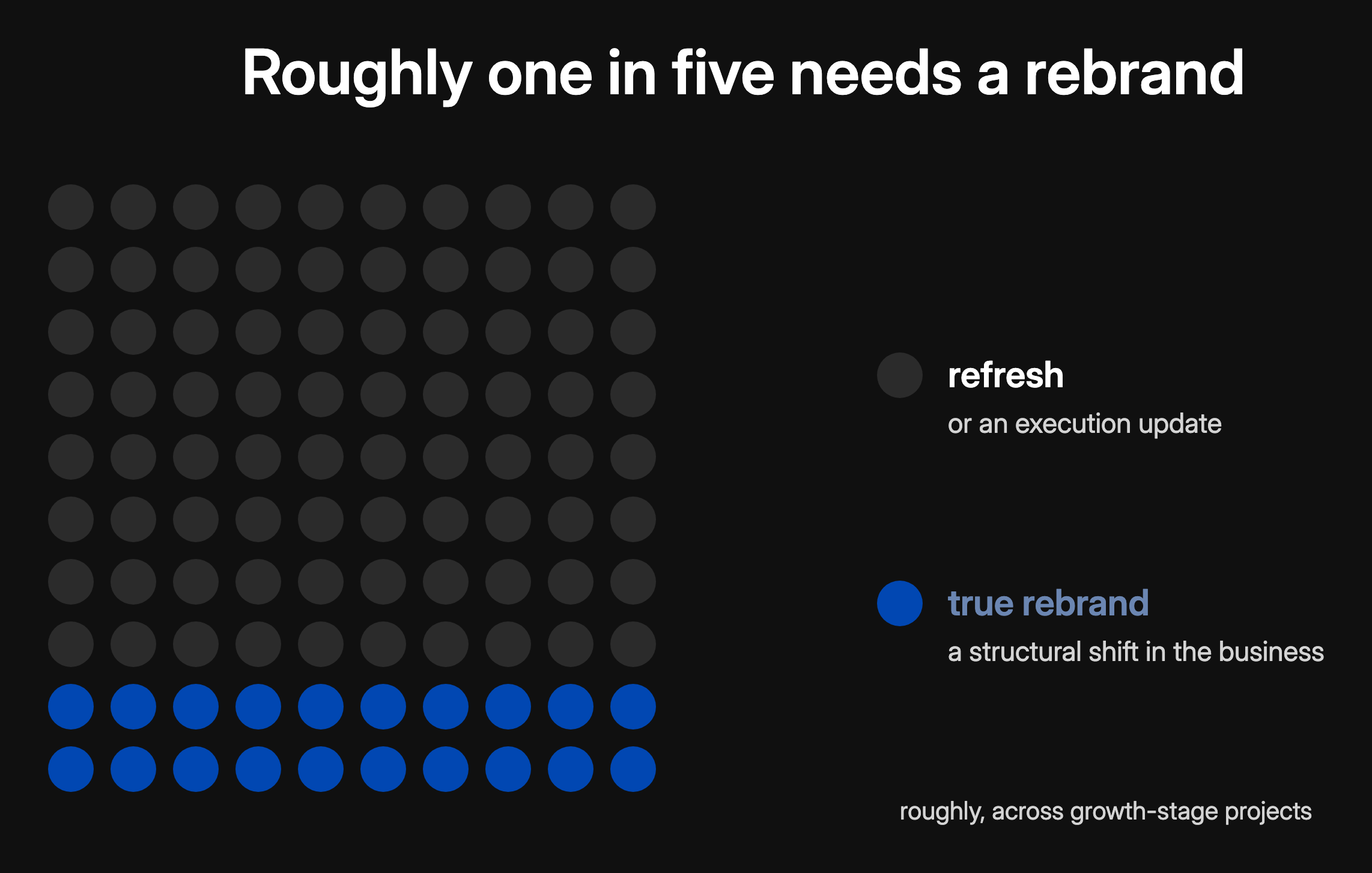
A brand refresh updates how a company looks and sounds and keeps its positioning. A rebrand changes the positioning itself: who the company is for, what it claims, and sometimes what it's called. In my experience, roughly one growth-stage company in five needs the second. The rest need a refresh, or a clearer strategy, before anyone redraws the logo.
Key takeaways
- A refresh changes the look, a rebrand changes the meaning. If positioning, audience and message still hold, you need the first.
- Most projects called rebrands are refreshes. The 20% Test below sorts them with five yes-or-no questions.
- Both wrong choices are expensive. An under-scoped refresh gets paid for twice, and an over-bought rebrand throws away recognition you'd already earned.
The trigger is real, the diagnosis is not
When companies raise capital, there is immediate pressure to signal progress. The product has evolved, the team has grown, and the market expectations have shifted. Naturally, leadership wants the brand to catch up.
But in most cases, the response is to update the visual layer (logo, website, design system), without first asking what the next stage of growth actually requires from the brand. Without answering that, teams move straight into execution. That's not a rebrand. It's a refresh, whether they call it that or not.
Rebranding after a funding round has its own timing problem.
Structural change vs visual update
A refresh is a surface-level improvement. It updates how the brand looks and feels but keeps the underlying structure intact. This can be effective when the positioning is already clear and still relevant.
A rebrand, on the other hand, redefines how the company is positioned in the market, how it communicates value, and how different functions (marketing, product, and sales) align around that narrative.
This distinction matters because execution behaves very differently depending on which path you're on. In a refresh, execution is relatively stable. You're applying a new layer to an existing foundation. In a rebrand, execution is downstream of decisions that don't yet exist.
Here's the rebrand vs refresh difference side by side:
| Brand refresh | Rebrand | |
|---|---|---|
| What changes | Visual identity, tone of voice, website structure and copy | Positioning, audience, message, sometimes the name and domain |
| What stays | Positioning, audience, name | Only what the new direction chooses to keep |
| Typical trigger | The look fell behind the business | The business changed underneath the brand |
| Who has to decide | Marketing, with leadership sign-off | Leadership, before marketing can execute |
| Main risk | Painting over a structural problem | Throwing away recognition you'd earned |
Why most rebrands are actually refreshes
From my experience, only a minority of growth-stage companies actually need a full rebrand driven by positioning. Roughly 20% of cases involve a true structural shift. The rest are primarily execution updates. The issue is that these two scenarios are often treated the same.
Teams initiate a rebrand project, hire agencies, and begin redesigning assets, assuming that clarity will emerge during the process. But if positioning hasn't been defined, execution becomes unstable. This leads to familiar patterns: messaging changes mid-project, design directions are revisited multiple times, and stakeholders introduce conflicting input late in the process. The work progresses, but alignment does not.
When a rebrand is actually needed
A true rebrand is required when the current brand no longer reflects the business. This typically happens when the product has evolved beyond its original category, the company is targeting a different type of customer, or the value proposition has fundamentally changed.
In these cases, a visual update alone cannot solve the problem. The brand needs to be realigned with the company's maturity. That means defining positioning first, before any design or development begins. Only then can execution move forward without constant rework.
Crossing that line leaves recognizable signs of an outgrown brand long before anyone calls the project a rebrand.
When to refresh vs rebrand, the 20% Test
Which side of that 20% you're on can be tested. The brand refresh vs rebrand decision guide I use in first conversations is five questions, one point for each yes, and it takes about ten minutes with the right people in the room.
- Has the business model or offer changed, beyond the look? A new product line, a platform where there used to be a single tool, services turning into software.
- Are you selling to a different buyer than the brand was built for? Moving upmarket, into a new industry, or from end users to the executives who sign.
- Does sales have to correct the website on calls? If reps spend the first ten minutes explaining what the site got wrong, the problem sits in the message, and new design won't reach it.
- Has the company outgrown its name or category? The name describes a product you no longer lead with, or the category label no longer fits what you sell.
- Would your leadership team describe what changed in different words? If three people give three answers, a new look will ship all three.
Score 0 to 2 and you need a refresh: keep the positioning, update how it's expressed, and brief it tightly. Score 3 to 5 and you need a rebrand conversation, one that starts with strategy before anyone opens a design file.
What the wrong choice costs, either way
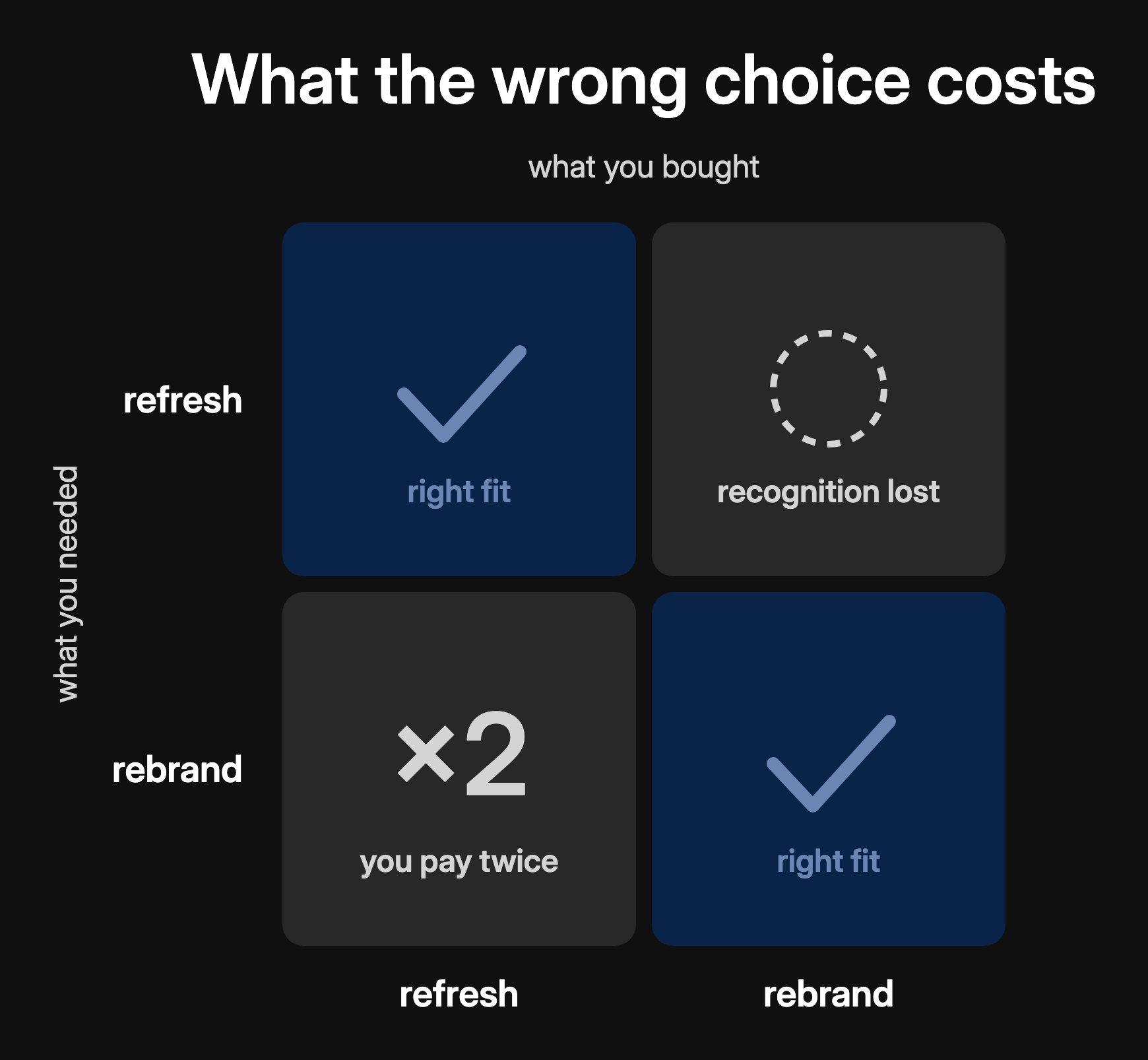
The brand refresh vs rebrand cost question usually gets answered with price ranges. The bigger cost is picking the wrong one, and it runs in both directions.
An under-scoped refresh is the common mistake. The company needed new positioning and bought a new look. For a while it feels like progress. Then sales keeps correcting the website, the message drifts again, and the rebrand happens anyway. You pay twice, and the second project starts with a team that's tired of the subject.
An over-bought rebrand is rarer and harder to undo. The positioning was fine and needed a better expression, but the company changed its name, its identity and often its domain, and recognition that took years to build went with them.
The side effects are practical too. A new domain is a site move, so you'll submit a Change of Address in Search Console and live with ranking fluctuation while Google reprocesses the site. A new logo can also fall outside the trademark you already hold: US rules allow minor changes to a registered mark, but a change that alters its overall impression counts as a material alteration and isn't permitted as an amendment, which in practice means filing the new mark separately.
Two B2B projects, one on each side
A refresh that stayed a refresh
Vertice, an intelligent procurement platform for enterprise finance and procurement teams, was a refresh from the start. The brand was staying; the website needed a clear structure and a closer fit with the brand the company already had. Elder Tuvey, Vertice's CEO and founder, put the outcome in his own words: "a site that better aligns with our brand" and "far simpler for our team to manage day to day." That's the definition of a refresh.
A rebrand that changed the name
Humin sits on the other side. In January 2026, Healthy Minds Innovations became Humin: a new name, a new domain, and a website rebuilt around a decision the old six-page site had never made. It spoke to one generic visitor while four different audiences were arriving: individuals, leaders, educators and scientists.
The new name was the visible part. The structural call underneath it, four audiences with their own paths through the site, did the work. I led the strategy, and the build started after those decisions were closed.
From January to August 2026, against the same months of 2025 in GA4, conversions rose 74% while views rose 71%, so the rebuilt site converted a higher share of a larger audience. A new logo on the old six pages would have missed both changes.
The risk of skipping the foundation
One of the most common misconceptions is that a rebrand should result in execution that doesn't need to be redone. In reality, that outcome depends entirely on whether the foundation was defined upfront.
If positioning is unclear, no level of execution quality will hold. Design, development, animation, and even SEO will need to adapt as the narrative shifts. This creates delivery risk and extends timelines. If positioning is clear, execution becomes significantly more stable. Work compounds instead of being repeatedly replaced.
What growth-stage companies should do instead
Before deciding between a rebrand and a refresh, leadership teams need to assess whether the challenge is structural or visual. That starts with alignment around market positioning, target audience, and core narrative.
If these elements are already clear and still relevant, a refresh is likely sufficient. If they are not, then the work is not design but strategy. Only after that foundation is defined does it make sense to move into execution.
Run the test with the people who own the answers. If you land on refresh, write a tight brief and protect what's working. If you land on rebrand, the next step is a B2B rebrand checklist that shows whether the decisions exist yet. Settling them before the build is what I do as a website strategy consultant.
Final thoughts
A refresh improves how the brand looks. A rebrand redefines what the brand means. Growth-stage companies often default to execution when the real need is alignment. But without a clear direction, even the best execution will struggle to deliver lasting value. Neither choice is the brave one. The right one matches what changed in the business, and the only way to know that is to ask before anyone opens a design file.
Frequently asked questions
Is a new logo a refresh or a rebrand?
Usually a refresh. A logo expresses the brand; it doesn't define it. If the positioning, the audience and the name stay the same, a new logo is a refresh, however different it looks. It becomes part of a rebrand when it's the visible end of a new direction, as when a company renames itself and needs a mark that fits the new name. Either way, check whether the new version is still covered by your existing trademark filing.
How long does a brand refresh take compared with a rebrand?
A refresh is mostly execution, so it moves at the speed of design and development against a strategy that already exists. A rebrand adds a decision phase first: positioning, audience and message have to be settled before design can start, and that phase runs on leadership's calendar. The build itself is often similar in size. What makes rebrands slower is the decision work, and what makes them late is doing it during design.
Does a brand refresh affect SEO?
Usually not, as long as URLs stay the same and pages keep the content that ranks. Refreshes that restructure the site are different, because any page that moves needs a redirect from its old address. A rebrand with a new name and domain is a full site move, which takes planning, a redirect for every URL that earns traffic, and patience while rankings settle.
Can you refresh now and rebrand later?
Yes, if you know that's what you're doing. A refresh that buys time while leadership works through positioning is a legitimate choice. It goes wrong when the refresh gets sold internally as the rebrand, because then the structural questions stay open under a newer look and come back in every sales conversation. Call it a refresh, keep the spend proportionate, and put the positioning work on the calendar.
How often should a B2B company refresh its brand?
When the expression falls behind the business, rather than on a fixed cycle. The usual signals are a website that no longer matches how sales describes the offer, visuals that look dated next to the competitors your buyers compare you with, or new products the current identity can't hold. If those signals arrive together with a new buyer or a new offer, run the 20% Test before you brief anyone.