

Website strategy is the set of decisions a website is built to execute: what the site is for, who it must persuade, what it must say, and what gets built as a result. It comes before design and development, and it's finished when those four answers are written down clearly enough that a build team could work from them without asking leadership another question. That's the whole definition. The rest of this article walks through each decision with examples from real projects, draws the line between strategy and the things it gets confused with, and shows what a finished strategy physically looks like.
A working definition, and why the order matters
Most definitions of website strategy you'll find describe a mood: aligning goals, understanding audiences, creating value. True and useless, because nothing in them tells you when you're done. A definition should be checkable, so here's mine again in checkable form: four questions, answered in writing, in order.
That's the Four Decisions framework, and the order is the part people skip. Every decision depends on the one before it. You can't choose a message until you know who has to believe it. You can't rank an audience until you know what the site is supposed to accomplish. Teams that start with structure ("we need a new homepage, three product pages and a pricing page") are answering question four first, which quietly outsources questions one through three to whoever designs those pages.
In practice, a finished b2b website strategy answers a short, unforgiving list: the site's one job; who must be persuaded first; what they need to believe, and in what order; what we claim and what we prove; which pages exist, and why each; what gets cut; what success looks like, in a number. Ten minutes against that list tells you whether a strategy exists in a company, whatever the deck says.
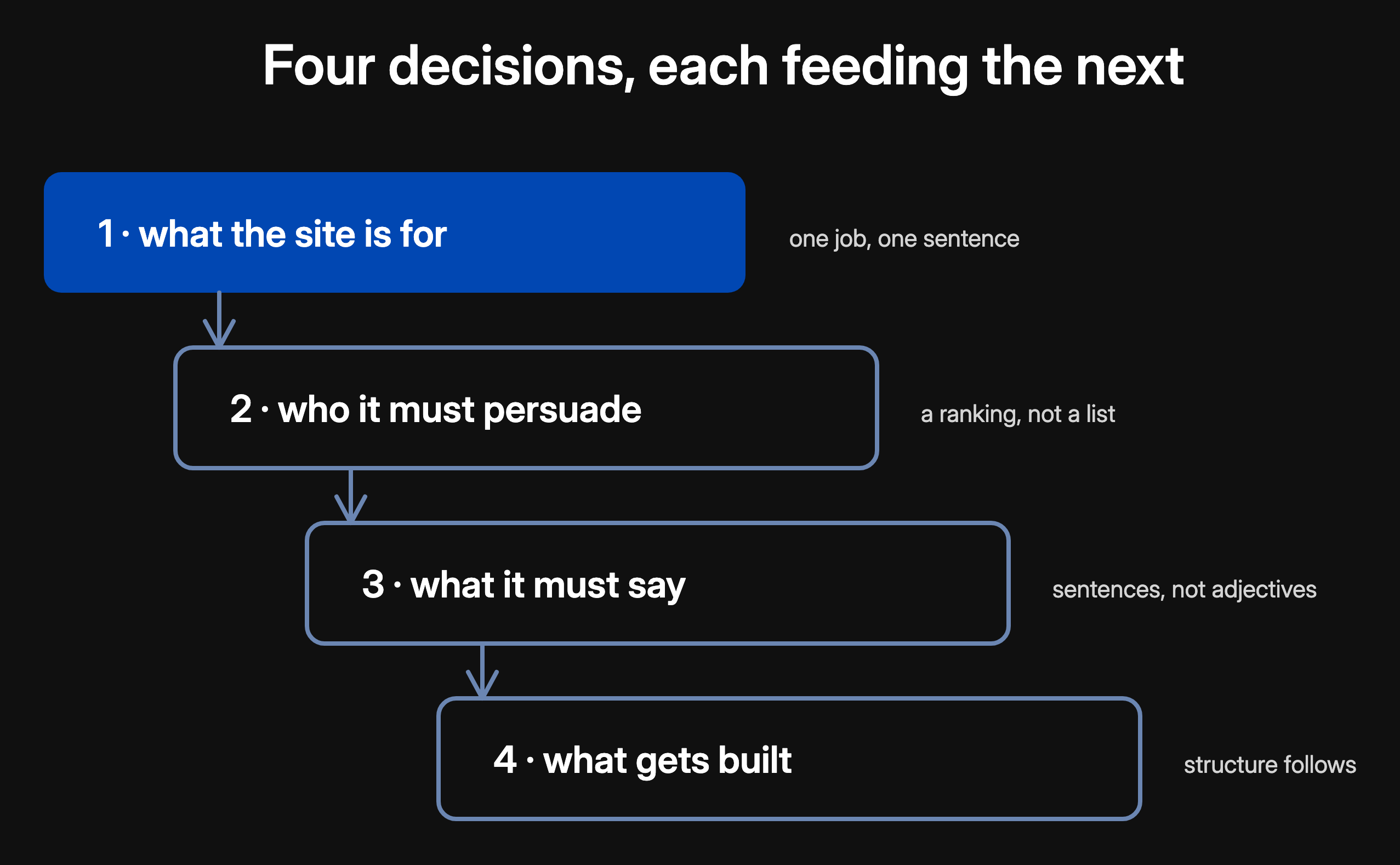
The four decisions, one by one
What the site is for
One job, stated in one sentence. Generate qualified demos. Prove enterprise credibility to buyers arriving from sales conversations. Reposition the company in a new category. A site can do several things, but it can only lead with one, and every page argues about hierarchy until that call is made. When Sedric, a compliance platform I worked with, made this call, the answer reshaped everything downstream: the site's job was to convert a qualified compliance buyer, not to greet every industry that might wander in.
Who it must persuade
Not a list of audiences, a ranking. The honest version of this decision hurts a little, because ranking means someone loses. Humin, a wellbeing organization, discovered during this decision that it wasn't serving one generic visitor but four distinct audiences, individuals, leaders, educators and scientists, each arriving with a different question. The strategy wasn't "serve everyone"; it was naming the four and structuring for them deliberately instead of averaging them into nobody.
What it must say
The message, written in sentences a salesperson could actually speak. What do we claim, what do we prove it with, and what do we deliberately not say. This is where positioning becomes copy-adjacent: if the message survives being read aloud to a skeptical buyer, it's ready; if it's a paragraph of category adjectives, it's decoration. The message gets written before pages exist, because pages are containers for it, not the other way around.
What gets built
Only now, structure: which pages exist, what job each one has, what gets killed. The sitemap stops being a list inherited from the old site and becomes an argument, every page justified by the three decisions above it. This is also where the strategy meets the b2b website redesign process, which takes these closed decisions and runs them through design and build on a schedule.
One company through all four decisions
Fiscallion, a fractional CFO firm, ran the full sequence from the least promising start: a one-page website with a single ranking keyword. Decision one, the job: make a considered, high-trust service findable and legible to founders researching before they buy, not close them on the first visit. Decision two, the audience: founders of funded tech companies first; others could be served, but they wouldn't shape the site. Decision three, the message: in a category where every firm sounds interchangeable, the call was to be clearer rather than louder, answering the buyer's questions in the order they ask them. Decision four, the structure: a homepage answering who we help, what we offer and why us, in that order; a services page with its own proof; a who-we-help page; and a blog with one job, ranking for the precise finance questions those founders ask.
Fourteen months later the site held 260 ranking keywords, up from one, and had become a cited source in AI answers. Read the four decisions again and notice what's missing: nothing about colors, layouts or animation. That's the division of labor working. Strategy decided what had to be true, and design made it real.
What website strategy is not
The term gets stretched over everything adjacent, so here's the fence.
- Not a design direction. Moodboards and visual references express decisions; they can't source them. Design that starts before the four answers exist is answering them by default.
- Not an SEO audit. An audit finds technical and content problems on the site you have. Strategy decides what site you should have. You can execute a flawless audit on a site that shouldn't exist in its current shape.
- Not a brand book. Guidelines govern how things look and sound. They're usually silent on what the site is for, who comes first, and what each page must prove.
- Not wireframes. Wireframes are the first execution of a strategy. When they're used to discover the strategy, every review becomes a leadership meeting with a designer held hostage.
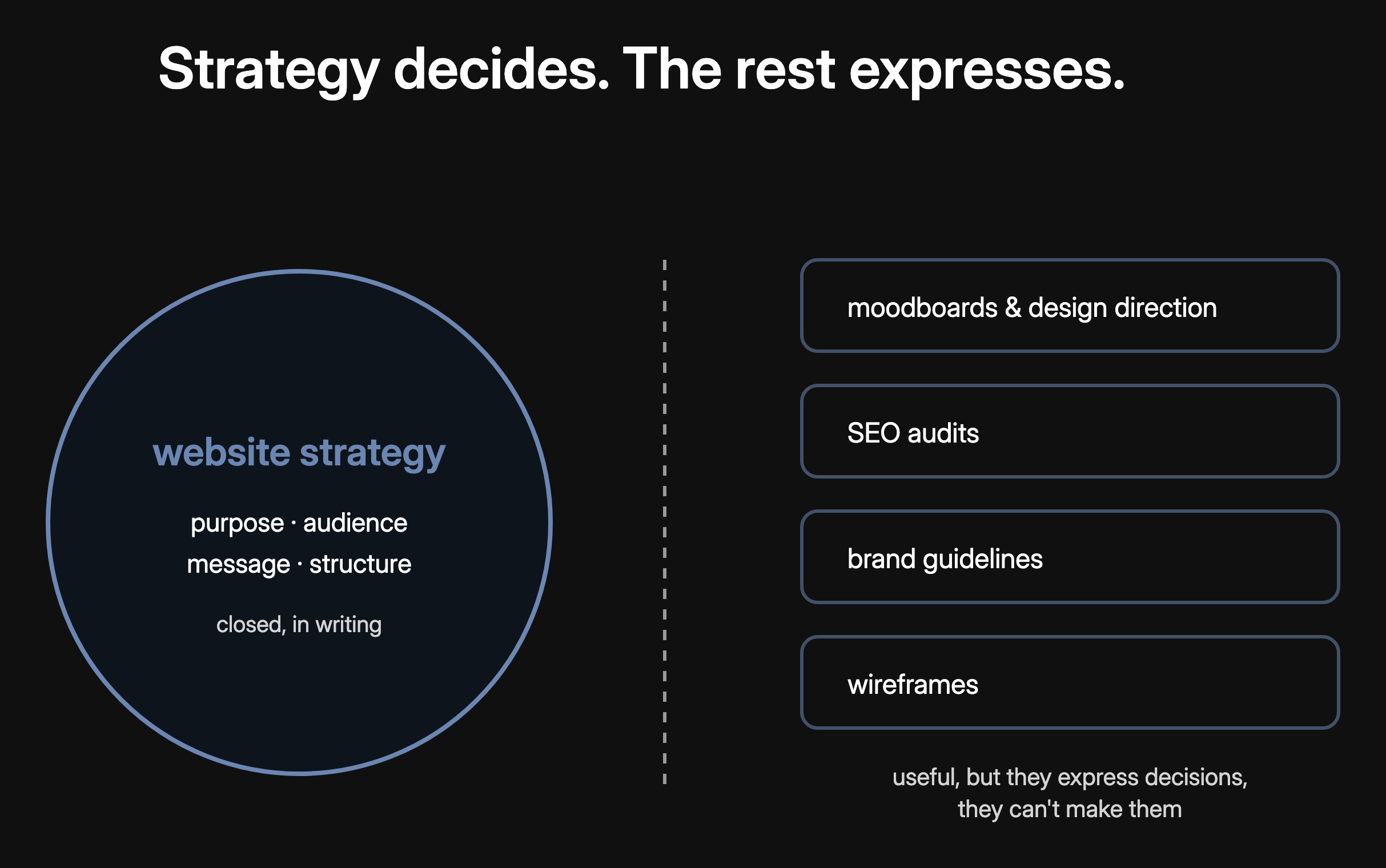
Where it sits among the other strategies
Website strategy inherits from above and dictates below. Above it sit business strategy (where the company plays and how it wins) and brand strategy (what it stands for and how it sounds). Website strategy doesn't reinvent those answers; it borrows and sharpens them for one asset with one job. Below it sit the channel tactics: SEO, paid, content, CRO, all of which perform against whatever the website gives them to work with.
That position explains a pattern every marketing leader has seen: channel work that keeps underdelivering no matter who runs it. The usual suspect isn't the channel, and it isn't the vendor. It's the layer above, sending qualified traffic into a site that never decided what it's for. Fixing the strategy layer is why the same roster of vendors suddenly performs, a mechanism working with multiple marketing vendors takes apart in detail.
What a finished strategy physically looks like
Deliverables vary by consultant, but the test doesn't: at the end, artifacts exist that another team can execute. In my engagements that means a written diagnosis of what the site needs to do, a direction the company has agreed to (positioning, ranked audience, message), and a build-ready brief: the structure mapped page by page, each page with a stated job and priority. Paper, not vibes. The measure of every artifact is the same question: could a competent build team start tomorrow without asking leadership anything?
If the answer is no, the strategy isn't finished, however thick the deck is. If the answer is yes, execution stops being the place where the company argues with itself, which is where most website budgets actually go, as execution without direction shows in painful detail.
Who does the work, and when
The decisions belong to leadership: positioning and audience calls can't be delegated below the people who own the business, and they can't be outsourced to the build vendor, who will resolve every ambiguity in favor of shipping. What can be brought in is someone to run the process: force the questions into the open, close them on a deadline, and write the results into an executable brief. That's the seat I work from as a Website Strategy Consultant, deliberately separate from the build so the strategy has no incentive to inflate it.
Timing is simpler: before design starts. The strategy phase is weeks when the owners are in the room, and it's the cheapest insurance the project can buy, because every question it closes is a revision round that never happens.
Final thoughts
Categories get muddy when a term means everything, and website strategy has been meaning everything for years: audits, moodboards, workshops, decks. The definition that survives contact with a real project is narrower and more demanding. Four decisions, in order, in writing, executable. Everything else on the project is either input to those decisions or execution of them, and naming which is which is half the clarity a project needs.
Key takeaways
- Website strategy is decisions, not documents about decisions. Research, audits and workshops feed it; only closed answers count as output.
- The four decisions have an order. Purpose feeds audience, audience feeds message, message feeds structure. Running them backwards is how sites end up beautiful and vague.
- It's finished when it's executable. The test of a strategy isn't insight, it's whether design and development can run without reopening leadership questions.
Frequently asked questions
What's the difference between website strategy and web design?
Strategy decides what the site is for, who it must persuade, what it says, and what gets built. Design decides how those decisions look and behave on screen. The confusion comes from sequencing: when strategy is missing, designers inherit its questions and answer them visually, which is slower and more expensive than answering them on paper. Good design executes strategy; it can't substitute for it.
How is website strategy different from brand strategy?
Brand strategy settles what the company stands for across every touchpoint: positioning, values, voice, identity. Website strategy applies and sharpens those answers for one asset with one job. They overlap at positioning and message, and a strong brand strategy makes the website work faster. But a brand book alone won't tell you which pages exist or what each must prove, and that gap is where website strategy lives.
How long does website strategy take?
Weeks, not months, if the decision owners participate. Two to four weeks is a realistic range for a growth-stage B2B company: enough time to diagnose, put ranked options on the table, and close the four decisions in writing. What stretches it is treating the questions as discoverable by research alone. Research informs the answers; only leadership can close them, so calendar time tracks their availability.
Who should own website strategy internally?
One named person with authority to close positioning questions, usually the marketing leader, backed explicitly by the CEO. Committees can advise; they can't own, because a decision with two owners reopens under pressure. The owner's job isn't having every answer, it's forcing each question to a close and defending the closed ones through design reviews.
Can a small company skip website strategy?
A five-person company with one product and one audience carries the strategy in its founder's head, and writing it down might take an afternoon, so the formal process would be overkill. The skip stops working at the first moment two people disagree about what the site should say. That disagreement is the signal: the strategy now needs to exist outside anyone's head, whatever you call the process that gets it there.