
Brand architecture is the set of rules for how a company's brands and sub-brands relate: which name leads, which names support it, and which products stand alone. David Aaker and Erich Joachimsthaler defined it in California Management Review as "an organizing structure of the brand portfolio that specifies brand roles and the nature of relationships between brands" (The Brand Relationship Spectrum, 2000).
In a B2B company the question arrives with a new product line or an acquisition, and the answer ends up on the website whether anyone decides it or not: in the menu, the domains and the product pages. The website half of that answer (which pages stay, merge or redirect and where each product sits in the sitemap) is part of my website strategy consulting.
Key takeaways
- It decides which name leads. Brand architecture sets the role of every brand you own, and the website shows the answer in its menu, its domains and its product pages.
- There are four models. A branded house, sub-brands, endorsed brands and a house of brands, from one master name to fully separate ones.
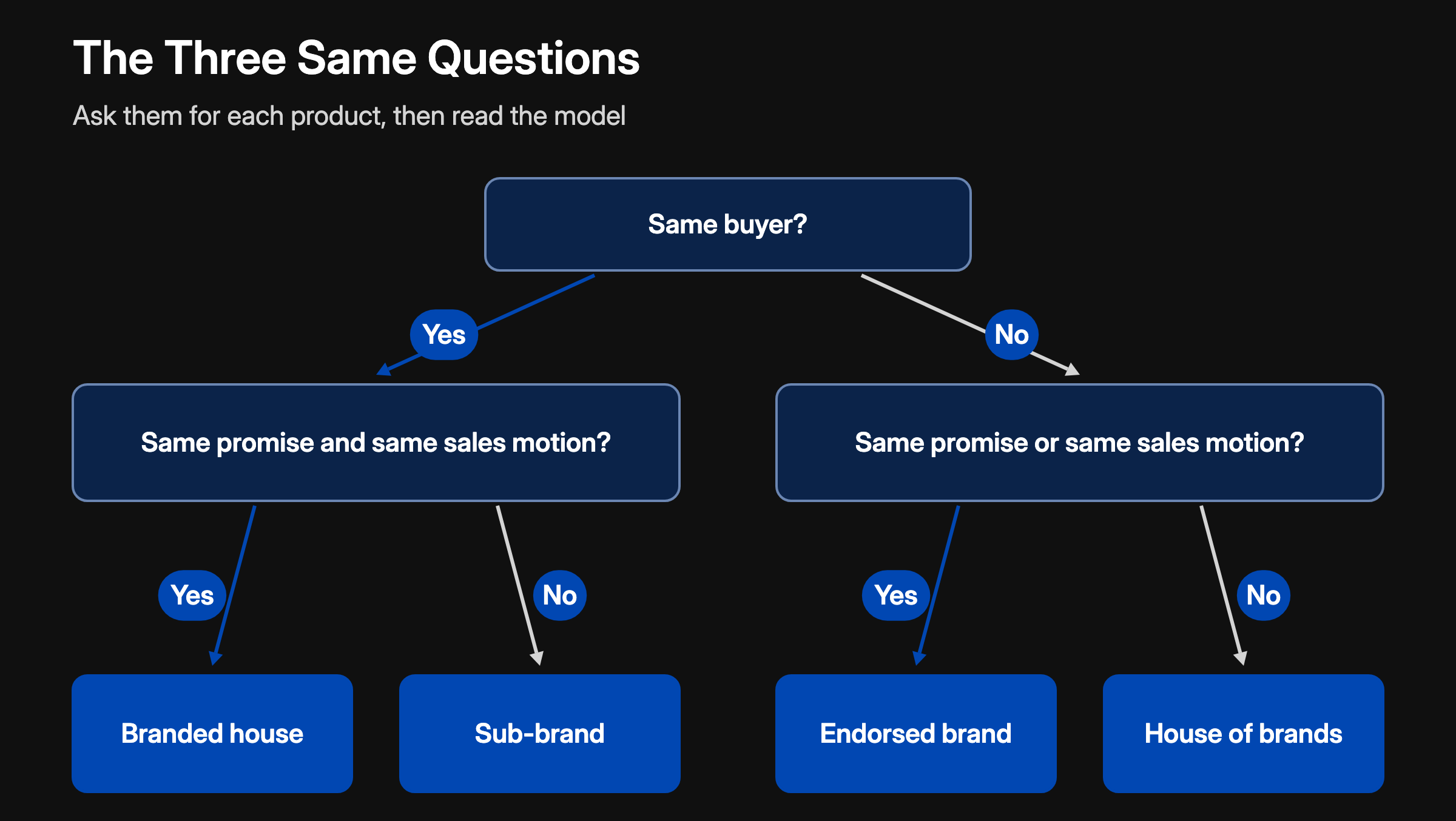
- Three questions pick the model. Same buyer, same promise, same sales motion: three yes means one master brand, three no means a separate brand.
- Decide it at the deal. An acquisition or a new product line is the moment to write the decision down, before the press release and the redesign.
Brand architecture decides which name leads
What is brand architecture in practice? A decision about names, made once and applied everywhere. Every product, page and domain inherits it, down to the logos and the sales deck.
A brand portfolio is the list of what you own. The architecture is the set of relationships between the items on that list. Aaker and Joachimsthaler's article introduces a "brand relationship spectrum" to help strategists with "subbrands, endorsed brands, and their alternatives." The four models below are those choices.
A quick test for your own company: list every product name on your website and in your sales deck. If two people on your team would draw different family trees from that list, the architecture hasn't been decided yet. It has only accumulated.
Brand architecture comes in four types
The types of brand architecture run along one line, from one master brand to fully separate brands. Here is each one as a buyer meets it, with brand architecture examples from the companies' own pages, read on 20 November 2026.

Branded house. One master brand, and every product named by what it does. The buyer meets one company, one site and one login.
Sub-brands. The parent's name leads and the product's name follows. Twilio's login menu lists "Twilio SendGrid" and "Twilio Segment". When it closed its acquisition of SendGrid in 2019, Twilio said SendGrid "will operate as a wholly owned subsidiary of Twilio" (Twilio), which settled ownership, not the name. Today SendGrid's old homepage redirects to a page on Twilio's own site, whose headline says the two "moved in together."
Endorsed brands. The product keeps its own name and its own site, and the parent appears as its backer. Trello runs on its own domain, with Atlassian's name in its logo and "Copyright © 2026 Atlassian" in its footer. When Atlassian announced it was buying Loom in October 2023, it said "Loom will remain available as a standalone product" and promised to integrate it "across our suite of tools" (Atlassian). Atlassian's software page now lists Loom next to Jira and Confluence.
House of brands. Separate brands with no visible parent: each has its own name, site, story and budget, and the buyer may never learn they share an owner. It fits products the parent's name can't help sell, like the restaurant app in the worked example further down.
One company can run more than one model. When Salesforce closed its acquisition of Slack in 2021, it said "Slack will continue to operate under the Slack brand" (Salesforce). Slack still runs on its own domain, with "a Salesforce company" in its footer, while Salesforce's products page lists it alongside Agentforce, Tableau and MuleSoft and names its core apps by job: Sales, Service, Marketing. Salesforce also runs a Slack section on its own site, as Atlassian runs a Loom page on its own, so an endorsed brand can keep its own site and still have a page on the parent's.
The live product menu below, with the company name hidden, shows how a branded house names its products: six of them, each a business function plus the same suffix, under one master name. A menu shows the naming, not who signs for each product.

These companies' pages show the result, not the reasoning, so I don't run the Three Same Questions for any of them. Write the current model next to each of your products. If your company ends up with three models and no rule for choosing between them, the rule further down gives you one.
The branded house trades freedom for borrowed trust
Branded house vs house of brands comes down to what each product borrows and what it pays for. A branded house lends every product the parent's name, site and proof, so a new product starts with trust it hasn't earned yet. The price is that every product has to keep the parent's promise. A house of brands lets each product make its own promise to its own buyer and charges it for that freedom: its own site, its own search presence, its own proof and its own budget.
| Model | Site | Site name Google can show | Proof | Menu |
|---|---|---|---|---|
| Branded house | One site, products in sections | The parent's | Shared | One product menu |
| Sub-brands | One site, a section per product | The parent's | Shared, plus the product's own | Products listed under the parent |
| Endorsed brands | The product's own domain | The product's own | Its own, with the parent as backer | A link out from the parent's menu, or a page about it on the parent's site |
| House of brands | A domain per brand | Each brand's own | Its own | An "Our brands" page, if anything |
The trade is real money. Every separate brand needs a site, a content plan and proof of its own. If you can't fund that for a product, it needs the parent's name. It also runs the other way: in a branded house, one product's problem lands on every product.
The Three Same Questions pick the model
This is the brand architecture framework I use, and it takes three questions per product. Same buyer: does the same role, in the same kind of company, sign for it? Same promise: does it deliver the result the parent brand is known for? Same sales motion: is it sold by the same team, on the same kind of contract?
In B2B, read "buyer" as the role that chooses and signs, not every user: two products used by different teams still share a buyer when they're sold as one platform, on one contract, and the same person signs for it. The answers map to the four models:
- Three yes: branded house. A descriptive name under the master brand.
- Same buyer, one or two no: sub-brand. The parent's name first, the product's second.
- A different buyer, at least one yes: endorsed brand. Its own name, with the parent named as the backer.
- Three no: house of brands. A separate brand.
Here's the rule run on the hypothetical demand-forecasting company from my positioning statement guide, which sells to purchasing directors at regional food distributors, as it adds four products:
| What it adds | Same buyer? | Same promise? | Same sales motion? | Model |
|---|---|---|---|---|
| A purchase-order module that drafts supplier orders from each fresh-line forecast, for the buyer to approve | Yes | Yes | Yes | Branded house: a descriptive module name |
| A self-serve write-off dashboard for the same buyers, paid monthly by card | Yes | Yes | No | Sub-brand: the parent's name first |
| An acquired route-planning tool for the same distributors' logistics managers, sold by the same reps on a contract the logistics manager signs | No | No | Yes | Endorsed brand: its own name, backed by the parent |
| An acquired point-of-sale app for restaurants, sold self-serve | No | No | No | House of brands: a separate brand |
The purchase-order module passes all three: the same purchasing director signs for it, it delivers the parent's promise of less fresh stock expiring, and the same reps sell it on the same contract. It gets a descriptive name and a place in the existing product menu. The write-off dashboard reaches the same buyers with the same promise, but on a card and without a rep, so the parent's name leads and the product's name follows.
The route-planning tool keeps its own name because its buyer, the logistics manager, may never have met the parent; the shared reps and the same kind of contract are the reason to say who backs it. The point-of-sale app shares nothing a restaurant owner would recognize, so it stays a separate brand.
The dry-goods module from my messaging framework guide fits the rule too: same buyer and same reps, but a different promise, so under the rule it's a sub-brand, on the page of its own that guide already gives it.
Run the questions per product, not once per company, and run them again when a product's buyer changes. Then run the website test: for every product that comes out endorsed or house of brands, decide what the parent's menu does with it (a link out, a page on the parent's site or nothing at all) and write it down before anyone designs that menu.
Five signs nobody decided the architecture
- Three naming patterns in one menu. Some products carry the parent's name, some carry their own, some carry both, and nobody inside the company can state the rule.
- Nobody can say which site is the product's home. The acquired product's old site and a page on the parent's site both stay live, say different things, and neither tells a buyer where to go.
- The footer stacks logos. Every brand the company owns sits at the bottom of every page, because nobody decided which ones the buyer needs to see.
- Sales renames products. The deck and the proposals use names the website doesn't, or the other way around.
- Nobody owns the acquired site. It still runs, nobody updates it, and nobody can say whether it should redirect.
Two or more of these, and the architecture is being decided page by page by whoever touches the site next.
Decide it at the deal, before the redesign
In B2B the question arrives with a deal: an acquisition, a new product line, or a raise that funds both, the moment I describe in when fintechs should rebrand for growth. The three acquisitions above show three different answers. Salesforce and Atlassian stated theirs at the deal, keeping Slack's name and keeping Loom as a standalone product. Twilio stated ownership at the deal, and its site shows the brand today: "Twilio SendGrid" in the login menu, with SendGrid's old pages redirecting to Twilio's site.
None of these is right for every company, but each is a choice someone made and made visible.
Write the architecture decision into the deal plan, as one page with five lines:
- the model, from the Three Same Questions;
- the product's name, and where the parent's name appears on it;
- the domain: kept, folded into a section of the parent's site, or redirected;
- the date the old site redirects, or the reason it stays;
- who owns the product's pages after the deal closes.
What the architecture changes on your website
The menu shows the model first. A branded house has one product menu. Sub-brands sit inside that menu under the parent's name. An endorsed brand gets a link out to its own site or a page on the parent's. A house of brands gets, at most, a link from an "Our brands" item. If you need that page, give it one job: send each buyer to the right brand's site, with one line per brand saying who it's for.
Domains decide what a buyer sees in search. Google's documentation says: "Currently, Google Search only supports one site name per site, where a site is defined by the domain or subdomain. Google Search does not support site names at the subdirectory level" (Google Search Central). So a sub-brand in a section of the parent's site appears under the parent's site name, which Google generates automatically. A product on its own domain or subdomain can appear under its own, though a subdomain without WebSite structured data on its home page may get the parent domain's site name instead. That matters when buyers still search for an acquired product by its old name: after the move, their result carries the parent's site name.
Product pages follow the same rule. In a branded house and under sub-brands, a product page borrows the parent's proof: its customer logos, its security page, its reviews. An endorsed product's site carries its own proof and names the parent as the backer, the way Trello's logo carries Atlassian's name. A house of brands keeps the parent off the page, so each brand needs proof it earned itself.
Bringing a brand's site into the parent's, the way SendGrid's pages were, is a site move. Google's guidance is that "301 and other permanent redirects don't cause a loss in PageRank," that a domain change, a new CMS and a new layout should happen "one at a time," and to "expect temporary fluctuation in site ranking during the move" (Google Search Central). The full checklist is in how to redesign a website without losing SEO.
Then the words follow the names. Every brand that keeps its own name needs its own positioning statement, and the messages nest the way the brands do. Under one master brand, that's the messaging architecture from my messaging framework guide: a company core message, a core message per product that agrees with it, then each product's pillars. An endorsed or separate brand gets a Message Guide of its own.
Final thoughts
This article stops at the architecture. Choosing the names, clearing trademarks and designing the navigation are separate jobs, and so is a rename, which my guide to B2B rebranding covers. What the architecture gives those jobs is a rule, so the next acquisition or product line doesn't reopen the argument. If you want the website side settled before the brief goes out (every product's place in the sitemap and every redirect), that's part of the work I do as a B2B website strategy consultant.
Frequently asked questions
What is brand architecture and what is its purpose?
It's the structure that decides how a company's brands relate: which name leads, which names support it and which stand alone. Its purpose is to make every new product, page and domain a decision the company has already made, so buyers meet one clear company or several deliberate ones.
What is the difference between brand architecture and a brand portfolio?
The portfolio is the list of brands a company owns. The architecture is the set of relationships between them: which one leads, which ones back others and which stand alone. Two companies with the same portfolio can run different architectures.
What is a sub-brand?
A product name that sits under the parent's name, with the parent leading, as in Twilio SendGrid. A self-serve add-on sold to the same buyers by card instead of through a rep is one. A subsidiary brand can be a sub-brand, an endorsed brand or a fully separate one, depending on how visible the parent is on its name, site and materials.
Can you change brand architecture later?
Yes. A separate brand can move to an endorsement and later to a sub-brand when its buyers converge with the parent's. Each move is also a website change with redirects, so plan it like a migration, one change at a time. Write the move into the same one-page decision as the original choice, so the next team knows why the brand changed level.
Does brand architecture affect SEO?
Through the domains it chooses. Google currently shows one site name per domain or subdomain, so a product in a section of the parent's site appears under the parent's name, and moving a brand's site into the parent's is a site move that needs permanent redirects. The architecture decides which of those you sign up for.