

Here's an awkward fact about this topic: nearly every guide to choosing a rebranding agency was written by a rebranding agency, and their selection criteria have a way of pointing at their own strengths. Onward, the agency I run with Sergej Spirovski, does this work, so I know the genre from the inside. This is the other version, written from the strategy seat, where I don't win the build either way. It covers what to settle before you evaluate anyone, the specialized-versus-generalist question for B2B, five answers any serious partner owes you, and the red flags no agency will print about itself.
Key takeaways
- Agency selection is not the starting point of a rebrand. It is a downstream consequence of strategic clarity. Run it before positioning is settled and the agency inherits decisions it was never positioned to make.
- The portfolio answers the wrong question. It shows how their work looks, not whether it worked, and not how they behave when your direction is ambiguous.
- Five concrete answers separate partners from vendors. Decisions made, artifacts delivered, your team's time, explicit exclusions, and portability of the output.
The hidden risk behind agency selection
Most agency evaluations focus on surface-level signals: portfolio quality, visual style, past clients, and process decks. These are useful, but they don't address the core risk. The real question is not whether an agency can design a strong brand or build a high-quality website, but whether they can operate within a clear and stable strategic direction. In many cases, that direction does not exist yet.
What usually happens is this: leadership teams move into agency selection before aligning on positioning. The agency is then expected to figure it out during execution. That's where projects begin to drift. I've watched the pattern from inside the build: an agency brought in to modernize a site starts with a broad brief, leadership agrees on the need for change but not on what the company represents, the design direction shifts multiple times, and stakeholders introduce conflicting feedback late. The agency delivers what was asked, but not what the business needed. The issue was not execution quality. It was the absence of alignment before execution began.
This isn't a niche failure mode. Nearly three quarters of major advertisers are reviewing their agency arrangements at any given moment, which says less about agencies and more about how often the partnership was scoped against an undefined direction.
Settle the direction before you evaluate anyone
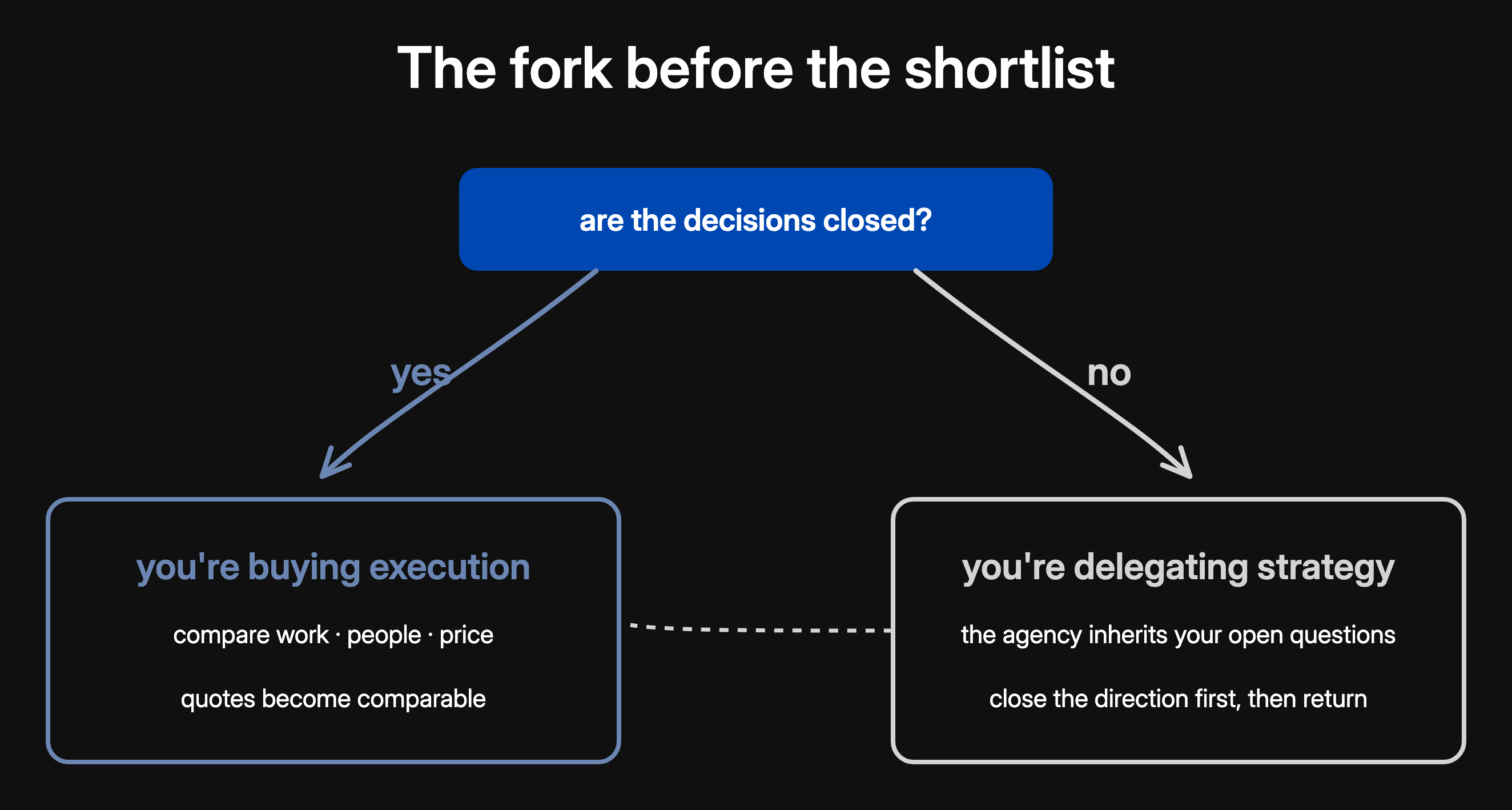
There's a simple fork that should come before any shortlist, and it changes what you're shopping for.
If leadership already agrees on positioning, audience, messaging, site structure and the definition of success, you're buying execution. Evaluate exactly that: relevant work, technical capability, the senior people who'll actually touch your account, process, timeline, price. This is the situation every agency guide assumes you're in, and their advice works fine there.
If those decisions are still open, you're not ready to buy execution, and interviewing agencies won't close the gap. Agency selection becomes a proxy for unresolved decisions, and even the best agency will be operating in unstable conditions. Close the decisions first, with an internal owner or an independent strategist, then run the selection with a brief every candidate can quote against. The quotes suddenly become comparable, which is its own return on the strategy work.
Specialized or generalist for a B2B rebrand
The question I get asked most in this arena is whether to pick a specialist in the vertical or a strong generalist. Honest answer: it matters less than the fork above, but it's a real trade.
A specialized agency arrives pre-educated. They know your buying committee, your compliance constraints, the phrases your category overuses. You skip the weeks of teaching procurement cycles, and their pattern library is full of relevant moves. The cost is that pattern library: specialists can converge on the category's house style, and if your rebrand's job is to stop sounding like everyone else, the category expert may be structurally bad at it.
A generalist brings range and fresher eyes, and is likelier to challenge sector conventions. The cost is the education period, paid in extended timelines and early strategic missteps while they learn how your market actually buys.
The tiebreaker: with closed decisions in hand, choose the specialist for speed when your category knowledge is the bottleneck, and the generalist for differentiation when category sameness is the disease. With open decisions, neither choice saves you, because you're delegating strategy to whoever you hire.
The five answers any partner owes you
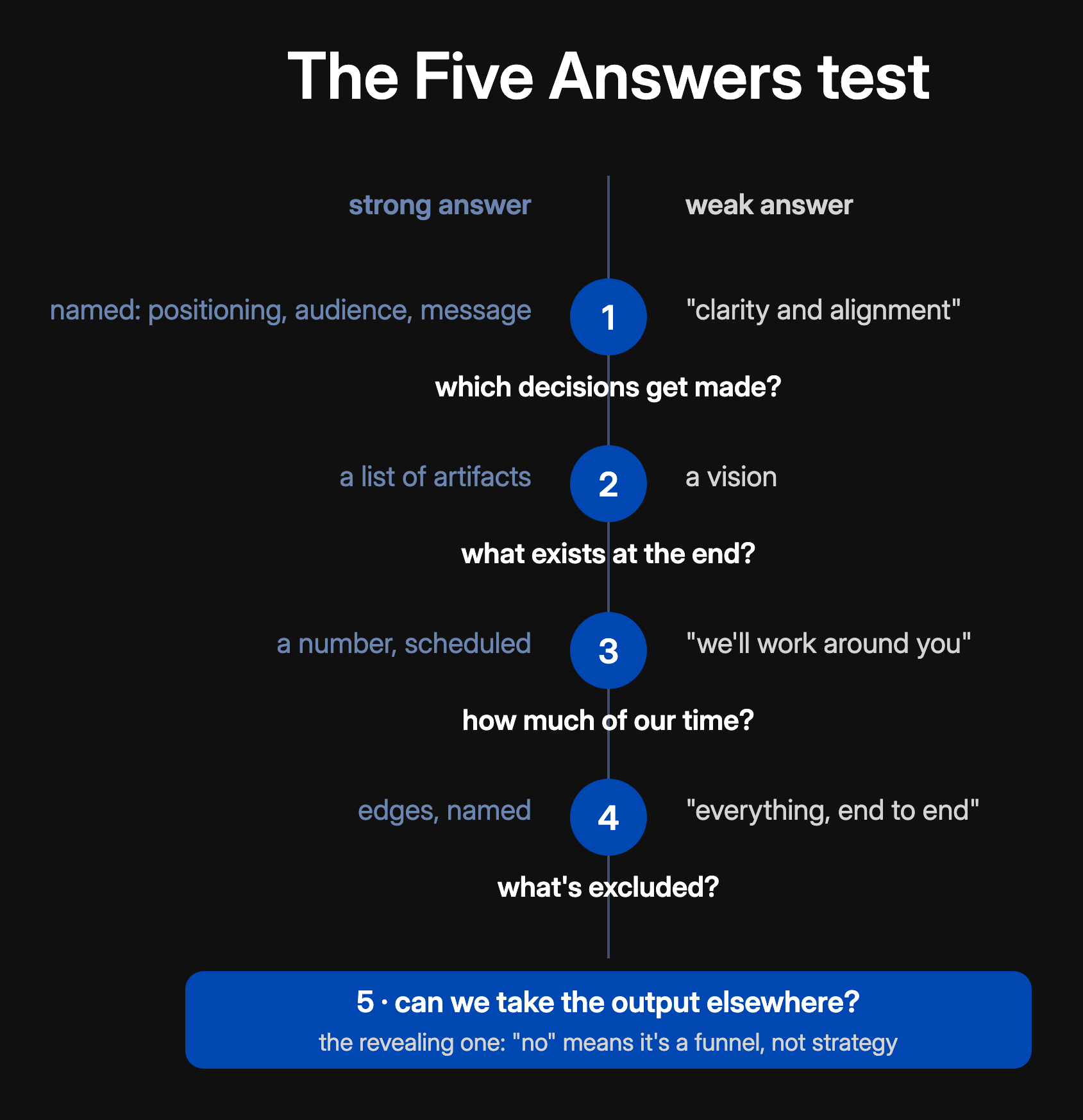
Portfolios impress; answers inform. Ask every candidate the same five questions and compare the concreteness, not the charisma.
- Which decisions get made during the engagement? A strong answer names them: positioning, audience priority, message hierarchy, structure. A weak answer promises "clarity" and "alignment," which are outcomes, not deliverables.
- What will physically exist at the end? Documents, sitemap, message guide, launched site. If the artifacts can't be listed, they can't be handed over.
- How much of our team's time will it take? A real process has a real number, scheduled up front. "We'll work around you" usually means rolling discovery, billed monthly.
- What is explicitly excluded? Serious partners name their edges without flinching. An agency that offers strategy, design, development, SEO, paid and everything after launch may do all of it, but you should still know which problem you're hiring them to solve first.
- Can we take the output to another partner? The revealing one. If the strategy work only becomes useful when you buy their build, it isn't strategy, it's a sales process with workshops.
Red flags an agency will never print
- Rolling discovery. No dated end to the strategy phase means the arguing is scheduled to happen during design, at design prices.
- Strategy bundled free into the build quote. Free strategy is priced at what it costs to produce. You'll get a mood-board workshop and a deck of adjectives.
- Motion before message. Animation and interaction design developed before the messaging is stable results in visually advanced work that has to be reworked multiple times because the underlying story keeps changing. This is a sequencing issue.
- Adjectives as deliverables. "Transformation," "elevation," "reimagining." Ask what physically exists at the end, and watch what happens.
- No pushback in the sales process. If they haven't challenged a single assumption while trying to win you, they won't start after the contract is signed.
Trust is built on direction, not style
When choosing an agency, trust is often placed in visual taste or past work. That is not where the real risk sits. Trust should be built around how the agency handles ambiguity. A strong agency can execute within a defined direction. A strong partner will challenge the absence of one.
Teams select agencies based on output, not on their ability to engage with strategy. As a result, the agency becomes responsible for decisions it was never positioned to make. Flip that: bring them a settled direction, and design, development, animation and SEO become coordinated efforts instead of disconnected outputs. Delivery risk drops. So does the pressure on both sides of the table. Getting to that settled direction before the selection is the work I do as a Website Strategy Consultant, and it's deliberately separate from any build, which is exactly what makes the fifth answer easy for me to give.
Final thoughts
Agency selection is not the starting point of a rebrand. It is a downstream consequence of strategic clarity. The real work happens earlier, in leadership discussions that define how the business should be presented. When that clarity is in place, agency selection becomes almost boring: the brief is written, the quotes are comparable, and any of three good shops could deliver. Without it, every option carries risk, and the most beautiful portfolio in the shortlist is just the most expensive way to find out what you should have decided first.
Frequently asked questions
How many agencies should we shortlist?
Three to five serious candidates, interviewed against the same written brief, is plenty. Long lists feel diligent but mostly measure your team's stamina. The quality of the comparison comes from the brief, not the sample size: with decisions closed, differences between agencies become visible in one meeting. Without a brief, ten interviews produce ten incomparable impressions.
Should strategy and execution come from the same partner?
It can work, if the strategy phase has its own scope, its own end date, and output you could take elsewhere. That last condition keeps everyone honest: strategy that only functions as a preamble to their build is a funnel, not a foundation. Separating the two, either with an independent strategist or a genuinely firewalled phase, costs a handoff and buys you bargaining power plus a portable direction.
How do we brief agencies so the quotes are comparable?
Give every candidate the same closed decisions: positioning in plain words, the priority audience, what the site must prove, the page structure, and what's out of scope. Then ask each to quote the same deliverable. When quotes still diverge wildly against an identical brief, the spread itself is information, usually about how much discovery someone plans to re-run.
When is the right time to start agency conversations?
After direction is settled, before you're desperate. Early conversations are fine for chemistry and budget calibration, but signing before positioning is closed converts your design reviews into leadership alignment sessions. If an announcement clock is forcing the sequence, fix the decisions in the weeks you have; a rebrand after a funding round shows how that split works under deadline.