




Most rebrands don't fail because of poor design or weak execution. They fail because decisions weren't clarified before execution began.
By the time an agency is selected, timelines are set, and the project is moving, many of the most critical questions are still unresolved. At that point, every decision becomes heavier, slower, and more expensive. This is where delivery risk starts.
Most rebrand checklists list assets: logo files, email signatures, the sales deck, the launch post. This B2B rebrand checklist lists decisions. It's ten yes-or-no questions before starting a rebrand, grouped in three gates, and the score tells you whether you're ready to brief a build team or still working out what the brand should say. If you're a VP of Marketing, treat it as the list of what to clarify before a rebrand starts spending money.
Key takeaways
- A rebrand checklist should test decisions, not deliverables. An asset list is easy to finish and says nothing about whether the company knows what it's rebranding into.
- The Readiness Ten scores one point per clear yes. Most teams lose their points in the first two gates, direction and ownership, long before budget becomes the problem.
- Gaps are cheapest to find now. A gap closed before design costs a meeting. The same gap found in review round three costs a redesign.
Execution before decisions leads to rework
When a company moves into execution too early, the symptoms show up quickly:
- Discussions feel unclear and unfocused
- Stakeholders have different interpretations of the brand
- Feedback loops expand instead of narrowing
- Decisions are revisited mid-process
I've seen teams start design and development work while still debating what the company actually represents. The result is predictable: rework, delays, and frustration across teams.
In one case, leadership wanted to jump straight into website design without agreeing on style direction. We proposed starting with moodboards to define the visual language. That would have taken a few hours. Instead, full page designs were created over several days, only to be rejected because alignment was never established. Execution didn't fail. The sequence did.
A readiness check exists to catch that trade before it happens. On a full rebrand the units change from hours and days to weeks and months, and the trade stays the same.
The Readiness Ten at a glance
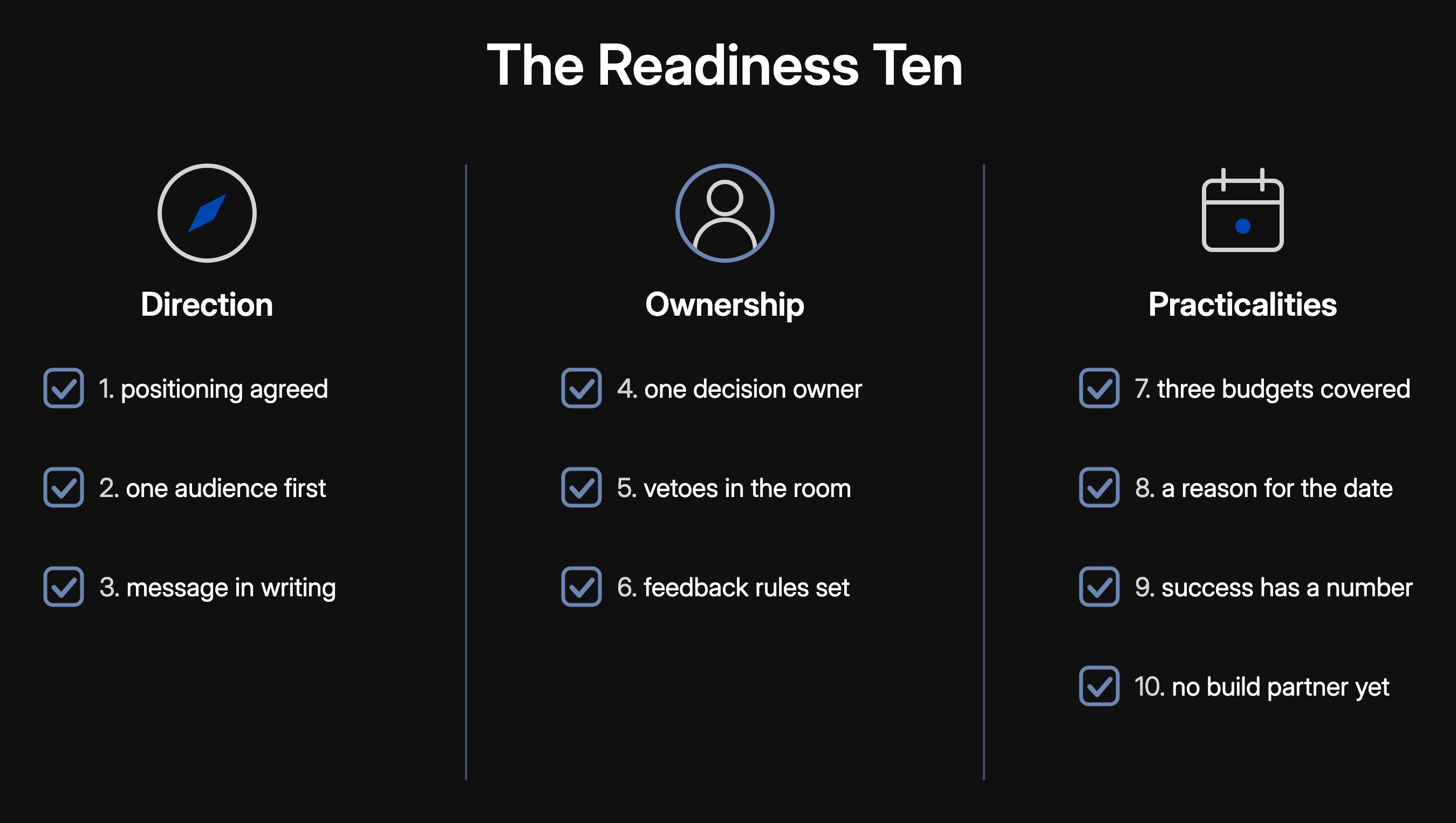
The Readiness Ten is a rebrand readiness checklist you can score in one working session. Give yourself one point for each clear yes. A "mostly" counts as a no, because "mostly agreed" is how positioning arguments end up in design reviews.
Direction, settled before design:
- 1. Positioning is agreed. Leadership can state what the company is and why it's different in one sentence, and nobody would word it differently.
- 2. One audience comes first. The buyer the brand is built for is named and ranked above the others.
- 3. The core message is written. It exists as full sentences a salesperson could say out loud.
Ownership, named before the first review:
- 4. One person makes the final call. A named owner with the authority to close a question and keep it closed.
- 5. Everyone with a veto is in the room. Anyone who can stop the launch takes part from the first session.
- 6. Feedback rules are set. Everyone knows who gives input, who decides, and what feedback gets checked against.
Practicalities, sized before anyone quotes:
- 7. The budget covers all three budgets. Strategy, build and rollout each have money behind them.
- 8. The timeline has a reason. The date comes from a business event, and the plan says what happens if it moves.
- 9. Success has a number. One metric the rebrand is expected to move, with a baseline measured before launch.
- 10. No build partner is chosen yet. The agency gets briefed once the decisions exist.
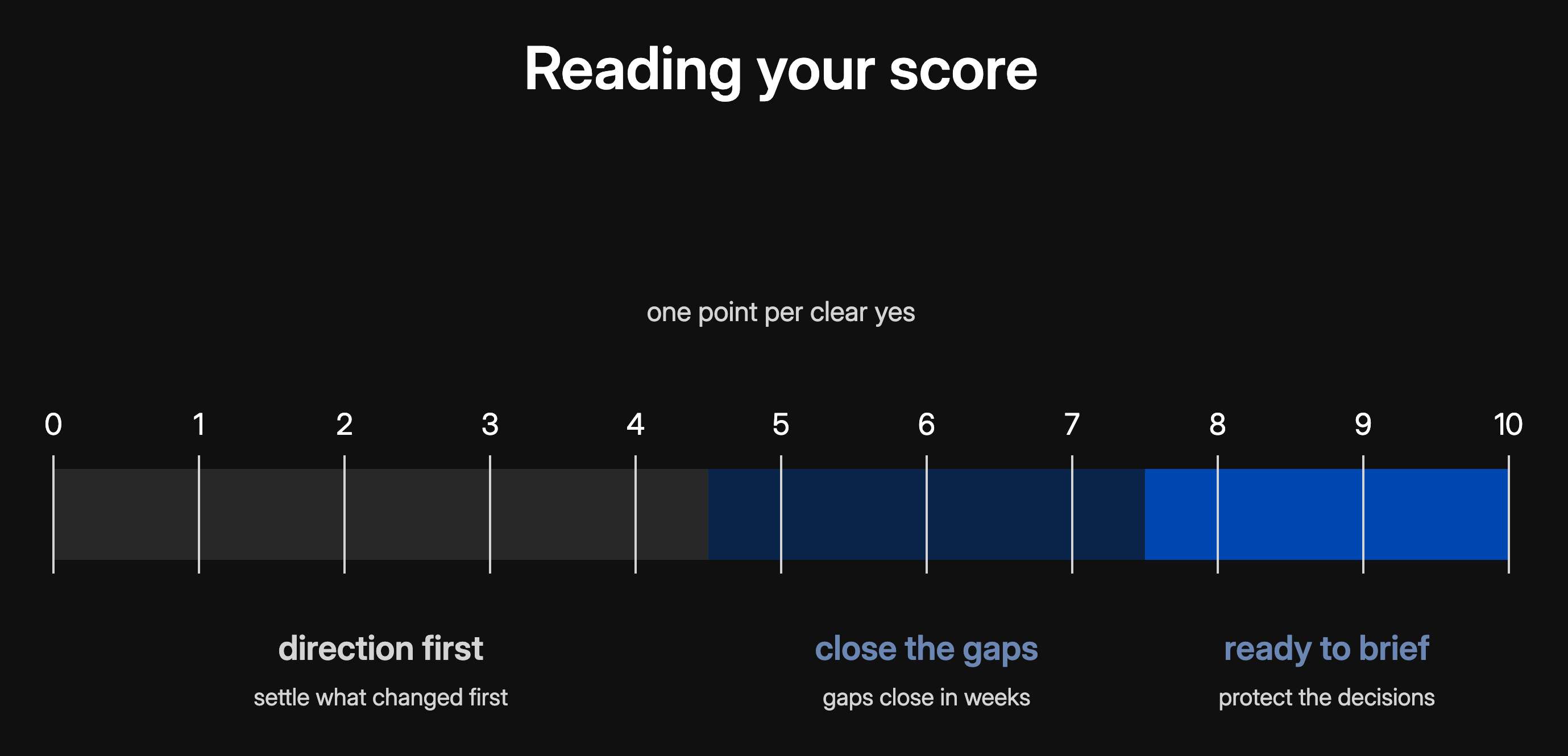
Score 8 to 10 and you're ready to brief a build team. Score 5 to 7 and you have gaps worth closing first. Score 4 or less and the company needs direction before it needs a rebrand.
Gate one, direction settled before design
The objectives should be defined beyond just surface-level requests like "We need a new website or a new design." Instead, the rebrand should start with: "What changed in the business?" or "What needs to be communicated differently?" Because otherwise, execution becomes disconnected from outcomes.
If the honest answer to what changed is "nothing structural, we just look dated", the project may be a refresh, and the difference between a brand refresh and a rebrand decides how much of this list you need.
Positioning agreed in one sentence
Before any rebrand work begins, leadership must agree on what the company is becoming, who it is for, and how it's different from others. If these expectations are unclear, execution becomes guesswork, and most rebrands go wrong. Teams assume positioning will be figured out during the process. But in reality, that creates instability. The clearer the direction, the faster the build.
Ready looks like one sentence your CEO, your sales lead and your newest marketer would all sign, written down with the date it was agreed. Skip it and the positioning still gets decided, by whoever gives the last round of feedback on the homepage.
One audience chosen to come first
B2B sites talk to several people at once: the buyer, the user, the executive who signs, sometimes investors and future hires. A brand can serve all of them, but it can only be built for one of them first. Ready means the priority buyer is named, the others are ranked behind them, and someone has written down who the brand is not for. Skip it and every page turns into a negotiation over whose question gets answered first.
The core message exists in writing
The message is the set of sentences you'll repeat everywhere: the claim, the proof behind it, and the true things you chose not to lead with. It's also one of the four decisions behind any website strategy. Ready means it's written in full sentences a salesperson could say to a skeptical buyer.
Skipping it has a recognizable cost. I remember one project where we started too early. The work began before we had properly defined the direction. At first, nothing seemed wrong and actually looked like progress… right up until:
- "What pages do we actually need? Why?"
- "What should the structure be?"
- "What tone of voice reflects the business today?"
- "What are we really offering? How should customers experience it?"
Eventually, we had to stop and go back to the beginning because the foundation wasn't in place. Once we clarified the strategy, the rest of the decisions became much easier.
Gate two, ownership named before the first review
One named person makes the call
In a project I managed, reducing decision-making to 3 stakeholders instead of 15 immediately changed the dynamic. Conversations became focused, decisions moved faster, and the project stopped getting blocked by small, unnecessary inputs. Clarity here is simple: "Who decides, and who provides input?"
Ready means a name rather than a committee: one person with the authority to close a positioning question, backed explicitly by the CEO. Who actually decides in a rebrand is often less obvious than the org chart suggests, which is why it belongs on paper. Execution moves faster when someone owns the thread from beginning to end.
Everyone with a veto is in the room
The most expensive stakeholder is the one who joins late. A founder, a sales leader or a board member who can reopen positioning will do it the first time they see the work, and if that's at 80% built, the rebrand pays for the argument twice. Ready means you've listed everyone who can stop or reopen the project, and each of them takes part from the first session. Skip it and the veto arrives with the final review.
Feedback rules agreed before the first review
One of the fastest ways to slow a rebrand is adopting a structure where everyone can approve everything. But not everyone needs equal influence over strategic decisions. First, define who contributes perspective, who challenges assumptions, and who makes final decisions.
The second rule matters as much: feedback gets checked against the written direction, and feedback that contradicts it goes to the decision owner instead of the designer. Skip it and review round three turns into a positioning debate held over a homepage mockup.
Gate three, practicalities sized before anyone quotes
The budget covers all three budgets
A rebrand spends money in three places: the strategy, the build and the rollout. The rollout is the one teams forget. Sales decks, product screens, templates, partner listings and email signatures all carry the old brand until someone pays to change them. If the name changes, the domain usually changes with it, which makes it a site move, and Google's own guidance is to expect temporary fluctuation in site ranking during the move.
Ready means all three lines exist in the budget. Skip it and the new brand launches on the website while the old one lives on in the sales deck for another year.
The timeline has a reason behind it
Good rebrand dates come from business events: a funding announcement, a product launch, entry into a new market. The reason matters because it tells you what can move. When the date is a funding announcement, the decisions fit before it and the full rebuild usually belongs after.
Ready means the date's reason is written down, along with what happens if it slips. An arbitrary deadline gets met by cutting the decision phase, the cheapest few weeks of the whole project.
Success has a number attached
After launch, someone will ask what changed. Pick the metric before work starts: qualified demo requests, win rate in the target segment, sales cycle length, whatever the rebrand is meant to move. Ready means one number and a baseline measured before launch. Without it, success gets defined after the fact, usually by how much people like the new logo.
No build partner chosen yet
This one surprises people, because hiring an agency feels like progress. The agency becomes like a buffer when a VP of Marketing is not aligned with the leadership team. Then time is spent on presenting multiple options instead of moving forward with a clear direction.
An agency briefed with closed decisions can give you a comparable quote and a faster build. Ready means you know what you'd brief; a shortlist is fine, a signed contract is early.
What to do with your score
At 8 to 10, brief the build team and protect what you decided. The risk now is reopening closed questions, so route every new opinion to the decision owner before it reaches the designers.
At 5 to 7, close the gaps before you hire a build team. They usually sit in the first two gates, and they close in weeks when the people who own the answers are in the room. Closing them in a fixed engagement before the build starts is the work I do as a B2B website strategy consultant.
At 4 or below, hold the rebrand and start with direction: what changed, who the company is for now, and what it should be saying. The brand work gets faster and cheaper once those answers exist.
Final thoughts
A rebrand is not a creative project. It is a decision-making process. The quality of the outcome depends on the clarity of the inputs.
Most of these ten can be scored in one honest working session. The hard part is getting the right people into it, and keeping them in the work until the answers are written down.