

For many fintech companies, the pressure doesn't start when funding arrives, but the day after. The investment announcement is exciting: the team celebrates, then hiring begins, and new customers start paying attention. Suddenly the company isn't speaking only to early adopters, but to enterprise buyers, partners, investors and future employees, all looking at the same website, reading the same messaging, and trying to understand what the business has now become. That's often when leadership finds out that although the company has grown, the brand hasn't. The question is what to do about it, in what order, and how much of it fits before the announcement.
Key takeaways
- A funding round doesn't create the need for a rebrand. It exposes whether the brand kept up with the company you actually became while raising.
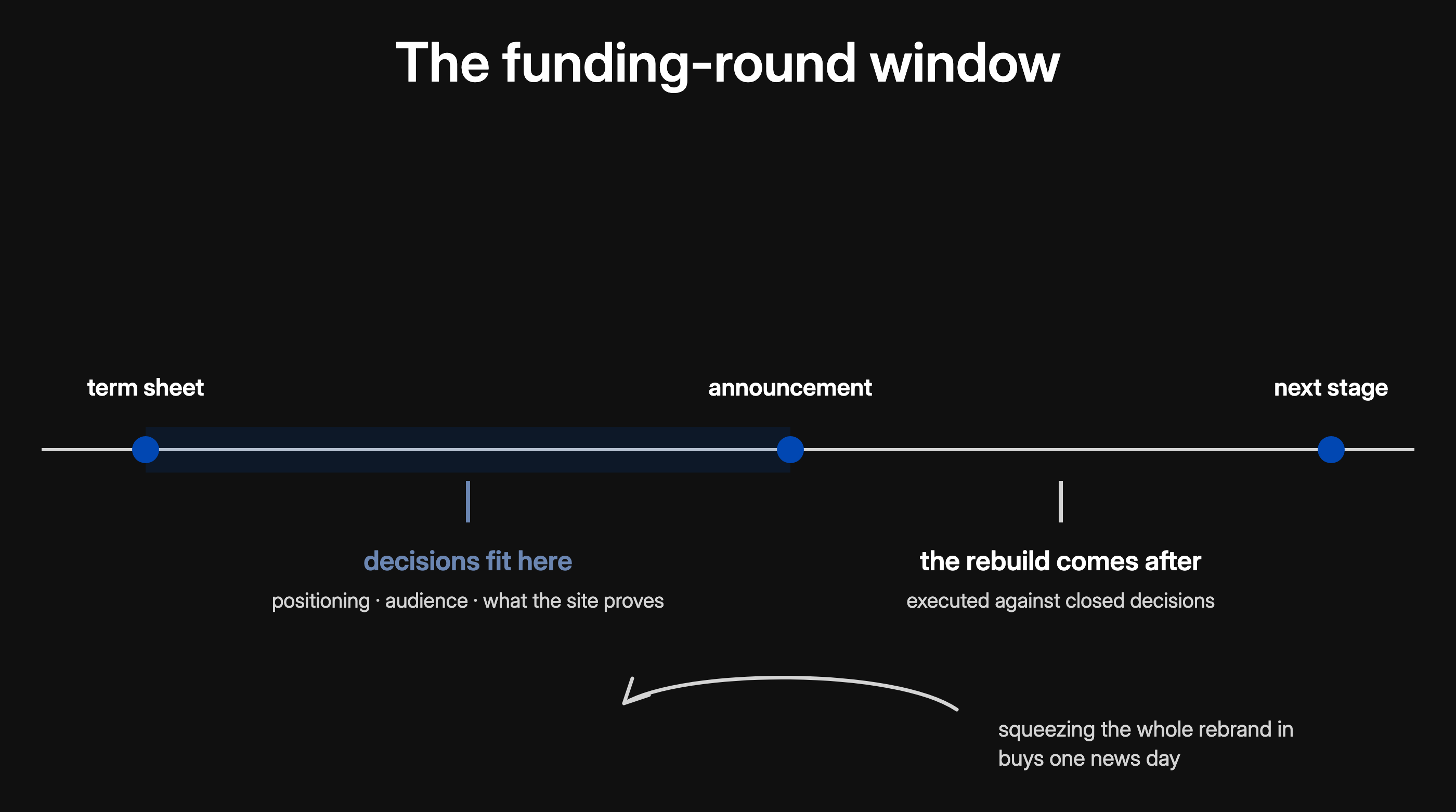
- The announcement is a real deadline, but only for decisions. Positioning and message fit in the window between term sheet and press release. A full rebuild doesn't.
- Pressure is the enemy, sequencing is the defense. Direction first, then design. The example below puts numbers on what that order buys.
The funding-round window, and what fits inside it
Here's the timing question hiding inside every one of these projects: the raise closes, the announcement date is set, and somewhere between those two points somebody says the website can't go out looking like this. They're usually right. They're also usually about to spend the window on the wrong work. The stage barely matters: the pattern is identical whether the rebrand comes after Series A or after Series B, only the budget and the audience scale.
The window between a closed round and its announcement is typically weeks, sometimes a couple of months. That is not enough time to rebrand well, and it is exactly enough time to decide. What the announcement actually requires is a company that can explain its new stage in one consistent story: to the journalists covering the round, to the enterprise buyers who will click through from the coverage, and to the investors' networks doing quiet diligence. A story is a set of decisions, and decisions fit in the window.
So split the work. Before the announcement: settle positioning for the new stage, choose the priority audience, agree on what the website must now prove, and fix the pages the coverage will actually hit, usually the homepage and one product page. After the announcement: run the full rebuild against those decisions, at a pace that produces work you'll keep. Companies that try to compress the whole rebrand into the window get a rushed site that expires again within a year, because it expressed the pressure, and pressure is not a position.
I've witnessed this firsthand
I've witnessed this firsthand after a major funding round with a fast-growing technology company. The investment brought new expectations almost overnight: as the team expanded, the leadership needed to communicate a more mature vision. Marketing faced enormous pressure to explain a business that had evolved far beyond the story its website told. The first instinct was to redesign everything as quickly as possible. But speed rarely solves the real problem.
Growth changes more than your headcount
Series A isn't simply a financial milestone; it's also a business one. It doesn't create the need for a rebrand, but exposes whether your brand has kept up with the change. Because the company you're building after funding is rarely the same one you pitched to secure the investment:
- Your product has evolved
- Your audience has expanded
- Sales conversations are different
- The expectations around your brand have changed
Yet many fintech companies still rely on messaging, positioning, and digital systems built for a previous stage of growth. Their website reflects where the company started, not where it's going, and everyone is telling a different interpretation of the same story about the business. That's when growth starts creating noise, and the full anatomy of that drift is what happens when your company has outgrown its brand.
Pressure makes rushed decisions feel reasonable
The VP of Marketing usually feels it first, because leadership wants quick progress, and investors expect maturity. The team also wants something new to present. As a result, every week without visible movement feels like falling behind. I've watched that pressure build many times, and it wasn't because people lacked talent. It happened because everyone wanted execution before they had defined the direction.
Why the strategic clarity first? Because without it, every design review becomes a discussion about opinions. Without a clear path forward, every messaging revision creates another version of the story, and every stakeholder sees something different. So instead of disappearing, the pressure simply moves in and takes charge of the project itself.
What has to be true before you spend the raise
The raise makes budget available, and available budget attracts projects. Before any of it goes to a rebrand, five things should check out.
- Leadership can state what shifted. Not "we grew," but what specifically changed: audience, product scope, competitive set, ambition. If the answer takes a meeting, the meeting comes before the money.
- The new audience is chosen, not accumulated. Post-raise you can suddenly serve everyone. The brand only works if someone decided who comes first.
- The story survives three retellings. CEO, sales lead and newest marketer describe the company the same way. If they don't, a rebrand will ship three versions in better fonts.
- The website has one defined job for the next stage. Prove enterprise credibility, or generate demo requests, or reposition the category. One, ranked first.
- Someone owns the decisions. A named person with authority to close positioning questions and keep them closed through design reviews.
Two or more failing means the raise is about to fund execution of an argument that hasn't happened yet. Have the argument first; it's cheaper than rework, and how to run the selection afterwards is covered in choosing the right agency for a rebrand.

The question that comes before any rebrand
The real question isn't whether you need a rebrand, but whether your business has outgrown its current structure. Before anything is redesigned, leadership needs to answer a few uncomfortable questions: What shifted? Who are we, and where are we today? What does this next stage of growth require from the brand? What story should every team be telling?
Those conversations take time and are also the reason execution becomes dramatically easier afterward. Once that direction is clear, everyone starts building the same company instead of describing different ones.
What the sequence looks like with numbers attached
Sedric, a compliance platform for financial services, is the cleanest example from my own work. The engagement ran in early 2026 with their VP of Marketing: direction first, structure second, build third. The site had been organised around industries, which forced every visitor to self-identify by sector before learning what the product does. We reorganised it around what Sedric actually sells, added the trust and pricing layers a compliance buyer needs, and Onward executed the rebuild against decisions that were already closed.
The following quarter, engagement time per user rose 28% and conversions grew 7%, while overall traffic deliberately narrowed to a more qualified audience. That's what a post-growth rebrand is supposed to do: fewer, better visitors who recognize themselves, and a site that no longer needs a sales rep to translate it. None of it came from moving fast in the announcement window. It came from deciding first.
Build for the company you're becoming
One lesson has stayed with me across growth-stage companies: the rebrand itself is rarely the hardest part. Understanding what the company has become is. That's why I don't start with design, but with clarity. First, we identify where growth has outpaced the current structure, where the business stands today, and what is actually misaligned. Then we define a direction that leadership agrees on. That definition work is the engagement I run as a Website Strategy Consultant, and it's deliberately separate from the build.
Only from there does the build become intentional. Once your rebrand has aligned with your company's maturity, your website reflects it. Your messaging starts to explain the business with confidence. Everything supports the same strategic narrative, and the execution doesn't need to be constantly redone because everyone is working from the same foundation.
Final thoughts
A funding round doesn't automatically mean it's time for a rebrand. But if growth has made your company harder to explain than it was a year ago, that's usually the signal. Not that you need a better website, but that you need a clearer direction. The strongest fintech brands don't just look more mature after they scale. They finally tell the same story the business is already living.
Frequently asked questions
Should we time the rebrand around the funding announcement?
Time the decisions around it, not the rebrand. The announcement needs a consistent story and a credible first impression on the pages the coverage will hit, which is achievable in weeks. The full rebuild belongs after, executed against the decisions the window produced. Announcement-driven full rebrands optimize for one news day and then live with the shortcuts for years.
How long does a rebrand take after a raise?
The decision layer takes weeks when the people who own the answers are in the room: positioning, audience, message, what the site must prove. The build phase depends on scope, but it runs on schedule when it starts from closed decisions and slips when it doubles as the forum for making them. Most timeline blowouts are unresolved strategy resurfacing as design revisions.
Strategy first or agency first?
Strategy first, every time it's possible. An agency briefed with closed decisions gives you a comparable quote and a fast build. An agency briefed with open questions gives you a discovery phase billed at build rates, and design reviews that double as leadership alignment sessions. If the direction doesn't exist yet, buy that first; it's the smaller check and it de-risks the bigger one.
Does every round justify a rebrand?
No. The question of when a startup should rebrand has a boring answer: when growth has made the company harder to explain, and not before. The round is a calendar event; the signal is explainability. If sales conversations, the pitch and the website still tell one story after the raise, spend nothing. If the company has become harder to explain than a year ago, the raise didn't cause that, growth did, and the round is simply a good moment to fund fixing it properly.