

Picture the quarterly review. Paid media hit its targets. The SEO agency's report is green. Content shipped everything on the calendar. And the number the board actually cares about barely moved. Nobody in that room underperformed, which is exactly why nobody can explain it. Working with multiple marketing vendors fails quietly like this: the problem almost never lives inside any single vendor. It lives between them, and it compounds while every individual report says things are fine. This article names that gap, shows you how to find it in one meeting, and gives you an honest answer to the question you're probably already asking: do we consolidate, or is there another way?
Key takeaways
- Vendor fragmentation is a structural problem, not a talent problem. Each vendor operates within their own scope, optimizes for their own metrics, and reports success independently.
- The damage shows up as a tax, paid three ways. Coordination eats your team's time, the message drifts across channels, and the data stops telling one story.
- The fix is rarely firing everyone. The solution is not fewer vendors. It is a clearer direction, owned at the leadership level and handed to every partner in the same words.
Why a strong vendor roster still underperforms
Growth-stage companies assemble specialists the way you'd expect: one agency for paid, one for SEO, a freelancer for content, a shop for the website. On paper it looks like a strong system, and every function is in expert hands.
Then the structure does what structures do. Each vendor operates within their own scope, optimizes for their own metrics, and reports success independently. What's missing is a shared definition of positioning and a clear statement of what the business is trying to achieve. That's a leadership-level gap, and no vendor can close it from inside their own lane.
The industry runs on this setup. Managing multiple agencies individually is the dominant model at 81% of major advertisers, and nearly three quarters of them are reviewing their arrangements at any given moment. My favorite detail from that research: about 60% of brands say they want fewer agencies, while half simultaneously want more specialists. Both instincts are honest. Specialists are genuinely better at their craft. The roster genuinely feels unmanageable. The tension between those two facts is where your growth quietly leaks, because execution becomes distributed while strategy remains undefined.
The coordination tax your roster quietly pays
I call the cost of that gap the coordination tax. It's the bill for running distributed execution without a shared direction, and it arrives in three installments. None of them appears on an invoice, which is why the roster survives budget review after budget review while the tax keeps compounding.
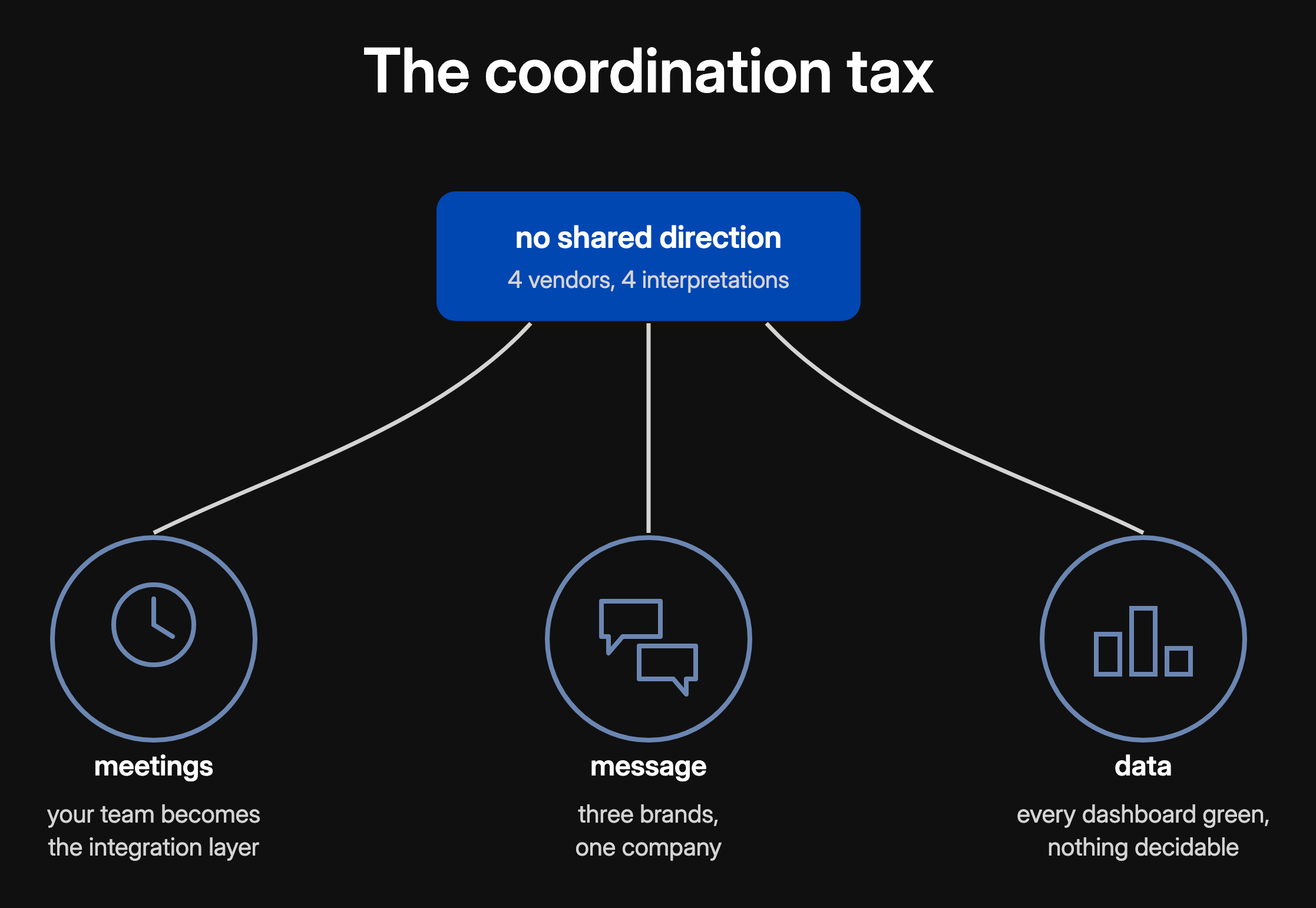
The meeting tax, paid in your calendar
The first installment is paid in your team's calendar. Internal teams spend more time coordinating vendors than making decisions, messaging varies across channels without being explicitly challenged, and performance looks strong in isolation but weak in aggregate. Instead of focusing on strategy, your best people become intermediaries, aligning vendors and resolving conflicts.
Here's the test I use: look at your marketing lead's last two weeks and count the hours spent translating context between partners, re-explaining the company, refereeing scope. That's headcount you're paying twice for, once in salary and once in the strategic work that didn't happen.
The message tax, paid in the market
The second installment is paid in the market. Without one written direction, each agency interprets the brand on its own, and each interpretation is reasonable in isolation.
I watched this at a B2B company preparing a website restructure while scaling acquisition. PR owned external positioning, a paid agency owned campaign messaging, a content team owned thought leadership. Every team made sensible decisions inside their scope. The company was presented as enterprise-grade in content, disruptive in ads, and product-led in sales materials. From the outside, the brand felt inconsistent. From the inside, every team believed they were aligned. Lead quality declined. Sales cycles slowed. The issue wasn't execution. There was no unified narrative to execute.
The data tax, paid in stalled decisions
The third installment is paid in decisions you can't make. Paid media reports strong conversion rates. The website shows drop-off. CRM shows low retention. Each dataset tells a different story, and without a shared source of truth, leadership can't act with confidence on any of them.
Sometimes the data tax turns into direct spend. I've seen two acquisition vendors, both measured on attributed revenue, end up competing for the same demand. Branded search terms get bid on from multiple directions. Attribution overlaps. Reports look strong individually. At the business level, acquisition costs increase significantly. No one flags the issue early because each vendor is technically hitting targets. The misalignment exists at the system level, and system-level problems don't show up in anyone's dashboard.
How to spot the tax in one meeting
You don't need an audit to find out whether you're paying it. Put your vendor roster in a room (or a doc) and ask five questions.
- Ask each vendor what the company sells and to whom. If you get materially different answers, the message tax is live. You'll usually get materially different answers.
- Ask who owns the primary metric. Not which metrics exist, but which single number every partner would sacrifice their channel metric for. Silence here is the meeting tax forming.
- Ask where the last big disagreement between vendors was resolved. If the answer is "it wasn't" or "in my inbox," your team is the integration layer.
- Ask what the website must prove. The website is where every vendor's output collides. If nobody can state its one job, each partner will assign it their own.
- Ask what changed after the last quarterly report. Reports that never alter decisions are the data tax in its purest form: information arriving without direction.
Two or more bad answers means the problem is structural. Which brings up the question everyone reaches for next: are there simply too many marketing vendors here, and should one agency replace them all?
When to consolidate and when to coordinate
Most articles on this topic are written by agencies, and they end the same way: bring it all to us. Sometimes that's even right. But it's one of two honest options, and the choice depends on where your problem actually sits.
Vendor consolidation is the right call when the overhead itself is the constraint: a small team drowning in vendor management, overlapping scopes you're paying for twice, no internal person who could own direction even if it existed. One accountable partner shrinks the coordination surface, at the price of narrower specialist depth and real switching costs. For an early-stage company with one dominant channel, that trade is often worth it.
Coordination is the right call when the specialists are genuinely good and the missing piece is direction. You keep the roster and change what it runs on: one written positioning, one audience decision, one definition of what the website must prove, handed to every vendor in the same words. The specialists stay specialists. They stop being interpreters.
The pattern I see in when growth creates confusion applies here too: companies add vendors as growth demands, but nobody revisits direction at the same pace. If that's your situation, firing the roster treats the symptom. The vendors were never the disease.
What one direction changes for the same roster
When direction is settled first, the same roster behaves differently. I saw it at Sedric, a compliance platform I worked with as their strategy layer. The core call was to reorganise the site around what the company actually sells, with one written direction that every function executed against. Same market, same team, tighter audience. Engagement time per user rose 28% the following quarter, and conversions grew 7% while overall traffic deliberately narrowed. Nothing about that required new vendors. It required one decision, made once, and used everywhere.
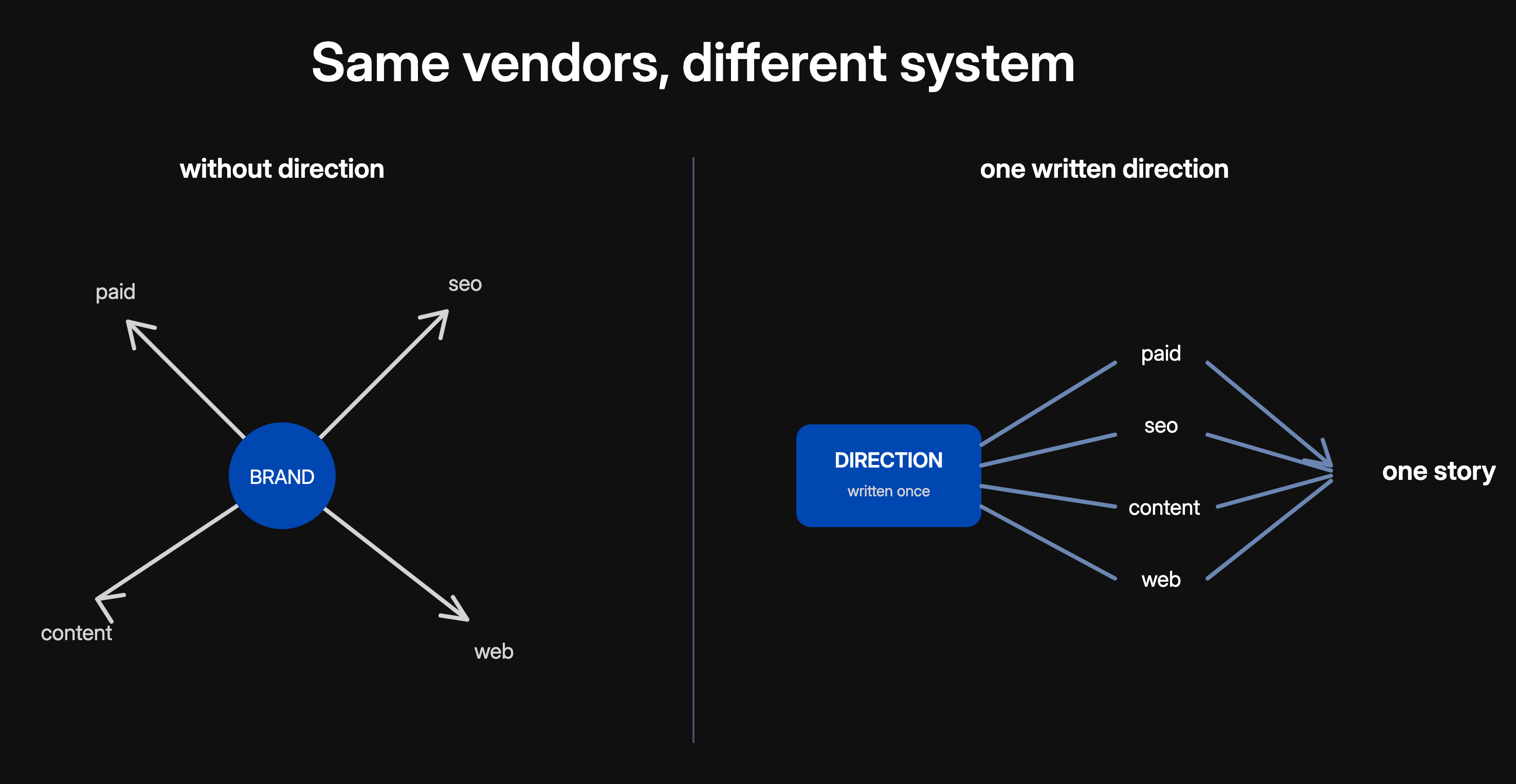
That's the general shape of the fix. Direction gets decided at the business level, before channel-level execution, and it's written down: what we stand for, who we're persuading, what each channel must prove. A one-page direction that every partner quotes beats a fifty-page strategy nobody opens. This is the work I do as a Website Strategy Consultant when the website is where the fragmentation shows, but the principle doesn't need me: someone at leadership level has to own it, or execution without direction stays the default state.
Vendor expertise is not the issue. Fragmentation is a symptom of misalignment, and growth comes from aligning the system before scaling execution.
Final thoughts
The uncomfortable part of this diagnosis is that it points inward. It's easier to run an agency review than to admit nobody ever wrote down what all those agencies should be building toward. But that's also the good news. Direction is cheaper than churn: you don't have to fire anyone, renegotiate anything, or survive another three-month onboarding to get it. You have to make a handful of decisions and put them in writing. The roster you already pay for gets better the day you do.
Frequently asked questions
How many marketing vendors is too many?
Wrong question, in my experience. Three vendors with one written direction outperform two vendors without one. The number that matters is how many interpretations of your positioning exist in the market. If it's more than one, you have too many, whether that took five vendors or two. Count interpretations first, contracts second.
Should we consolidate everything under one agency?
Only if coordination overhead itself is your constraint: a team too small to manage partners, overlapping paid scopes, no possible internal owner for direction. If your specialists are strong and the gap is a shared direction, consolidation swaps a strategy problem for a switching cost and narrower depth. Fix direction first; consolidate after, if the overhead still hurts.
Who should own vendor alignment?
Someone at leadership level, on the client side. It can't be delegated to any single vendor, because every vendor will resolve ambiguity in favor of their own channel. That's not cynicism, it's their job. The owner doesn't need to run marketing day to day. They need the authority to close positioning and audience decisions, and to keep them closed.
What should the shared direction document contain?
Four things, one page if you can manage it: what the company stands for (positioning, in plain words), who the priority audience is, what the website must prove to them, and what each channel is accountable for. The test of the document is whether a new vendor could read it and brief themselves. If onboarding still requires three calls of oral tradition, it isn't done.
Is this a vendor performance problem?
Almost never, and that's what makes it expensive. Performance problems get caught by reporting. Coordination problems hide inside good reports, because each vendor really is hitting their targets. If every partner looks good individually and the aggregate looks flat, stop auditing the vendors and start auditing the direction they were given. Usually nobody can find it.